

72
3 Theoretical Study of Rh-Catalyzed …
The use of oxidizing directing groups as internal oxidants has recently emerged as
an attractive strategy in C–H activation, which majorly involves N-oxide, N-acyloxy,
N-methoxy, N-sulfinyl, hydrazine, and nitroso groups [165–171]. Two common
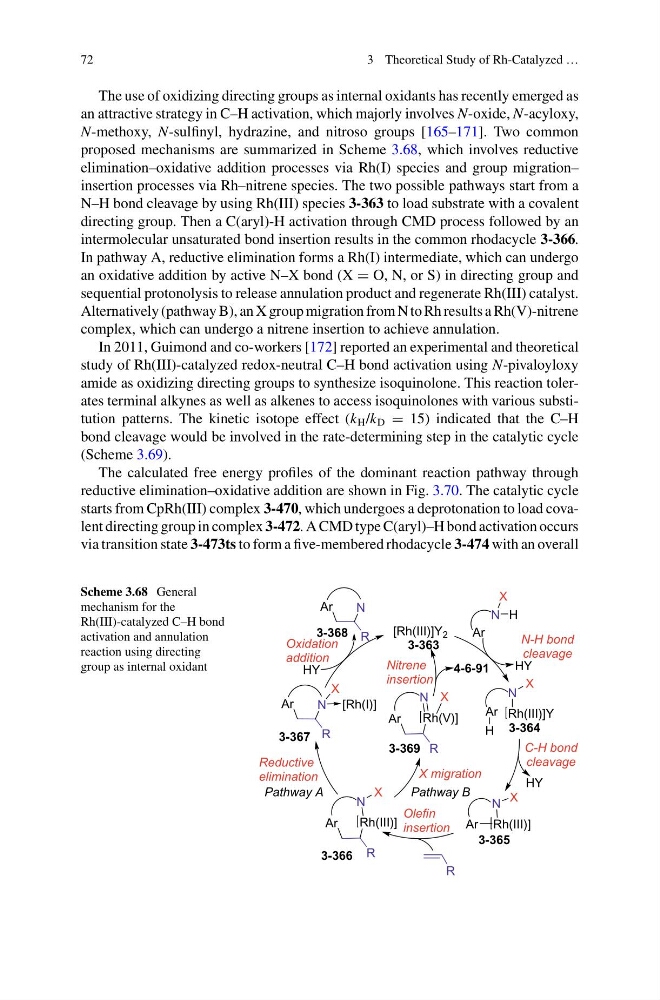
proposed mechanisms are summarized in Scheme 3.68, which involves reductive
elimination–oxidative addition processes via Rh(I) species and group migration–
insertion processes via Rh–nitrene species. The two possible pathways start from a
N–H bond cleavage by using Rh(III) species 3-363 to load substrate with a covalent
directing group. Then a C(aryl)-H activation through CMD process followed by an
intermolecular unsaturated bond insertion results in the common rhodacycle 3-366.
In pathway A, reductive elimination forms a Rh(I) intermediate, which can undergo
an oxidative addition by active N–X bond (X = O, N, or S) in directing group and
sequential protonolysis to release annulation product and regenerate Rh(III) catalyst.
Alternatively (pathway B), an X group migration from N to Rh results a Rh(V)-nitrene
complex, which can undergo a nitrene insertion to achieve annulation.
In 2011, Guimond and co-workers [172] reported an experimental and theoretical
study of Rh(III)-catalyzed redox-neutral C–H bond activation using N-pivaloyloxy
amide as oxidizing directing groups to synthesize isoquinolone. This reaction tolerates terminal alkynes as well as alkenes to access isoquinolones with various substitution patterns. The kinetic isotope effect (k H /k D = 15) indicated that the C–H
bond cleavage would be involved in the rate-determining step in the catalytic cycle
(Scheme 3.69).
The calculated free energy profiles of the dominant reaction pathway through
reductive elimination–oxidative addition are shown in Fig. 3.70. The catalytic cycle
starts from CpRh(III) complex 3-470, which undergoes a deprotonation to load covalent directing group in complex 3-472. A CMD type C(aryl)–H bond activation occurs
via transition state 3-473ts to form a five-membered rhodacycle 3-474 with an overall
Scheme 3.68 General
mechanism for the
Rh(III)-catalyzed C–H bond
activation and annulation
reaction using directing
group as internal oxidant
[Rh(III)]Y 2
Ar
N
HY
Ar
N
Rh(III)]Y
3-365
3-364
Oxidation
addition
HY
3-363
Olefin
insertion
N-H bond
cleavage
N
Rh(III)]
Ar
[Rh(I)]
3-367
Reductive
elimination
H
C-H bond
cleavage
H
HY
R
3-366
N
Rh(III)]
Ar
R
N
Ar
R
X
X
X
X
X
N
Ar
R
3-368
Pathway A
Pathway B
3-369
N
Rh(V)]
Ar
R
X
X migration
Nitrene
insertion
4-6-91
3 Theoretical Study of Rh-Catalyzed …
The use of oxidizing directing groups as internal oxidants has recently emerged as
an attractive strategy in C–H activation, which majorly involves N-oxide, N-acyloxy,
N-methoxy, N-sulfinyl, hydrazine, and nitroso groups [165–171]. Two common
proposed mechanisms are summarized in Scheme 3.68, which involves reductive
elimination–oxidative addition processes via Rh(I) species and group migration–
insertion processes via Rh–nitrene species. The two possible pathways start from a
N–H bond cleavage by using Rh(III) species 3-363 to load substrate with a covalent
directing group. Then a C(aryl)-H activation through CMD process followed by an
intermolecular unsaturated bond insertion results in the common rhodacycle 3-366.
In pathway A, reductive elimination forms a Rh(I) intermediate, which can undergo
an oxidative addition by active N–X bond (X = O, N, or S) in directing group and
sequential protonolysis to release annulation product and regenerate Rh(III) catalyst.
Alternatively (pathway B), an X group migration from N to Rh results a Rh(V)-nitrene
complex, which can undergo a nitrene insertion to achieve annulation.
In 2011, Guimond and co-workers [172] reported an experimental and theoretical
study of Rh(III)-catalyzed redox-neutral C–H bond activation using N-pivaloyloxy
amide as oxidizing directing groups to synthesize isoquinolone. This reaction tolerates terminal alkynes as well as alkenes to access isoquinolones with various substitution patterns. The kinetic isotope effect (k H /k D = 15) indicated that the C–H
bond cleavage would be involved in the rate-determining step in the catalytic cycle
(Scheme 3.69).
The calculated free energy profiles of the dominant reaction pathway through
reductive elimination–oxidative addition are shown in Fig. 3.70. The catalytic cycle
starts from CpRh(III) complex 3-470, which undergoes a deprotonation to load covalent directing group in complex 3-472. A CMD type C(aryl)–H bond activation occurs
via transition state 3-473ts to form a five-membered rhodacycle 3-474 with an overall
Scheme 3.68 General
mechanism for the
Rh(III)-catalyzed C–H bond
activation and annulation
reaction using directing
group as internal oxidant
[Rh(III)]Y 2
Ar
N
HY
Ar
N
Rh(III)]Y
3-365
3-364
Oxidation
addition
HY
3-363
Olefin
insertion
N-H bond
cleavage
N
Rh(III)]
Ar
[Rh(I)]
3-367
Reductive
elimination
H
C-H bond
cleavage
H
HY
R
3-366
N
Rh(III)]
Ar
R
N
Ar
R
X
X
X
X
X
N
Ar
R
3-368
Pathway A
Pathway B
3-369
N
Rh(V)]
Ar
R
X
X migration
Nitrene
insertion
4-6-91