

3.6 Rh-Catalyzed C–H Bond Annulation
75
2.5 mol % [Cp*RhCl 2 ] 2
2 eq. CsOAc
MeOH, 65 C
78 % yield
+
N
N
H
O
OPiv
n-Pr
n-Pr
N
NH
O
n-Pr
n-Pr
N
+
NH
O
n-Pr
n-Pr
C2
C4
[C2 : C4 = 1.7 : 1]
1 mol % [Cp*RhCl 2 ] 2
0.5 eq. NaOAc
MeOH, 20 C
90 % yield
+
N
N
H
O
OPiv
n-Pr
n-Pr
N
NH
O
n-Pr
n-Pr
N
+
NH
O
n-Pr
n-Pr
C2
C4
[C2 : C4 = 17 : 1]
O
O
O
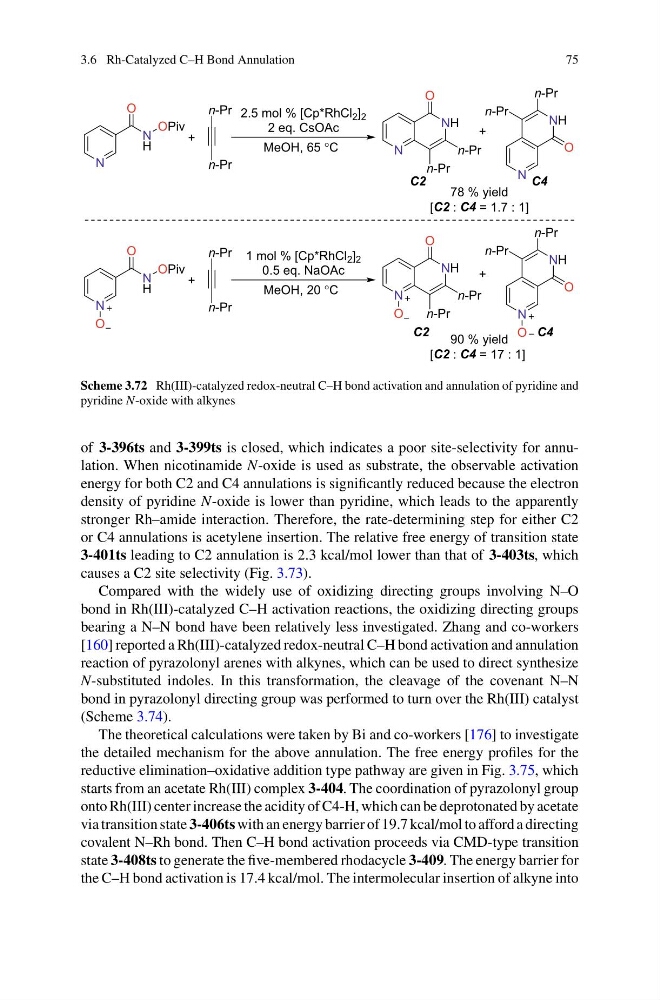
Scheme 3.72 Rh(III)-catalyzed redox-neutral C–H bond activation and annulation of pyridine and
pyridine N-oxide with alkynes
of 3-396ts and 3-399ts is closed, which indicates a poor site-selectivity for annulation. When nicotinamide N-oxide is used as substrate, the observable activation
energy for both C2 and C4 annulations is significantly reduced because the electron
density of pyridine N-oxide is lower than pyridine, which leads to the apparently
stronger Rh–amide interaction. Therefore, the rate-determining step for either C2
or C4 annulations is acetylene insertion. The relative free energy of transition state
3-401ts leading to C2 annulation is 2.3 kcal/mol lower than that of 3-403ts, which
causes a C2 site selectivity (Fig. 3.73).
Compared with the widely use of oxidizing directing groups involving N–O
bond in Rh(III)-catalyzed C–H activation reactions, the oxidizing directing groups
bearing a N–N bond have been relatively less investigated. Zhang and co-workers
[160] reported a Rh(III)-catalyzed redox-neutral C–H bond activation and annulation
reaction of pyrazolonyl arenes with alkynes, which can be used to direct synthesize
N-substituted indoles. In this transformation, the cleavage of the covenant N–N
bond in pyrazolonyl directing group was performed to turn over the Rh(III) catalyst
(Scheme 3.74).
The theoretical calculations were taken by Bi and co-workers [176] to investigate
the detailed mechanism for the above annulation. The free energy profiles for the
reductive elimination–oxidative addition type pathway are given in Fig. 3.75, which
starts from an acetate Rh(III) complex 3-404. The coordination of pyrazolonyl group
onto Rh(III) center increase the acidity of C4-H, which can be deprotonated by acetate
via transition state 3-406ts with an energy barrier of 19.7 kcal/mol to afford a directing
covalent N–Rh bond. Then C–H bond activation proceeds via CMD-type transition
state 3-408ts to generate the five-membered rhodacycle 3-409. The energy barrier for
the C–H bond activation is 17.4 kcal/mol. The intermolecular insertion of alkyne into
75
2.5 mol % [Cp*RhCl 2 ] 2
2 eq. CsOAc
MeOH, 65 C
78 % yield
+
N
N
H
O
OPiv
n-Pr
n-Pr
N
NH
O
n-Pr
n-Pr
N
+
NH
O
n-Pr
n-Pr
C2
C4
[C2 : C4 = 1.7 : 1]
1 mol % [Cp*RhCl 2 ] 2
0.5 eq. NaOAc
MeOH, 20 C
90 % yield
+
N
N
H
O
OPiv
n-Pr
n-Pr
N
NH
O
n-Pr
n-Pr
N
+
NH
O
n-Pr
n-Pr
C2
C4
[C2 : C4 = 17 : 1]
O
O
O
Scheme 3.72 Rh(III)-catalyzed redox-neutral C–H bond activation and annulation of pyridine and
pyridine N-oxide with alkynes
of 3-396ts and 3-399ts is closed, which indicates a poor site-selectivity for annulation. When nicotinamide N-oxide is used as substrate, the observable activation
energy for both C2 and C4 annulations is significantly reduced because the electron
density of pyridine N-oxide is lower than pyridine, which leads to the apparently
stronger Rh–amide interaction. Therefore, the rate-determining step for either C2
or C4 annulations is acetylene insertion. The relative free energy of transition state
3-401ts leading to C2 annulation is 2.3 kcal/mol lower than that of 3-403ts, which
causes a C2 site selectivity (Fig. 3.73).
Compared with the widely use of oxidizing directing groups involving N–O
bond in Rh(III)-catalyzed C–H activation reactions, the oxidizing directing groups
bearing a N–N bond have been relatively less investigated. Zhang and co-workers
[160] reported a Rh(III)-catalyzed redox-neutral C–H bond activation and annulation
reaction of pyrazolonyl arenes with alkynes, which can be used to direct synthesize
N-substituted indoles. In this transformation, the cleavage of the covenant N–N
bond in pyrazolonyl directing group was performed to turn over the Rh(III) catalyst
(Scheme 3.74).
The theoretical calculations were taken by Bi and co-workers [176] to investigate
the detailed mechanism for the above annulation. The free energy profiles for the
reductive elimination–oxidative addition type pathway are given in Fig. 3.75, which
starts from an acetate Rh(III) complex 3-404. The coordination of pyrazolonyl group
onto Rh(III) center increase the acidity of C4-H, which can be deprotonated by acetate
via transition state 3-406ts with an energy barrier of 19.7 kcal/mol to afford a directing
covalent N–Rh bond. Then C–H bond activation proceeds via CMD-type transition
state 3-408ts to generate the five-membered rhodacycle 3-409. The energy barrier for
the C–H bond activation is 17.4 kcal/mol. The intermolecular insertion of alkyne into