

68
3 Theoretical Study of Rh-Catalyzed …
deprotonation and coupling with alkynes to give heterocyclic products. The k H /k D
value for KIE was found to be about 2.7, which suggests that C–H bond cleavage is
involved in the rate-determining step in the catalytic cycle (Scheme 3.62).
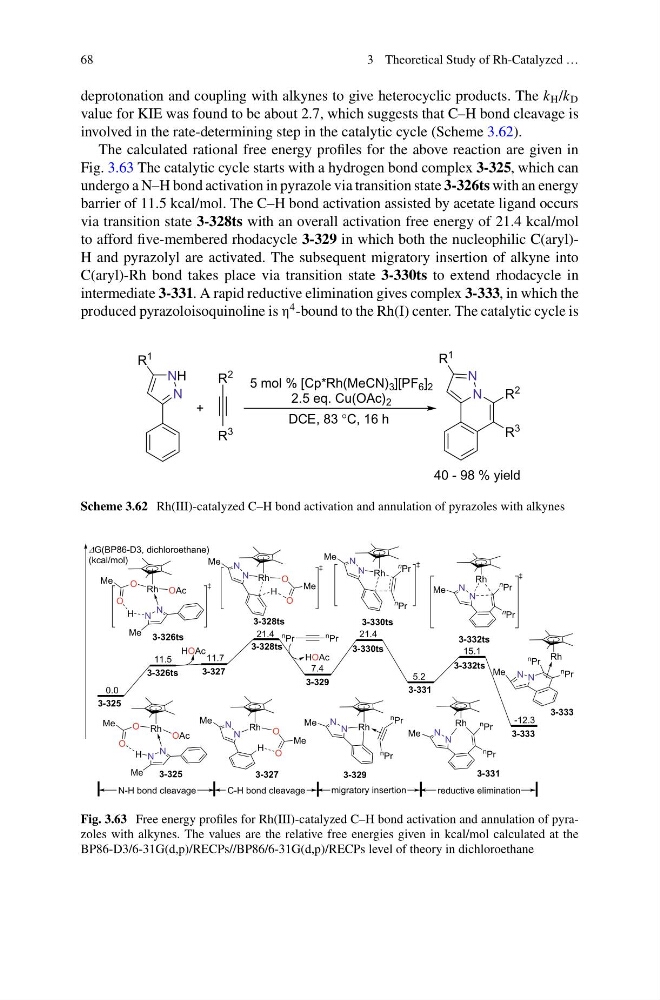
The calculated rational free energy profiles for the above reaction are given in
Fig. 3.63 The catalytic cycle starts with a hydrogen bond complex 3-325, which can
undergo a N–H bond activation in pyrazole via transition state 3-326ts with an energy
barrier of 11.5 kcal/mol. The C–H bond activation assisted by acetate ligand occurs
via transition state 3-328ts with an overall activation free energy of 21.4 kcal/mol
to afford five-membered rhodacycle 3-329 in which both the nucleophilic C(aryl)H and pyrazolyl are activated. The subsequent migratory insertion of alkyne into
C(aryl)-Rh bond takes place via transition state 3-330ts to extend rhodacycle in
intermediate 3-331. A rapid reductive elimination gives complex 3-333, in which the
produced pyrazoloisoquinoline is η
4 -bound to the Rh(I) center. The catalytic cycle is
5 mol % [Cp*Rh(MeCN) 3 ][PF 6 ] 2
2.5 eq. Cu(OAc) 2
DCE, 83 C, 16 h
40 - 98 % yield
N
NH
R
1
R
2
R
3
+
N
N
R
1
R
2
R
3
Scheme 3.62 Rh(III)-catalyzed C–H bond activation and annulation of pyrazoles with alkynes
(kcal/mol)
3-326ts
11.5
3-327
11.7
3-328ts
21.4
migratory insertion
21.4
3-332ts
15.1
3-329
7.4
3-330ts
N-H bond cleavage
3-331
5.2
G(BP86-D3, dichloroethane)
HOAc
reductive elimination
3-325
0.0
3-333
-12.3
3-325
3-326ts
3-327
3-328ts
n Pr
n Pr
HOAc
3-329
3-330ts
3-331
3-332ts
3-333
C-H bond cleavage
Rh
n Pr
n Pr
N
N
Me
Rh
N
N
Me
n
Pr
n Pr
Rh n Pr
n Pr
N
N
Me
Rh n Pr
n Pr
N
N
Me
Rh
N
N
Me
n Pr
n Pr
Rh
N
N
Me
O
O
H
Me
Rh
N
N
Me
O
O
H
Me
Rh
N
N
Me
OAc
O
H
Me
O
Rh
N
N
Me
OAc
O
H
Me
O
Fig. 3.63 Free energy profiles for Rh(III)-catalyzed C–H bond activation and annulation of pyrazoles with alkynes. The values are the relative free energies given in kcal/mol calculated at the
BP86-D3/6-31G(d,p)/RECPs//BP86/6-31G(d,p)/RECPs level of theory in dichloroethane
3 Theoretical Study of Rh-Catalyzed …
deprotonation and coupling with alkynes to give heterocyclic products. The k H /k D
value for KIE was found to be about 2.7, which suggests that C–H bond cleavage is
involved in the rate-determining step in the catalytic cycle (Scheme 3.62).
The calculated rational free energy profiles for the above reaction are given in
Fig. 3.63 The catalytic cycle starts with a hydrogen bond complex 3-325, which can
undergo a N–H bond activation in pyrazole via transition state 3-326ts with an energy
barrier of 11.5 kcal/mol. The C–H bond activation assisted by acetate ligand occurs
via transition state 3-328ts with an overall activation free energy of 21.4 kcal/mol
to afford five-membered rhodacycle 3-329 in which both the nucleophilic C(aryl)H and pyrazolyl are activated. The subsequent migratory insertion of alkyne into
C(aryl)-Rh bond takes place via transition state 3-330ts to extend rhodacycle in
intermediate 3-331. A rapid reductive elimination gives complex 3-333, in which the
produced pyrazoloisoquinoline is η
4 -bound to the Rh(I) center. The catalytic cycle is
5 mol % [Cp*Rh(MeCN) 3 ][PF 6 ] 2
2.5 eq. Cu(OAc) 2
DCE, 83 C, 16 h
40 - 98 % yield
N
NH
R
1
R
2
R
3
+
N
N
R
1
R
2
R
3
Scheme 3.62 Rh(III)-catalyzed C–H bond activation and annulation of pyrazoles with alkynes
(kcal/mol)
3-326ts
11.5
3-327
11.7
3-328ts
21.4
migratory insertion
21.4
3-332ts
15.1
3-329
7.4
3-330ts
N-H bond cleavage
3-331
5.2
G(BP86-D3, dichloroethane)
HOAc
reductive elimination
3-325
0.0
3-333
-12.3
3-325
3-326ts
3-327
3-328ts
n Pr
n Pr
HOAc
3-329
3-330ts
3-331
3-332ts
3-333
C-H bond cleavage
Rh
n Pr
n Pr
N
N
Me
Rh
N
N
Me
n
Pr
n Pr
Rh n Pr
n Pr
N
N
Me
Rh n Pr
n Pr
N
N
Me
Rh
N
N
Me
n Pr
n Pr
Rh
N
N
Me
O
O
H
Me
Rh
N
N
Me
O
O
H
Me
Rh
N
N
Me
OAc
O
H
Me
O
Rh
N
N
Me
OAc
O
H
Me
O
Fig. 3.63 Free energy profiles for Rh(III)-catalyzed C–H bond activation and annulation of pyrazoles with alkynes. The values are the relative free energies given in kcal/mol calculated at the
BP86-D3/6-31G(d,p)/RECPs//BP86/6-31G(d,p)/RECPs level of theory in dichloroethane