

3.6 Rh-Catalyzed C–H Bond Annulation
67
2.5 mol % [Cp*RhCl 2 ] 2
0.5 mmol Cu(OAc) 2
t-AmOH, 110 C, 12h
62 - 98 % yield
O
N
H
Ph
R
N
O
Ph
R
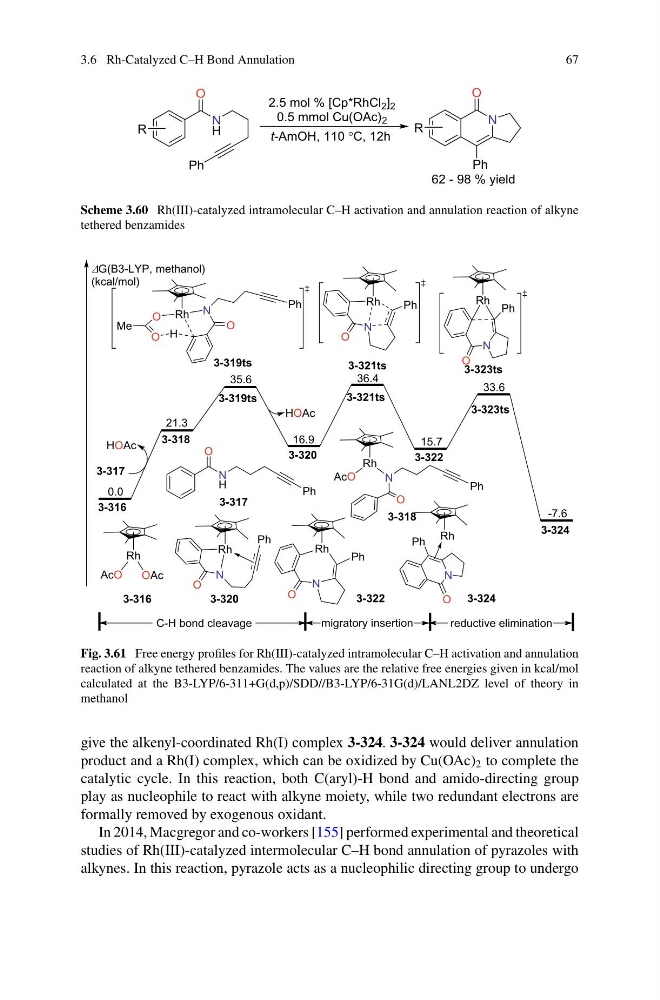
Scheme 3.60 Rh(III)-catalyzed intramolecular C–H activation and annulation reaction of alkyne
tethered benzamides
3-316
0.0
(kcal/mol)
3-318
21.3
3-319ts
35.6
3-320
16.9
migratory insertion
15.7
3-324
-7.6
3-321ts
36.4
3-322
C-H bond cleavage
3-323ts
33.6
G(B3-LYP, methanol)
HOAc
reductive elimination
3-316
3-317
HOAc
N
H
O
Ph
3-317
3-318
3-319ts
3-320
3-321ts
3-323ts
3-322
3-324
Rh
N
O
Ph
Rh
OAc
AcO
Rh
O
O
N
Me
H
O
Ph
AcO
Rh
N
O
Ph
Rh
N
O
Ph
Rh
N
O
Ph
N
O
Ph
Rh
N
O
Ph
Rh
Fig. 3.61 Free energy profiles for Rh(III)-catalyzed intramolecular C–H activation and annulation
reaction of alkyne tethered benzamides. The values are the relative free energies given in kcal/mol
calculated at the B3-LYP/6-311+G(d,p)/SDD//B3-LYP/6-31G(d)/LANL2DZ level of theory in
methanol
give the alkenyl-coordinated Rh(I) complex 3-324. 3-324 would deliver annulation
product and a Rh(I) complex, which can be oxidized by Cu(OAc) 2 to complete the
catalytic cycle. In this reaction, both C(aryl)-H bond and amido-directing group
play as nucleophile to react with alkyne moiety, while two redundant electrons are
formally removed by exogenous oxidant.
In 2014, Macgregor and co-workers [155] performed experimental and theoretical
studies of Rh(III)-catalyzed intermolecular C–H bond annulation of pyrazoles with
alkynes. In this reaction, pyrazole acts as a nucleophilic directing group to undergo
67
2.5 mol % [Cp*RhCl 2 ] 2
0.5 mmol Cu(OAc) 2
t-AmOH, 110 C, 12h
62 - 98 % yield
O
N
H
Ph
R
N
O
Ph
R
Scheme 3.60 Rh(III)-catalyzed intramolecular C–H activation and annulation reaction of alkyne
tethered benzamides
3-316
0.0
(kcal/mol)
3-318
21.3
3-319ts
35.6
3-320
16.9
migratory insertion
15.7
3-324
-7.6
3-321ts
36.4
3-322
C-H bond cleavage
3-323ts
33.6
G(B3-LYP, methanol)
HOAc
reductive elimination
3-316
3-317
HOAc
N
H
O
Ph
3-317
3-318
3-319ts
3-320
3-321ts
3-323ts
3-322
3-324
Rh
N
O
Ph
Rh
OAc
AcO
Rh
O
O
N
Me
H
O
Ph
AcO
Rh
N
O
Ph
Rh
N
O
Ph
Rh
N
O
Ph
N
O
Ph
Rh
N
O
Ph
Rh
Fig. 3.61 Free energy profiles for Rh(III)-catalyzed intramolecular C–H activation and annulation
reaction of alkyne tethered benzamides. The values are the relative free energies given in kcal/mol
calculated at the B3-LYP/6-311+G(d,p)/SDD//B3-LYP/6-31G(d)/LANL2DZ level of theory in
methanol
give the alkenyl-coordinated Rh(I) complex 3-324. 3-324 would deliver annulation
product and a Rh(I) complex, which can be oxidized by Cu(OAc) 2 to complete the
catalytic cycle. In this reaction, both C(aryl)-H bond and amido-directing group
play as nucleophile to react with alkyne moiety, while two redundant electrons are
formally removed by exogenous oxidant.
In 2014, Macgregor and co-workers [155] performed experimental and theoretical
studies of Rh(III)-catalyzed intermolecular C–H bond annulation of pyrazoles with
alkynes. In this reaction, pyrazole acts as a nucleophilic directing group to undergo