

66
3 Theoretical Study of Rh-Catalyzed …
release N-aminoindole product and regenerate Rh(III) active species 3-298 by coordination of a phenyldiazene substrate. During the whole catalytic cycle, the oxidative
state of Rh remains at +3.
3.6.2 Directing Group as Nucleophile
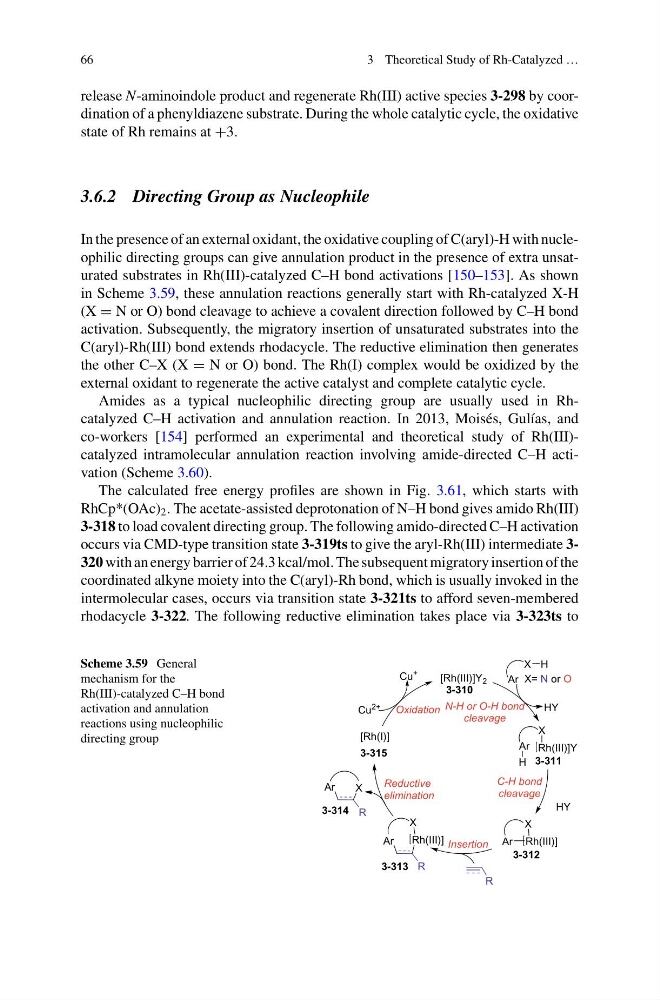
In the presence of an external oxidant, the oxidative coupling of C(aryl)-H with nucleophilic directing groups can give annulation product in the presence of extra unsaturated substrates in Rh(III)-catalyzed C–H bond activations [150–153]. As shown
in Scheme 3.59, these annulation reactions generally start with Rh-catalyzed X-H
(X = N or O) bond cleavage to achieve a covalent direction followed by C–H bond
activation. Subsequently, the migratory insertion of unsaturated substrates into the
C(aryl)-Rh(III) bond extends rhodacycle. The reductive elimination then generates
the other C–X (X = N or O) bond. The Rh(I) complex would be oxidized by the
external oxidant to regenerate the active catalyst and complete catalytic cycle.
Amides as a typical nucleophilic directing group are usually used in Rhcatalyzed C–H activation and annulation reaction. In 2013, Moisés, Gulías, and
co-workers [154] performed an experimental and theoretical study of Rh(III)catalyzed intramolecular annulation reaction involving amide-directed C–H activation (Scheme 3.60).
The calculated free energy profiles are shown in Fig. 3.61, which starts with
RhCp*(OAc) 2 . The acetate-assisted deprotonation of N–H bond gives amido Rh(III)
3-318 to load covalent directing group. The following amido-directed C–H activation
occurs via CMD-type transition state 3-319ts to give the aryl-Rh(III) intermediate 3320 with an energy barrier of 24.3 kcal/mol. The subsequent migratory insertion of the
coordinated alkyne moiety into the C(aryl)-Rh bond, which is usually invoked in the
intermolecular cases, occurs via transition state 3-321ts to afford seven-membered
rhodacycle 3-322. The following reductive elimination takes place via 3-323ts to
Scheme 3.59 General
mechanism for the
Rh(III)-catalyzed C–H bond
activation and annulation
reactions using nucleophilic
directing group
[Rh(III)]Y 2
Ar
X
HY
Ar
X
Rh(III)]Y
3-312
3-311
Oxidation
Cu
2+
3-310
Insertion
N-H or O-H bond
cleavage
Cu
+
X
Rh(III)]
Ar
[Rh(I)]
3-315
Reductive
elimination
H
C-H bond
cleavage
H
HY
R
3-313
X
Rh(III)]
Ar
R
X= N or O
X
Ar
R
3-314
3 Theoretical Study of Rh-Catalyzed …
release N-aminoindole product and regenerate Rh(III) active species 3-298 by coordination of a phenyldiazene substrate. During the whole catalytic cycle, the oxidative
state of Rh remains at +3.
3.6.2 Directing Group as Nucleophile
In the presence of an external oxidant, the oxidative coupling of C(aryl)-H with nucleophilic directing groups can give annulation product in the presence of extra unsaturated substrates in Rh(III)-catalyzed C–H bond activations [150–153]. As shown
in Scheme 3.59, these annulation reactions generally start with Rh-catalyzed X-H
(X = N or O) bond cleavage to achieve a covalent direction followed by C–H bond
activation. Subsequently, the migratory insertion of unsaturated substrates into the
C(aryl)-Rh(III) bond extends rhodacycle. The reductive elimination then generates
the other C–X (X = N or O) bond. The Rh(I) complex would be oxidized by the
external oxidant to regenerate the active catalyst and complete catalytic cycle.
Amides as a typical nucleophilic directing group are usually used in Rhcatalyzed C–H activation and annulation reaction. In 2013, Moisés, Gulías, and
co-workers [154] performed an experimental and theoretical study of Rh(III)catalyzed intramolecular annulation reaction involving amide-directed C–H activation (Scheme 3.60).
The calculated free energy profiles are shown in Fig. 3.61, which starts with
RhCp*(OAc) 2 . The acetate-assisted deprotonation of N–H bond gives amido Rh(III)
3-318 to load covalent directing group. The following amido-directed C–H activation
occurs via CMD-type transition state 3-319ts to give the aryl-Rh(III) intermediate 3320 with an energy barrier of 24.3 kcal/mol. The subsequent migratory insertion of the
coordinated alkyne moiety into the C(aryl)-Rh bond, which is usually invoked in the
intermolecular cases, occurs via transition state 3-321ts to afford seven-membered
rhodacycle 3-322. The following reductive elimination takes place via 3-323ts to
Scheme 3.59 General
mechanism for the
Rh(III)-catalyzed C–H bond
activation and annulation
reactions using nucleophilic
directing group
[Rh(III)]Y 2
Ar
X
HY
Ar
X
Rh(III)]Y
3-312
3-311
Oxidation
Cu
2+
3-310
Insertion
N-H or O-H bond
cleavage
Cu
+
X
Rh(III)]
Ar
[Rh(I)]
3-315
Reductive
elimination
H
C-H bond
cleavage
H
HY
R
3-313
X
Rh(III)]
Ar
R
X= N or O
X
Ar
R
3-314