

3.6 Rh-Catalyzed C–H Bond Annulation
65
2.5 mol % [Cp*RhCl 2 ] 2
10 mol % AgOAc
DCE/HOAc (3:1), RT, 24h
60 - 93 % yield
N
N
Boc
+
R
2
R
3
R
1
R
1
N
N Boc
H
R
2
R
1
Scheme 3.57 Rh(III)-catalyzed intermolecular annulation reaction of aryl-substituted diazenecarboxylates with alkenes
3-298
0.0
(kcal/mol)
3-299ts
19.4
3-300
4.2
3-301
-4.7
migratory insertion
-6.8
3-305
-10.4
3-302ts
13.2
3-303
C-H bond cleavage
protonation
3-304ts
9.7
G(M06-2X, dichloroethane)
3-307
-31.2
3-308ts
-27.4
3-309
-33.1
3-306ts
0.7
HOAc
3-298
3-299ts
3-300
3-301
3-302ts
3-303
3-304ts
3-305
3-306ts
3-307
HOAc
3-308ts
3-309
ligand exchange
cyclization
Rh
O
O
N
N
Boc
Me
H
Rh
O
O
N
N
Boc
Me
H
Rh
N
N Boc
Rh
N
N Boc
Rh
N
N Boc
Rh
N
N Boc
Rh
N N
O
O
t Bu
Rh
N
N Boc
Rh
N N
O
O
t Bu
Rh
N
O
O
t Bu
N
Rh
N
N
H
Boc
Me
O
O
Rh
N
N
H
Me
O
O
t BuO
O
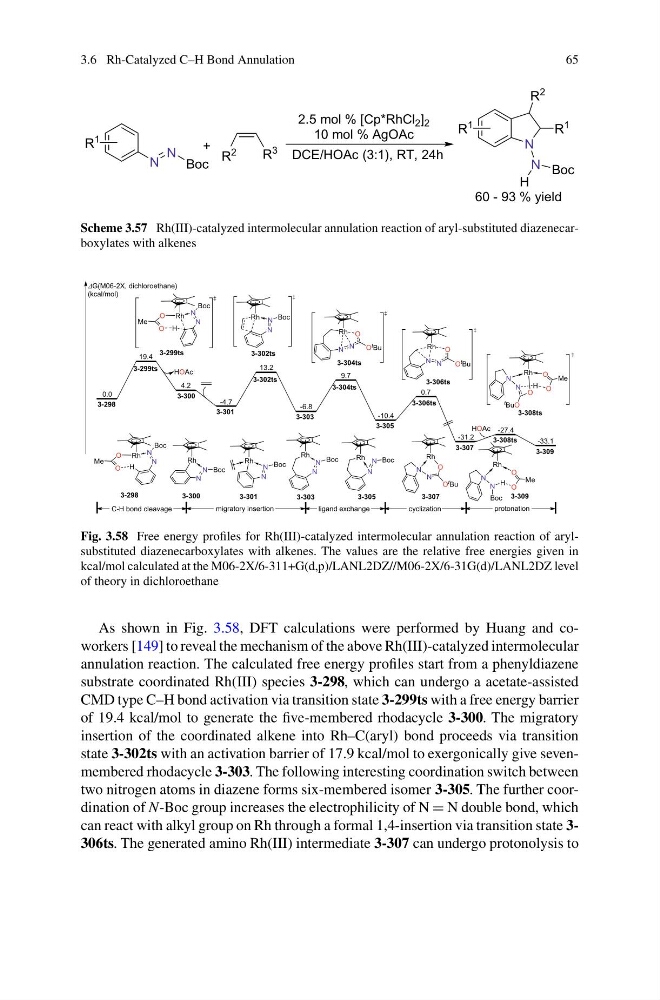
Fig. 3.58 Free energy profiles for Rh(III)-catalyzed intermolecular annulation reaction of arylsubstituted diazenecarboxylates with alkenes. The values are the relative free energies given in
kcal/mol calculated at the M06-2X/6-311+G(d,p)/LANL2DZ//M06-2X/6-31G(d)/LANL2DZ level
of theory in dichloroethane
As shown in Fig. 3.58, DFT calculations were performed by Huang and coworkers [149] to reveal the mechanism of the above Rh(III)-catalyzed intermolecular
annulation reaction. The calculated free energy profiles start from a phenyldiazene
substrate coordinated Rh(III) species 3-298, which can undergo a acetate-assisted
CMD type C–H bond activation via transition state 3-299ts with a free energy barrier
of 19.4 kcal/mol to generate the five-membered rhodacycle 3-300. The migratory
insertion of the coordinated alkene into Rh–C(aryl) bond proceeds via transition
state 3-302ts with an activation barrier of 17.9 kcal/mol to exergonically give sevenmembered rhodacycle 3-303. The following interesting coordination switch between
two nitrogen atoms in diazene forms six-membered isomer 3-305. The further coordination of N-Boc group increases the electrophilicity of N = N double bond, which
can react with alkyl group on Rh through a formal 1,4-insertion via transition state 3306ts. The generated amino Rh(III) intermediate 3-307 can undergo protonolysis to
65
2.5 mol % [Cp*RhCl 2 ] 2
10 mol % AgOAc
DCE/HOAc (3:1), RT, 24h
60 - 93 % yield
N
N
Boc
+
R
2
R
3
R
1
R
1
N
N Boc
H
R
2
R
1
Scheme 3.57 Rh(III)-catalyzed intermolecular annulation reaction of aryl-substituted diazenecarboxylates with alkenes
3-298
0.0
(kcal/mol)
3-299ts
19.4
3-300
4.2
3-301
-4.7
migratory insertion
-6.8
3-305
-10.4
3-302ts
13.2
3-303
C-H bond cleavage
protonation
3-304ts
9.7
G(M06-2X, dichloroethane)
3-307
-31.2
3-308ts
-27.4
3-309
-33.1
3-306ts
0.7
HOAc
3-298
3-299ts
3-300
3-301
3-302ts
3-303
3-304ts
3-305
3-306ts
3-307
HOAc
3-308ts
3-309
ligand exchange
cyclization
Rh
O
O
N
N
Boc
Me
H
Rh
O
O
N
N
Boc
Me
H
Rh
N
N Boc
Rh
N
N Boc
Rh
N
N Boc
Rh
N
N Boc
Rh
N N
O
O
t Bu
Rh
N
N Boc
Rh
N N
O
O
t Bu
Rh
N
O
O
t Bu
N
Rh
N
N
H
Boc
Me
O
O
Rh
N
N
H
Me
O
O
t BuO
O
Fig. 3.58 Free energy profiles for Rh(III)-catalyzed intermolecular annulation reaction of arylsubstituted diazenecarboxylates with alkenes. The values are the relative free energies given in
kcal/mol calculated at the M06-2X/6-311+G(d,p)/LANL2DZ//M06-2X/6-31G(d)/LANL2DZ level
of theory in dichloroethane
As shown in Fig. 3.58, DFT calculations were performed by Huang and coworkers [149] to reveal the mechanism of the above Rh(III)-catalyzed intermolecular
annulation reaction. The calculated free energy profiles start from a phenyldiazene
substrate coordinated Rh(III) species 3-298, which can undergo a acetate-assisted
CMD type C–H bond activation via transition state 3-299ts with a free energy barrier
of 19.4 kcal/mol to generate the five-membered rhodacycle 3-300. The migratory
insertion of the coordinated alkene into Rh–C(aryl) bond proceeds via transition
state 3-302ts with an activation barrier of 17.9 kcal/mol to exergonically give sevenmembered rhodacycle 3-303. The following interesting coordination switch between
two nitrogen atoms in diazene forms six-membered isomer 3-305. The further coordination of N-Boc group increases the electrophilicity of N = N double bond, which
can react with alkyl group on Rh through a formal 1,4-insertion via transition state 3306ts. The generated amino Rh(III) intermediate 3-307 can undergo protonolysis to