

64
3 Theoretical Study of Rh-Catalyzed …
3-287
0.0
(kcal/mol)
3-288
6.7
3-289ts
7.6
3-290
3.3
reductive elimination
1.3
3-294
-12.6
3-291ts
16.7
3-292
C-H bond cleavage
3-293ts
28.5
G(B3-LYP)
migratory insertion
3-287
3-288
3-289ts
3-290
3-291ts
3-292
3-293ts
3-294
3-296
-12.5
N
N
3-295 3-297
3-295
N
N
3-297
ligand exchange
Me 3 P Rh
Cl
N
N
H
Me 3 P Rh
Cl
N
N
H
Me 3 P Rh
Cl
N
N
H
Me 3 P Rh
Cl
N
N
Me 3 P Rh
Cl H
N N
N
N
Me 3 P Rh
Cl
Me 3 P Rh
Cl
N
N
N
N
Me 3 P Rh
Cl
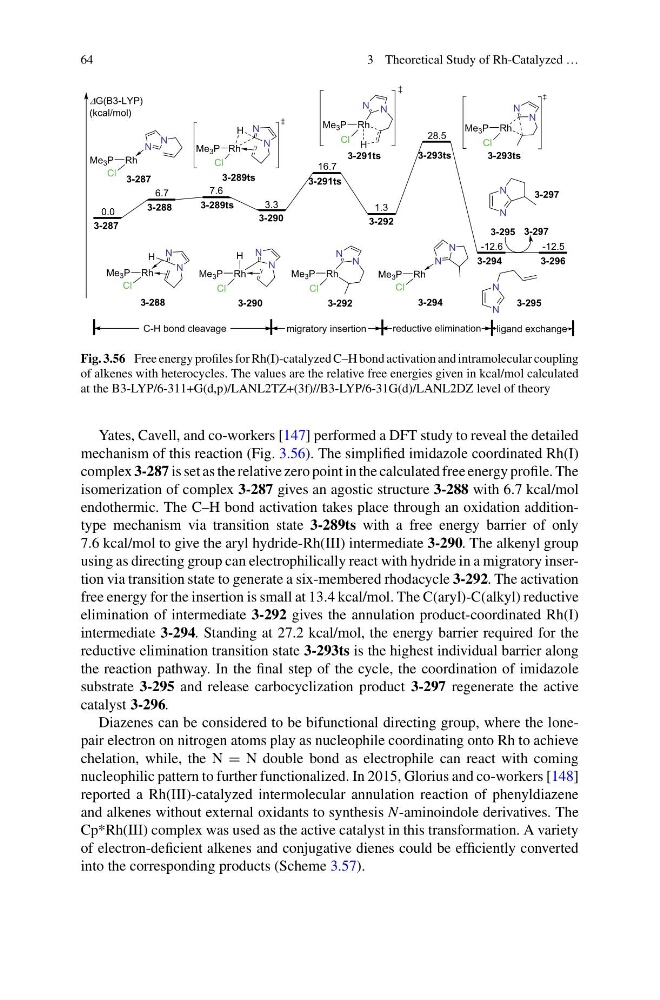
Fig. 3.56 Free energy profiles for Rh(I)-catalyzed C–H bond activation and intramolecular coupling
of alkenes with heterocycles. The values are the relative free energies given in kcal/mol calculated
at the B3-LYP/6-311+G(d,p)/LANL2TZ+(3f)//B3-LYP/6-31G(d)/LANL2DZ level of theory
Yates, Cavell, and co-workers [147] performed a DFT study to reveal the detailed
mechanism of this reaction (Fig. 3.56). The simplified imidazole coordinated Rh(I)
complex 3-287 is set as the relative zero point in the calculated free energy profile. The
isomerization of complex 3-287 gives an agostic structure 3-288 with 6.7 kcal/mol
endothermic. The C–H bond activation takes place through an oxidation additiontype mechanism via transition state 3-289ts with a free energy barrier of only
7.6 kcal/mol to give the aryl hydride-Rh(III) intermediate 3-290. The alkenyl group
using as directing group can electrophilically react with hydride in a migratory insertion via transition state to generate a six-membered rhodacycle 3-292. The activation
free energy for the insertion is small at 13.4 kcal/mol. The C(aryl)-C(alkyl) reductive
elimination of intermediate 3-292 gives the annulation product-coordinated Rh(I)
intermediate 3-294. Standing at 27.2 kcal/mol, the energy barrier required for the
reductive elimination transition state 3-293ts is the highest individual barrier along
the reaction pathway. In the final step of the cycle, the coordination of imidazole
substrate 3-295 and release carbocyclization product 3-297 regenerate the active
catalyst 3-296.
Diazenes can be considered to be bifunctional directing group, where the lonepair electron on nitrogen atoms play as nucleophile coordinating onto Rh to achieve
chelation, while, the N = N double bond as electrophile can react with coming
nucleophilic pattern to further functionalized. In 2015, Glorius and co-workers [148]
reported a Rh(III)-catalyzed intermolecular annulation reaction of phenyldiazene
and alkenes without external oxidants to synthesis N-aminoindole derivatives. The
Cp*Rh(III) complex was used as the active catalyst in this transformation. A variety
of electron-deficient alkenes and conjugative dienes could be efficiently converted
into the corresponding products (Scheme 3.57).
3 Theoretical Study of Rh-Catalyzed …
3-287
0.0
(kcal/mol)
3-288
6.7
3-289ts
7.6
3-290
3.3
reductive elimination
1.3
3-294
-12.6
3-291ts
16.7
3-292
C-H bond cleavage
3-293ts
28.5
G(B3-LYP)
migratory insertion
3-287
3-288
3-289ts
3-290
3-291ts
3-292
3-293ts
3-294
3-296
-12.5
N
N
3-295 3-297
3-295
N
N
3-297
ligand exchange
Me 3 P Rh
Cl
N
N
H
Me 3 P Rh
Cl
N
N
H
Me 3 P Rh
Cl
N
N
H
Me 3 P Rh
Cl
N
N
Me 3 P Rh
Cl H
N N
N
N
Me 3 P Rh
Cl
Me 3 P Rh
Cl
N
N
N
N
Me 3 P Rh
Cl
Fig. 3.56 Free energy profiles for Rh(I)-catalyzed C–H bond activation and intramolecular coupling
of alkenes with heterocycles. The values are the relative free energies given in kcal/mol calculated
at the B3-LYP/6-311+G(d,p)/LANL2TZ+(3f)//B3-LYP/6-31G(d)/LANL2DZ level of theory
Yates, Cavell, and co-workers [147] performed a DFT study to reveal the detailed
mechanism of this reaction (Fig. 3.56). The simplified imidazole coordinated Rh(I)
complex 3-287 is set as the relative zero point in the calculated free energy profile. The
isomerization of complex 3-287 gives an agostic structure 3-288 with 6.7 kcal/mol
endothermic. The C–H bond activation takes place through an oxidation additiontype mechanism via transition state 3-289ts with a free energy barrier of only
7.6 kcal/mol to give the aryl hydride-Rh(III) intermediate 3-290. The alkenyl group
using as directing group can electrophilically react with hydride in a migratory insertion via transition state to generate a six-membered rhodacycle 3-292. The activation
free energy for the insertion is small at 13.4 kcal/mol. The C(aryl)-C(alkyl) reductive
elimination of intermediate 3-292 gives the annulation product-coordinated Rh(I)
intermediate 3-294. Standing at 27.2 kcal/mol, the energy barrier required for the
reductive elimination transition state 3-293ts is the highest individual barrier along
the reaction pathway. In the final step of the cycle, the coordination of imidazole
substrate 3-295 and release carbocyclization product 3-297 regenerate the active
catalyst 3-296.
Diazenes can be considered to be bifunctional directing group, where the lonepair electron on nitrogen atoms play as nucleophile coordinating onto Rh to achieve
chelation, while, the N = N double bond as electrophile can react with coming
nucleophilic pattern to further functionalized. In 2015, Glorius and co-workers [148]
reported a Rh(III)-catalyzed intermolecular annulation reaction of phenyldiazene
and alkenes without external oxidants to synthesis N-aminoindole derivatives. The
Cp*Rh(III) complex was used as the active catalyst in this transformation. A variety
of electron-deficient alkenes and conjugative dienes could be efficiently converted
into the corresponding products (Scheme 3.57).