

3.6 Rh-Catalyzed C–H Bond Annulation
63
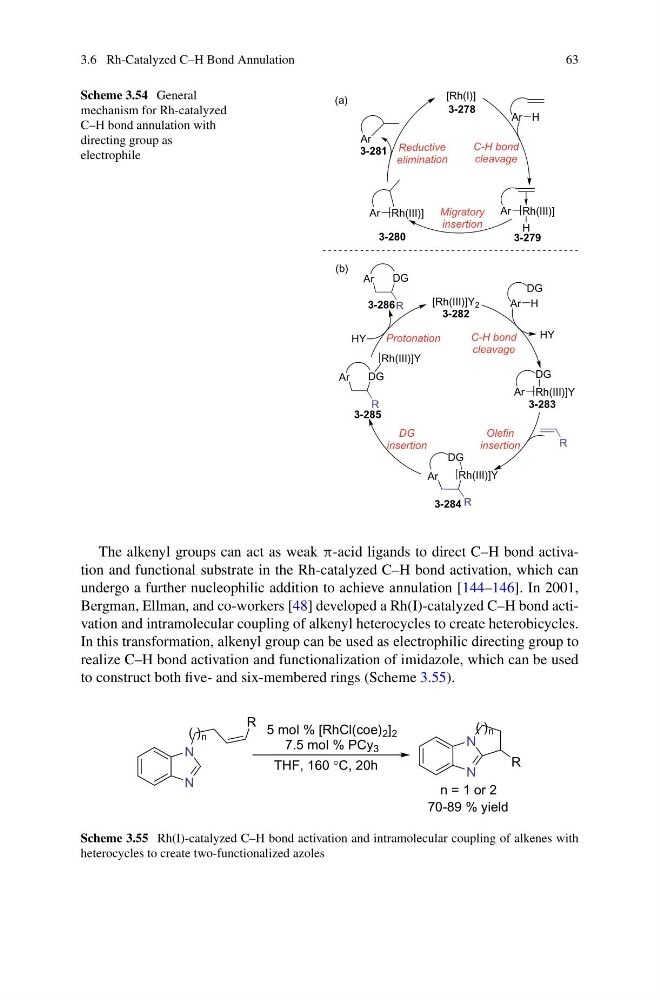
Scheme 3.54 General
mechanism for Rh-catalyzed
C–H bond annulation with
directing group as
electrophile
(a)
(b)
DG
Rh(III)]Y
Ar
R
Reductive
elimination
[Rh(I)]
3-278
C-H bond
cleavage
Ar Rh(III)]
3-279
3-280
Migratory
insertion
H
3-281
Ar H
Ar Rh(III)]
Ar
R
Ar
DG
Rh(III)]Y
3-283
Olefin
insertion
3-284
[Rh(III)]Y 2
Ar H
DG
HY
Protonation
3-282
DG
insertion
C-H bond
cleavage
3-285
HY
3-286
Rh(III)]Y
Ar
R
DG
Ar
R
DG
The alkenyl groups can act as weak π-acid ligands to direct C–H bond activation and functional substrate in the Rh-catalyzed C–H bond activation, which can
undergo a further nucleophilic addition to achieve annulation [144–146]. In 2001,
Bergman, Ellman, and co-workers [48] developed a Rh(I)-catalyzed C–H bond activation and intramolecular coupling of alkenyl heterocycles to create heterobicycles.
In this transformation, alkenyl group can be used as electrophilic directing group to
realize C–H bond activation and functionalization of imidazole, which can be used
to construct both five- and six-membered rings (Scheme 3.55).
5 mol % [RhCl(coe) 2 ] 2
7.5 mol % PCy 3
THF, 160 C, 20h
70-89 % yield
N
N
N
N
R
( ) n
( ) n
n = 1 or 2
R
Scheme 3.55 Rh(I)-catalyzed C–H bond activation and intramolecular coupling of alkenes with
heterocycles to create two-functionalized azoles
63
Scheme 3.54 General
mechanism for Rh-catalyzed
C–H bond annulation with
directing group as
electrophile
(a)
(b)
DG
Rh(III)]Y
Ar
R
Reductive
elimination
[Rh(I)]
3-278
C-H bond
cleavage
Ar Rh(III)]
3-279
3-280
Migratory
insertion
H
3-281
Ar H
Ar Rh(III)]
Ar
R
Ar
DG
Rh(III)]Y
3-283
Olefin
insertion
3-284
[Rh(III)]Y 2
Ar H
DG
HY
Protonation
3-282
DG
insertion
C-H bond
cleavage
3-285
HY
3-286
Rh(III)]Y
Ar
R
DG
Ar
R
DG
The alkenyl groups can act as weak π-acid ligands to direct C–H bond activation and functional substrate in the Rh-catalyzed C–H bond activation, which can
undergo a further nucleophilic addition to achieve annulation [144–146]. In 2001,
Bergman, Ellman, and co-workers [48] developed a Rh(I)-catalyzed C–H bond activation and intramolecular coupling of alkenyl heterocycles to create heterobicycles.
In this transformation, alkenyl group can be used as electrophilic directing group to
realize C–H bond activation and functionalization of imidazole, which can be used
to construct both five- and six-membered rings (Scheme 3.55).
5 mol % [RhCl(coe) 2 ] 2
7.5 mol % PCy 3
THF, 160 C, 20h
70-89 % yield
N
N
N
N
R
( ) n
( ) n
n = 1 or 2
R
Scheme 3.55 Rh(I)-catalyzed C–H bond activation and intramolecular coupling of alkenes with
heterocycles to create two-functionalized azoles