

3.6 Rh-Catalyzed C–H Bond Annulation
69
completed by the release of the annulation product and reoxidation of an unspecified
Rh(I) species to the active Rh(III) catalyst.
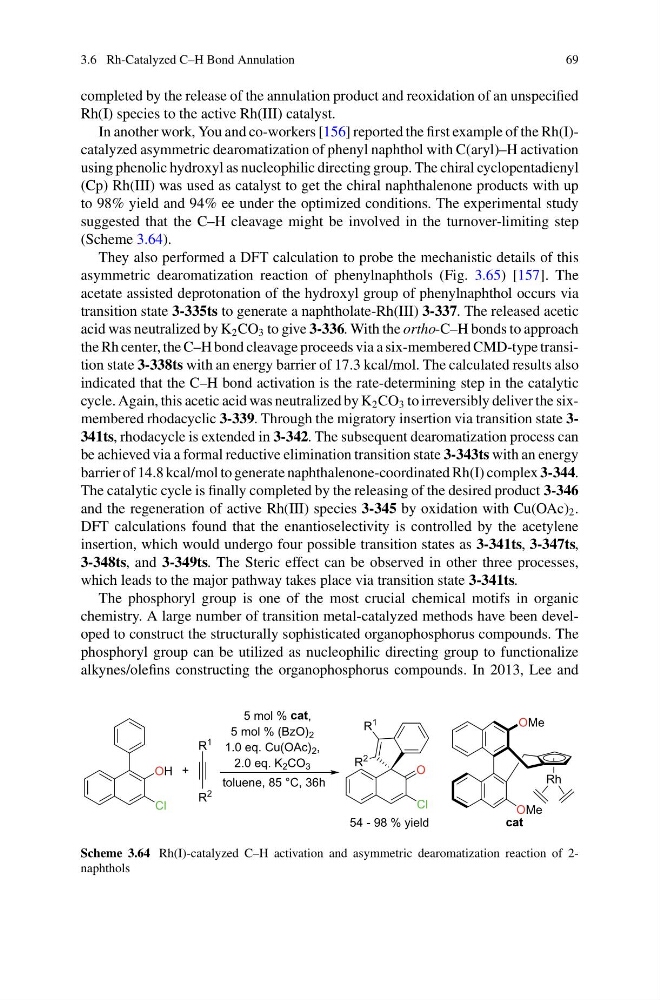
In another work, You and co-workers [156] reported the first example of the Rh(I)catalyzed asymmetric dearomatization of phenyl naphthol with C(aryl)–H activation
using phenolic hydroxyl as nucleophilic directing group. The chiral cyclopentadienyl
(Cp) Rh(III) was used as catalyst to get the chiral naphthalenone products with up
to 98% yield and 94% ee under the optimized conditions. The experimental study
suggested that the C–H cleavage might be involved in the turnover-limiting step
(Scheme 3.64).
They also performed a DFT calculation to probe the mechanistic details of this
asymmetric dearomatization reaction of phenylnaphthols (Fig. 3.65) [157]. The
acetate assisted deprotonation of the hydroxyl group of phenylnaphthol occurs via
transition state 3-335ts to generate a naphtholate-Rh(III) 3-337. The released acetic
acid was neutralized by K 2 CO 3 to give 3-336. With the ortho-C–H bonds to approach
the Rh center, the C–H bond cleavage proceeds via a six-membered CMD-type transition state 3-338ts with an energy barrier of 17.3 kcal/mol. The calculated results also
indicated that the C–H bond activation is the rate-determining step in the catalytic
cycle. Again, this acetic acid was neutralized by K 2 CO 3 to irreversibly deliver the sixmembered rhodacyclic 3-339. Through the migratory insertion via transition state 3341ts, rhodacycle is extended in 3-342. The subsequent dearomatization process can
be achieved via a formal reductive elimination transition state 3-343ts with an energy
barrier of 14.8 kcal/mol to generate naphthalenone-coordinated Rh(I) complex 3-344.
The catalytic cycle is finally completed by the releasing of the desired product 3-346
and the regeneration of active Rh(III) species 3-345 by oxidation with Cu(OAc) 2 .
DFT calculations found that the enantioselectivity is controlled by the acetylene
insertion, which would undergo four possible transition states as 3-341ts, 3-347ts,
3-348ts, and 3-349ts. The Steric effect can be observed in other three processes,
which leads to the major pathway takes place via transition state 3-341ts.
The phosphoryl group is one of the most crucial chemical motifs in organic
chemistry. A large number of transition metal-catalyzed methods have been developed to construct the structurally sophisticated organophosphorus compounds. The
phosphoryl group can be utilized as nucleophilic directing group to functionalize
alkynes/olefins constructing the organophosphorus compounds. In 2013, Lee and
Rh
OH
Cl
+
R
1
R
2
5 mol % cat,
5 mol % (BzO) 2
1.0 eq. Cu(OAc) 2 ,
2.0 eq. K 2 CO 3
toluene, 85 °C, 36h
O
Cl
R
1
R
2
OMe
OMe
cat
54 - 98 % yield
Scheme 3.64 Rh(I)-catalyzed C–H activation and asymmetric dearomatization reaction of 2naphthols
69
completed by the release of the annulation product and reoxidation of an unspecified
Rh(I) species to the active Rh(III) catalyst.
In another work, You and co-workers [156] reported the first example of the Rh(I)catalyzed asymmetric dearomatization of phenyl naphthol with C(aryl)–H activation
using phenolic hydroxyl as nucleophilic directing group. The chiral cyclopentadienyl
(Cp) Rh(III) was used as catalyst to get the chiral naphthalenone products with up
to 98% yield and 94% ee under the optimized conditions. The experimental study
suggested that the C–H cleavage might be involved in the turnover-limiting step
(Scheme 3.64).
They also performed a DFT calculation to probe the mechanistic details of this
asymmetric dearomatization reaction of phenylnaphthols (Fig. 3.65) [157]. The
acetate assisted deprotonation of the hydroxyl group of phenylnaphthol occurs via
transition state 3-335ts to generate a naphtholate-Rh(III) 3-337. The released acetic
acid was neutralized by K 2 CO 3 to give 3-336. With the ortho-C–H bonds to approach
the Rh center, the C–H bond cleavage proceeds via a six-membered CMD-type transition state 3-338ts with an energy barrier of 17.3 kcal/mol. The calculated results also
indicated that the C–H bond activation is the rate-determining step in the catalytic
cycle. Again, this acetic acid was neutralized by K 2 CO 3 to irreversibly deliver the sixmembered rhodacyclic 3-339. Through the migratory insertion via transition state 3341ts, rhodacycle is extended in 3-342. The subsequent dearomatization process can
be achieved via a formal reductive elimination transition state 3-343ts with an energy
barrier of 14.8 kcal/mol to generate naphthalenone-coordinated Rh(I) complex 3-344.
The catalytic cycle is finally completed by the releasing of the desired product 3-346
and the regeneration of active Rh(III) species 3-345 by oxidation with Cu(OAc) 2 .
DFT calculations found that the enantioselectivity is controlled by the acetylene
insertion, which would undergo four possible transition states as 3-341ts, 3-347ts,
3-348ts, and 3-349ts. The Steric effect can be observed in other three processes,
which leads to the major pathway takes place via transition state 3-341ts.
The phosphoryl group is one of the most crucial chemical motifs in organic
chemistry. A large number of transition metal-catalyzed methods have been developed to construct the structurally sophisticated organophosphorus compounds. The
phosphoryl group can be utilized as nucleophilic directing group to functionalize
alkynes/olefins constructing the organophosphorus compounds. In 2013, Lee and
Rh
OH
Cl
+
R
1
R
2
5 mol % cat,
5 mol % (BzO) 2
1.0 eq. Cu(OAc) 2 ,
2.0 eq. K 2 CO 3
toluene, 85 °C, 36h
O
Cl
R
1
R
2
OMe
OMe
cat
54 - 98 % yield
Scheme 3.64 Rh(I)-catalyzed C–H activation and asymmetric dearomatization reaction of 2naphthols