

54
3 Theoretical Study of Rh-Catalyzed …
3-202 and regenerate the active catalyst 3-195 to complete the catalytic cycle. The
oxidation state of the Rh(III) center is retained during the whole catalytic cycle.
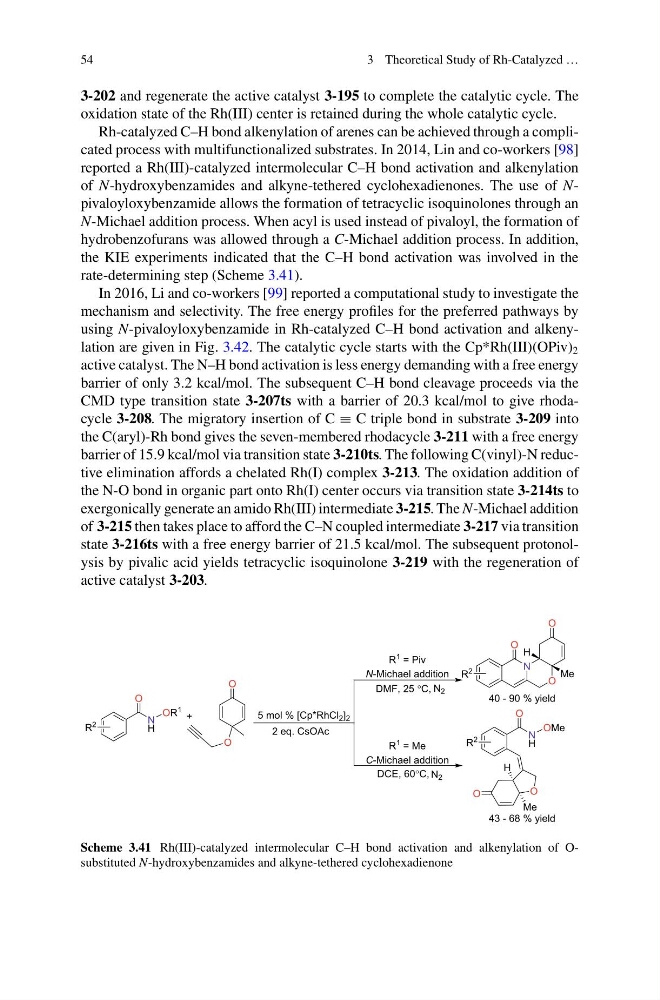
Rh-catalyzed C–H bond alkenylation of arenes can be achieved through a complicated process with multifunctionalized substrates. In 2014, Lin and co-workers [98]
reported a Rh(III)-catalyzed intermolecular C–H bond activation and alkenylation
of N-hydroxybenzamides and alkyne-tethered cyclohexadienones. The use of Npivaloyloxybenzamide allows the formation of tetracyclic isoquinolones through an
N-Michael addition process. When acyl is used instead of pivaloyl, the formation of
hydrobenzofurans was allowed through a C-Michael addition process. In addition,
the KIE experiments indicated that the C–H bond activation was involved in the
rate-determining step (Scheme 3.41).
In 2016, Li and co-workers [99] reported a computational study to investigate the
mechanism and selectivity. The free energy profiles for the preferred pathways by
using N-pivaloyloxybenzamide in Rh-catalyzed C–H bond activation and alkenylation are given in Fig. 3.42. The catalytic cycle starts with the Cp*Rh(III)(OPiv) 2
active catalyst. The N–H bond activation is less energy demanding with a free energy
barrier of only 3.2 kcal/mol. The subsequent C–H bond cleavage proceeds via the
CMD type transition state 3-207ts with a barrier of 20.3 kcal/mol to give rhodacycle 3-208. The migratory insertion of C ≡ C triple bond in substrate 3-209 into
the C(aryl)-Rh bond gives the seven-membered rhodacycle 3-211 with a free energy
barrier of 15.9 kcal/mol via transition state 3-210ts. The following C(vinyl)-N reductive elimination affords a chelated Rh(I) complex 3-213. The oxidation addition of
the N-O bond in organic part onto Rh(I) center occurs via transition state 3-214ts to
exergonically generate an amido Rh(III) intermediate 3-215. The N-Michael addition
of 3-215 then takes place to afford the C–N coupled intermediate 3-217 via transition
state 3-216ts with a free energy barrier of 21.5 kcal/mol. The subsequent protonolysis by pivalic acid yields tetracyclic isoquinolone 3-219 with the regeneration of
active catalyst 3-203.
5 mol % [Cp*RhCl 2 ] 2
+
N
H
OR
1
O
O
O
R
1 = Piv
N-Michael addition
DMF, 25 C, N 2
R
1 = Me
C-Michael addition
2 eq. CsOAc
DCE, 60C, N 2
R
2
N
O
R
2
O
H
Me
O
40 - 90 % yield
43 - 68 % yield
N
H
OMe
O
R
2
O
O
H
Me
Scheme 3.41 Rh(III)-catalyzed intermolecular C–H bond activation and alkenylation of Osubstituted N-hydroxybenzamides and alkyne-tethered cyclohexadienone
3 Theoretical Study of Rh-Catalyzed …
3-202 and regenerate the active catalyst 3-195 to complete the catalytic cycle. The
oxidation state of the Rh(III) center is retained during the whole catalytic cycle.
Rh-catalyzed C–H bond alkenylation of arenes can be achieved through a complicated process with multifunctionalized substrates. In 2014, Lin and co-workers [98]
reported a Rh(III)-catalyzed intermolecular C–H bond activation and alkenylation
of N-hydroxybenzamides and alkyne-tethered cyclohexadienones. The use of Npivaloyloxybenzamide allows the formation of tetracyclic isoquinolones through an
N-Michael addition process. When acyl is used instead of pivaloyl, the formation of
hydrobenzofurans was allowed through a C-Michael addition process. In addition,
the KIE experiments indicated that the C–H bond activation was involved in the
rate-determining step (Scheme 3.41).
In 2016, Li and co-workers [99] reported a computational study to investigate the
mechanism and selectivity. The free energy profiles for the preferred pathways by
using N-pivaloyloxybenzamide in Rh-catalyzed C–H bond activation and alkenylation are given in Fig. 3.42. The catalytic cycle starts with the Cp*Rh(III)(OPiv) 2
active catalyst. The N–H bond activation is less energy demanding with a free energy
barrier of only 3.2 kcal/mol. The subsequent C–H bond cleavage proceeds via the
CMD type transition state 3-207ts with a barrier of 20.3 kcal/mol to give rhodacycle 3-208. The migratory insertion of C ≡ C triple bond in substrate 3-209 into
the C(aryl)-Rh bond gives the seven-membered rhodacycle 3-211 with a free energy
barrier of 15.9 kcal/mol via transition state 3-210ts. The following C(vinyl)-N reductive elimination affords a chelated Rh(I) complex 3-213. The oxidation addition of
the N-O bond in organic part onto Rh(I) center occurs via transition state 3-214ts to
exergonically generate an amido Rh(III) intermediate 3-215. The N-Michael addition
of 3-215 then takes place to afford the C–N coupled intermediate 3-217 via transition
state 3-216ts with a free energy barrier of 21.5 kcal/mol. The subsequent protonolysis by pivalic acid yields tetracyclic isoquinolone 3-219 with the regeneration of
active catalyst 3-203.
5 mol % [Cp*RhCl 2 ] 2
+
N
H
OR
1
O
O
O
R
1 = Piv
N-Michael addition
DMF, 25 C, N 2
R
1 = Me
C-Michael addition
2 eq. CsOAc
DCE, 60C, N 2
R
2
N
O
R
2
O
H
Me
O
40 - 90 % yield
43 - 68 % yield
N
H
OMe
O
R
2
O
O
H
Me
Scheme 3.41 Rh(III)-catalyzed intermolecular C–H bond activation and alkenylation of Osubstituted N-hydroxybenzamides and alkyne-tethered cyclohexadienone