

3.3 Rh-Catalyzed C–H Bond Alkenylation
53
5 mol % [Cp*RhCl 2 ] 2
25 mol % Cu(OAc) 2
. H 2 O
DMF, 80 C
+
51 - 99 % yield
N
Ph
Ph
N
Ph
H
Ph
R
R
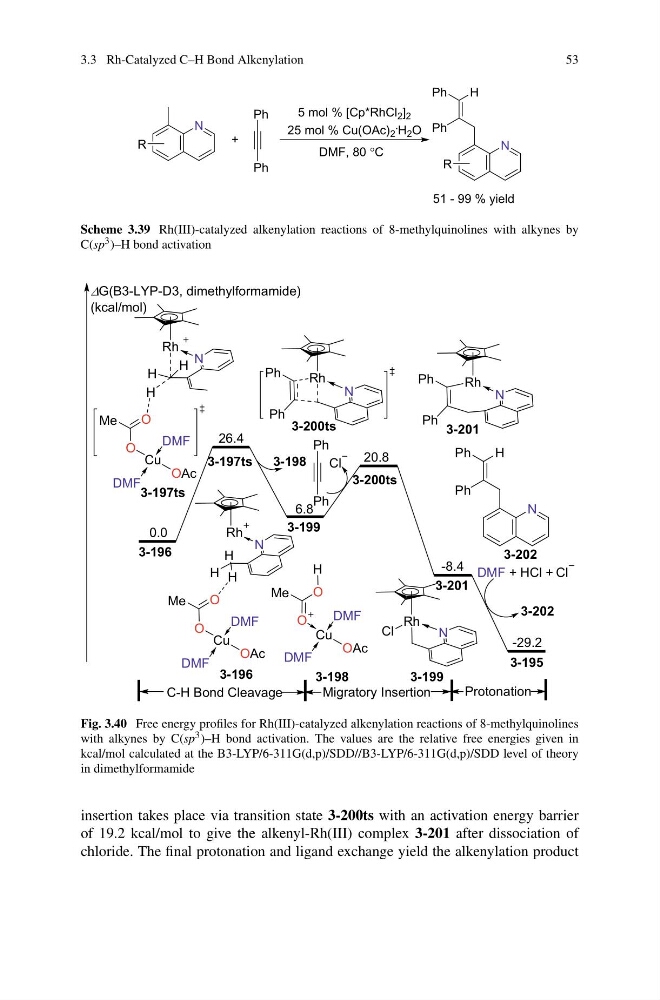
Scheme 3.39 Rh(III)-catalyzed alkenylation reactions of 8-methylquinolines with alkynes by
C(sp 3 )–H bond activation
G(B3-LYP-D3, dimethylformamide)
(kcal/mol)
3-196
0.0
3-197ts
26.4
3-199
6.8
C-H Bond Cleavage
Migratory Insertion
3-201
-8.4
3-195
-29.2
Protonation
3-200ts
20.8
3-197ts
3-196
3-198
Cu
O
OAc
DMF
DMF
O
Me
H
3-198
3-199
Ph
Ph
3-200ts
3-201
Cl
DMF + HCl +
3-202
3-202
N
Ph
H
Ph
Cl
Rh
N
H
H
H
Cu
O
OAc
DMF
DMF
O
Me
Rh
N
H
H
H
Cu
O
OAc
DMF
DMF
O
Me
Rh
N
Cl
Rh
N
Ph
Ph
Rh
N
Ph
Ph
Fig. 3.40 Free energy profiles for Rh(III)-catalyzed alkenylation reactions of 8-methylquinolines
with alkynes by C(sp 3 )–H bond activation. The values are the relative free energies given in
kcal/mol calculated at the B3-LYP/6-311G(d,p)/SDD//B3-LYP/6-311G(d,p)/SDD level of theory
in dimethylformamide
insertion takes place via transition state 3-200ts with an activation energy barrier
of 19.2 kcal/mol to give the alkenyl-Rh(III) complex 3-201 after dissociation of
chloride. The final protonation and ligand exchange yield the alkenylation product
53
5 mol % [Cp*RhCl 2 ] 2
25 mol % Cu(OAc) 2
. H 2 O
DMF, 80 C
+
51 - 99 % yield
N
Ph
Ph
N
Ph
H
Ph
R
R
Scheme 3.39 Rh(III)-catalyzed alkenylation reactions of 8-methylquinolines with alkynes by
C(sp 3 )–H bond activation
G(B3-LYP-D3, dimethylformamide)
(kcal/mol)
3-196
0.0
3-197ts
26.4
3-199
6.8
C-H Bond Cleavage
Migratory Insertion
3-201
-8.4
3-195
-29.2
Protonation
3-200ts
20.8
3-197ts
3-196
3-198
Cu
O
OAc
DMF
DMF
O
Me
H
3-198
3-199
Ph
Ph
3-200ts
3-201
Cl
DMF + HCl +
3-202
3-202
N
Ph
H
Ph
Cl
Rh
N
H
H
H
Cu
O
OAc
DMF
DMF
O
Me
Rh
N
H
H
H
Cu
O
OAc
DMF
DMF
O
Me
Rh
N
Cl
Rh
N
Ph
Ph
Rh
N
Ph
Ph
Fig. 3.40 Free energy profiles for Rh(III)-catalyzed alkenylation reactions of 8-methylquinolines
with alkynes by C(sp 3 )–H bond activation. The values are the relative free energies given in
kcal/mol calculated at the B3-LYP/6-311G(d,p)/SDD//B3-LYP/6-311G(d,p)/SDD level of theory
in dimethylformamide
insertion takes place via transition state 3-200ts with an activation energy barrier
of 19.2 kcal/mol to give the alkenyl-Rh(III) complex 3-201 after dissociation of
chloride. The final protonation and ligand exchange yield the alkenylation product