

3.3 Rh-Catalyzed C–H Bond Alkenylation
55
3-203
0.0
G(M06, DMF)
(kcal/mol)
3-205ts
3.2
3-206
-7.2
3-207ts
13.1
3-208
-7.8
C-H Bond Cleavage
Migratory Insertion
-36.0
3-212ts
-14.2
3-213
-29.6
Protonation
3-210ts
8.1
3-204
3-211
3-214ts
-23.8
3-215
-99.1
3-216ts
-77.6
3-217
-101.1
3-218ts
-87.3
3-203
-117.3
3-203
N
H
OPiv
O
3-204
3-204
3-206
HOPiv
3-207ts
HOPiv
3-208
O
O
3-209
3-209
3-210ts
3-211
3-212ts
3-213
3-214ts
3-215
3-216ts
3-217
HOPiv
3-218ts
N
O
O
H
Me
O
3-219
3-219
N-H Bond Cleavage
Reductive Elimination
Oxidation Addition
Migratory Insertion
Rh
PivO
OPiv
Rh
PivO
N
PivO
O
H
O
O
t Bu
Rh
N
PivO
O
OPiv
Rh
N
PivO
O
Rh
PivO
N
PivO
O
O
O
t Bu
H
Rh
N
PivO
O
H
O
O
Rh
N
O
H
O
O
O
O
t Bu
Rh
N
O
H
O
O
O
O
t Bu
Rh
O
O
O
O
t Bu
N
O
Rh
O
O
O
O
N
O
t Bu
Rh
O
O
N
O
PivO
Rh
O
O
N
O
PivO
Rh
PivO
N
O
O
O
Me
H
O
O
t Bu
H
Rh
PivO
N
O
O
O
Me
H
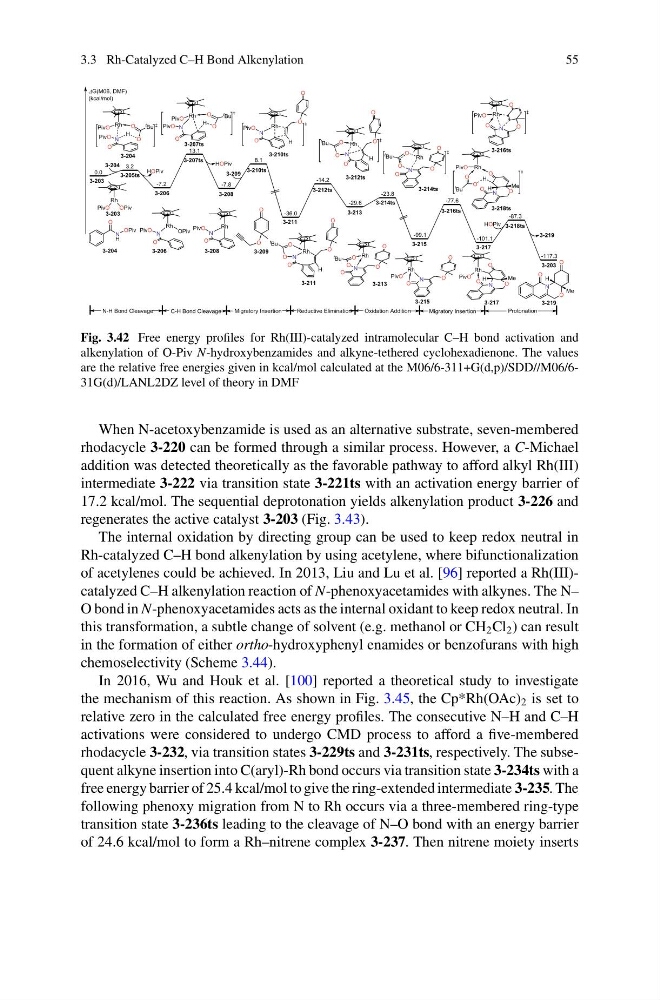
Fig. 3.42 Free energy profiles for Rh(III)-catalyzed intramolecular C–H bond activation and
alkenylation of O-Piv N-hydroxybenzamides and alkyne-tethered cyclohexadienone. The values
are the relative free energies given in kcal/mol calculated at the M06/6-311+G(d,p)/SDD//M06/631G(d)/LANL2DZ level of theory in DMF
When N-acetoxybenzamide is used as an alternative substrate, seven-membered
rhodacycle 3-220 can be formed through a similar process. However, a C-Michael
addition was detected theoretically as the favorable pathway to afford alkyl Rh(III)
intermediate 3-222 via transition state 3-221ts with an activation energy barrier of
17.2 kcal/mol. The sequential deprotonation yields alkenylation product 3-226 and
regenerates the active catalyst 3-203 (Fig. 3.43).
The internal oxidation by directing group can be used to keep redox neutral in
Rh-catalyzed C–H bond alkenylation by using acetylene, where bifunctionalization
of acetylenes could be achieved. In 2013, Liu and Lu et al. [96] reported a Rh(III)catalyzed C–H alkenylation reaction of N-phenoxyacetamides with alkynes. The N–
O bond in N-phenoxyacetamides acts as the internal oxidant to keep redox neutral. In
this transformation, a subtle change of solvent (e.g. methanol or CH 2 Cl 2 ) can result
in the formation of either ortho-hydroxyphenyl enamides or benzofurans with high
chemoselectivity (Scheme 3.44).
In 2016, Wu and Houk et al. [100] reported a theoretical study to investigate
the mechanism of this reaction. As shown in Fig. 3.45, the Cp*Rh(OAc) 2 is set to
relative zero in the calculated free energy profiles. The consecutive N–H and C–H
activations were considered to undergo CMD process to afford a five-membered
rhodacycle 3-232, via transition states 3-229ts and 3-231ts, respectively. The subsequent alkyne insertion into C(aryl)-Rh bond occurs via transition state 3-234ts with a
free energy barrier of 25.4 kcal/mol to give the ring-extended intermediate 3-235. The
following phenoxy migration from N to Rh occurs via a three-membered ring-type
transition state 3-236ts leading to the cleavage of N–O bond with an energy barrier
of 24.6 kcal/mol to form a Rh–nitrene complex 3-237. Then nitrene moiety inserts
55
3-203
0.0
G(M06, DMF)
(kcal/mol)
3-205ts
3.2
3-206
-7.2
3-207ts
13.1
3-208
-7.8
C-H Bond Cleavage
Migratory Insertion
-36.0
3-212ts
-14.2
3-213
-29.6
Protonation
3-210ts
8.1
3-204
3-211
3-214ts
-23.8
3-215
-99.1
3-216ts
-77.6
3-217
-101.1
3-218ts
-87.3
3-203
-117.3
3-203
N
H
OPiv
O
3-204
3-204
3-206
HOPiv
3-207ts
HOPiv
3-208
O
O
3-209
3-209
3-210ts
3-211
3-212ts
3-213
3-214ts
3-215
3-216ts
3-217
HOPiv
3-218ts
N
O
O
H
Me
O
3-219
3-219
N-H Bond Cleavage
Reductive Elimination
Oxidation Addition
Migratory Insertion
Rh
PivO
OPiv
Rh
PivO
N
PivO
O
H
O
O
t Bu
Rh
N
PivO
O
OPiv
Rh
N
PivO
O
Rh
PivO
N
PivO
O
O
O
t Bu
H
Rh
N
PivO
O
H
O
O
Rh
N
O
H
O
O
O
O
t Bu
Rh
N
O
H
O
O
O
O
t Bu
Rh
O
O
O
O
t Bu
N
O
Rh
O
O
O
O
N
O
t Bu
Rh
O
O
N
O
PivO
Rh
O
O
N
O
PivO
Rh
PivO
N
O
O
O
Me
H
O
O
t Bu
H
Rh
PivO
N
O
O
O
Me
H
Fig. 3.42 Free energy profiles for Rh(III)-catalyzed intramolecular C–H bond activation and
alkenylation of O-Piv N-hydroxybenzamides and alkyne-tethered cyclohexadienone. The values
are the relative free energies given in kcal/mol calculated at the M06/6-311+G(d,p)/SDD//M06/631G(d)/LANL2DZ level of theory in DMF
When N-acetoxybenzamide is used as an alternative substrate, seven-membered
rhodacycle 3-220 can be formed through a similar process. However, a C-Michael
addition was detected theoretically as the favorable pathway to afford alkyl Rh(III)
intermediate 3-222 via transition state 3-221ts with an activation energy barrier of
17.2 kcal/mol. The sequential deprotonation yields alkenylation product 3-226 and
regenerates the active catalyst 3-203 (Fig. 3.43).
The internal oxidation by directing group can be used to keep redox neutral in
Rh-catalyzed C–H bond alkenylation by using acetylene, where bifunctionalization
of acetylenes could be achieved. In 2013, Liu and Lu et al. [96] reported a Rh(III)catalyzed C–H alkenylation reaction of N-phenoxyacetamides with alkynes. The N–
O bond in N-phenoxyacetamides acts as the internal oxidant to keep redox neutral. In
this transformation, a subtle change of solvent (e.g. methanol or CH 2 Cl 2 ) can result
in the formation of either ortho-hydroxyphenyl enamides or benzofurans with high
chemoselectivity (Scheme 3.44).
In 2016, Wu and Houk et al. [100] reported a theoretical study to investigate
the mechanism of this reaction. As shown in Fig. 3.45, the Cp*Rh(OAc) 2 is set to
relative zero in the calculated free energy profiles. The consecutive N–H and C–H
activations were considered to undergo CMD process to afford a five-membered
rhodacycle 3-232, via transition states 3-229ts and 3-231ts, respectively. The subsequent alkyne insertion into C(aryl)-Rh bond occurs via transition state 3-234ts with a
free energy barrier of 25.4 kcal/mol to give the ring-extended intermediate 3-235. The
following phenoxy migration from N to Rh occurs via a three-membered ring-type
transition state 3-236ts leading to the cleavage of N–O bond with an energy barrier
of 24.6 kcal/mol to form a Rh–nitrene complex 3-237. Then nitrene moiety inserts