

50
3 Theoretical Study of Rh-Catalyzed …
3-170. After releasing of alkenylated product 3-171, active catalytic complex 3-163
is regenerated by the oxidation of Cu(OAc) 2 .
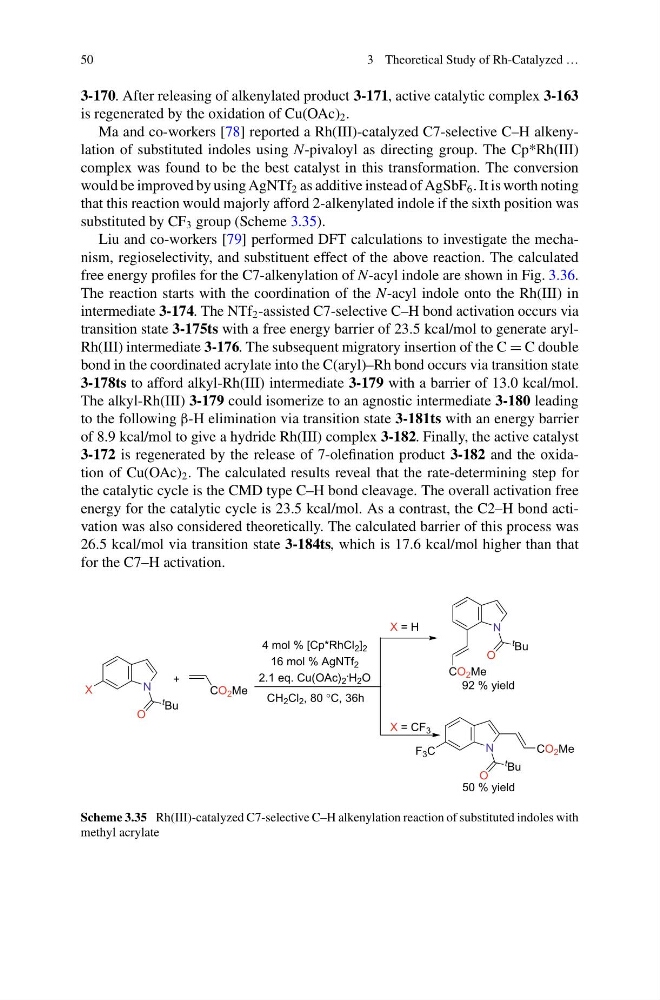
Ma and co-workers [78] reported a Rh(III)-catalyzed C7-selective C–H alkenylation of substituted indoles using N-pivaloyl as directing group. The Cp*Rh(III)
complex was found to be the best catalyst in this transformation. The conversion
would be improved by using AgNTf 2 as additive instead of AgSbF 6 . It is worth noting
that this reaction would majorly afford 2-alkenylated indole if the sixth position was
substituted by CF 3 group (Scheme 3.35).
Liu and co-workers [79] performed DFT calculations to investigate the mechanism, regioselectivity, and substituent effect of the above reaction. The calculated
free energy profiles for the C7-alkenylation of N-acyl indole are shown in Fig. 3.36.
The reaction starts with the coordination of the N-acyl indole onto the Rh(III) in
intermediate 3-174. The NTf 2 -assisted C7-selective C–H bond activation occurs via
transition state 3-175ts with a free energy barrier of 23.5 kcal/mol to generate arylRh(III) intermediate 3-176. The subsequent migratory insertion of the C = C double
bond in the coordinated acrylate into the C(aryl)–Rh bond occurs via transition state
3-178ts to afford alkyl-Rh(III) intermediate 3-179 with a barrier of 13.0 kcal/mol.
The alkyl-Rh(III) 3-179 could isomerize to an agnostic intermediate 3-180 leading
to the following β-H elimination via transition state 3-181ts with an energy barrier
of 8.9 kcal/mol to give a hydride Rh(III) complex 3-182. Finally, the active catalyst
3-172 is regenerated by the release of 7-olefination product 3-182 and the oxidation of Cu(OAc) 2 . The calculated results reveal that the rate-determining step for
the catalytic cycle is the CMD type C–H bond cleavage. The overall activation free
energy for the catalytic cycle is 23.5 kcal/mol. As a contrast, the C2–H bond activation was also considered theoretically. The calculated barrier of this process was
26.5 kcal/mol via transition state 3-184ts, which is 17.6 kcal/mol higher than that
for the C7–H activation.
4 mol % [Cp*RhCl 2 ] 2
16 mol % AgNTf 2
2.1 eq. Cu(OAc) 2
. H 2 O
CH 2 Cl 2 , 80 C, 36h
+
CO 2 Me
N
t Bu
O
X
X = H
X = CF 3
N
t Bu
O
CO 2 Me
92 % yield
N
t Bu
O
50 % yield
F 3 C
CO 2 Me
Scheme 3.35 Rh(III)-catalyzed C7-selective C–H alkenylation reaction of substituted indoles with
methyl acrylate
3 Theoretical Study of Rh-Catalyzed …
3-170. After releasing of alkenylated product 3-171, active catalytic complex 3-163
is regenerated by the oxidation of Cu(OAc) 2 .
Ma and co-workers [78] reported a Rh(III)-catalyzed C7-selective C–H alkenylation of substituted indoles using N-pivaloyl as directing group. The Cp*Rh(III)
complex was found to be the best catalyst in this transformation. The conversion
would be improved by using AgNTf 2 as additive instead of AgSbF 6 . It is worth noting
that this reaction would majorly afford 2-alkenylated indole if the sixth position was
substituted by CF 3 group (Scheme 3.35).
Liu and co-workers [79] performed DFT calculations to investigate the mechanism, regioselectivity, and substituent effect of the above reaction. The calculated
free energy profiles for the C7-alkenylation of N-acyl indole are shown in Fig. 3.36.
The reaction starts with the coordination of the N-acyl indole onto the Rh(III) in
intermediate 3-174. The NTf 2 -assisted C7-selective C–H bond activation occurs via
transition state 3-175ts with a free energy barrier of 23.5 kcal/mol to generate arylRh(III) intermediate 3-176. The subsequent migratory insertion of the C = C double
bond in the coordinated acrylate into the C(aryl)–Rh bond occurs via transition state
3-178ts to afford alkyl-Rh(III) intermediate 3-179 with a barrier of 13.0 kcal/mol.
The alkyl-Rh(III) 3-179 could isomerize to an agnostic intermediate 3-180 leading
to the following β-H elimination via transition state 3-181ts with an energy barrier
of 8.9 kcal/mol to give a hydride Rh(III) complex 3-182. Finally, the active catalyst
3-172 is regenerated by the release of 7-olefination product 3-182 and the oxidation of Cu(OAc) 2 . The calculated results reveal that the rate-determining step for
the catalytic cycle is the CMD type C–H bond cleavage. The overall activation free
energy for the catalytic cycle is 23.5 kcal/mol. As a contrast, the C2–H bond activation was also considered theoretically. The calculated barrier of this process was
26.5 kcal/mol via transition state 3-184ts, which is 17.6 kcal/mol higher than that
for the C7–H activation.
4 mol % [Cp*RhCl 2 ] 2
16 mol % AgNTf 2
2.1 eq. Cu(OAc) 2
. H 2 O
CH 2 Cl 2 , 80 C, 36h
+
CO 2 Me
N
t Bu
O
X
X = H
X = CF 3
N
t Bu
O
CO 2 Me
92 % yield
N
t Bu
O
50 % yield
F 3 C
CO 2 Me
Scheme 3.35 Rh(III)-catalyzed C7-selective C–H alkenylation reaction of substituted indoles with
methyl acrylate