

3.3 Rh-Catalyzed C–H Bond Alkenylation
49
1 mol % [Cp*RhCl 2 ] 2
4 mol % AgSbF 6
2 eq. Cu(OAc) 2
THP, 110 C, 24h
+
50 - 82 % yield
O
N
O
R
COO
n Bu
O
N
O
R
COO
n Bu
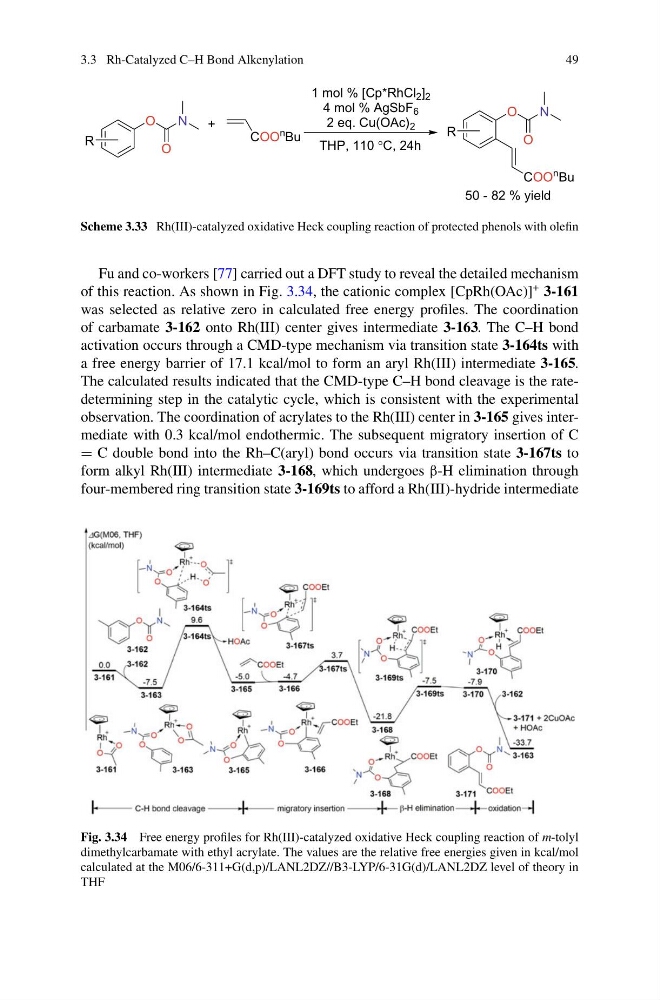
Scheme 3.33 Rh(III)-catalyzed oxidative Heck coupling reaction of protected phenols with olefin
Fu and co-workers [77] carried out a DFT study to reveal the detailed mechanism
of this reaction. As shown in Fig. 3.34, the cationic complex [CpRh(OAc)]
+ 3-161
was selected as relative zero in calculated free energy profiles. The coordination
of carbamate 3-162 onto Rh(III) center gives intermediate 3-163. The C–H bond
activation occurs through a CMD-type mechanism via transition state 3-164ts with
a free energy barrier of 17.1 kcal/mol to form an aryl Rh(III) intermediate 3-165.
The calculated results indicated that the CMD-type C–H bond cleavage is the ratedetermining step in the catalytic cycle, which is consistent with the experimental
observation. The coordination of acrylates to the Rh(III) center in 3-165 gives intermediate with 0.3 kcal/mol endothermic. The subsequent migratory insertion of C
= C double bond into the Rh–C(aryl) bond occurs via transition state 3-167ts to
form alkyl Rh(III) intermediate 3-168, which undergoes β-H elimination through
four-membered ring transition state 3-169ts to afford a Rh(III)-hydride intermediate
Fig. 3.34 Free energy profiles for Rh(III)-catalyzed oxidative Heck coupling reaction of m-tolyl
dimethylcarbamate with ethyl acrylate. The values are the relative free energies given in kcal/mol
calculated at the M06/6-311+G(d,p)/LANL2DZ//B3-LYP/6-31G(d)/LANL2DZ level of theory in
THF
49
1 mol % [Cp*RhCl 2 ] 2
4 mol % AgSbF 6
2 eq. Cu(OAc) 2
THP, 110 C, 24h
+
50 - 82 % yield
O
N
O
R
COO
n Bu
O
N
O
R
COO
n Bu
Scheme 3.33 Rh(III)-catalyzed oxidative Heck coupling reaction of protected phenols with olefin
Fu and co-workers [77] carried out a DFT study to reveal the detailed mechanism
of this reaction. As shown in Fig. 3.34, the cationic complex [CpRh(OAc)]
+ 3-161
was selected as relative zero in calculated free energy profiles. The coordination
of carbamate 3-162 onto Rh(III) center gives intermediate 3-163. The C–H bond
activation occurs through a CMD-type mechanism via transition state 3-164ts with
a free energy barrier of 17.1 kcal/mol to form an aryl Rh(III) intermediate 3-165.
The calculated results indicated that the CMD-type C–H bond cleavage is the ratedetermining step in the catalytic cycle, which is consistent with the experimental
observation. The coordination of acrylates to the Rh(III) center in 3-165 gives intermediate with 0.3 kcal/mol endothermic. The subsequent migratory insertion of C
= C double bond into the Rh–C(aryl) bond occurs via transition state 3-167ts to
form alkyl Rh(III) intermediate 3-168, which undergoes β-H elimination through
four-membered ring transition state 3-169ts to afford a Rh(III)-hydride intermediate
Fig. 3.34 Free energy profiles for Rh(III)-catalyzed oxidative Heck coupling reaction of m-tolyl
dimethylcarbamate with ethyl acrylate. The values are the relative free energies given in kcal/mol
calculated at the M06/6-311+G(d,p)/LANL2DZ//B3-LYP/6-31G(d)/LANL2DZ level of theory in
THF