

48
3 Theoretical Study of Rh-Catalyzed …
The protonation of 3-151 by [QNO-H]
+ via transition state 3-152ts yields alkylation
product 3-154 and regenerates active catalyst 3-144.
3.3 Rh-Catalyzed C–H Bond Alkenylation
3.3.1 C–H Bond Alkenylation by Using Olefins
Olefins can be considered as the nucleophile to undertake oxidative coupling with the
C–H bond in arenes using a Rh(III) catalyst in the presence of an external oxidant,
which can be mechanistically considered as an oxidative Heck-type coupling [13,
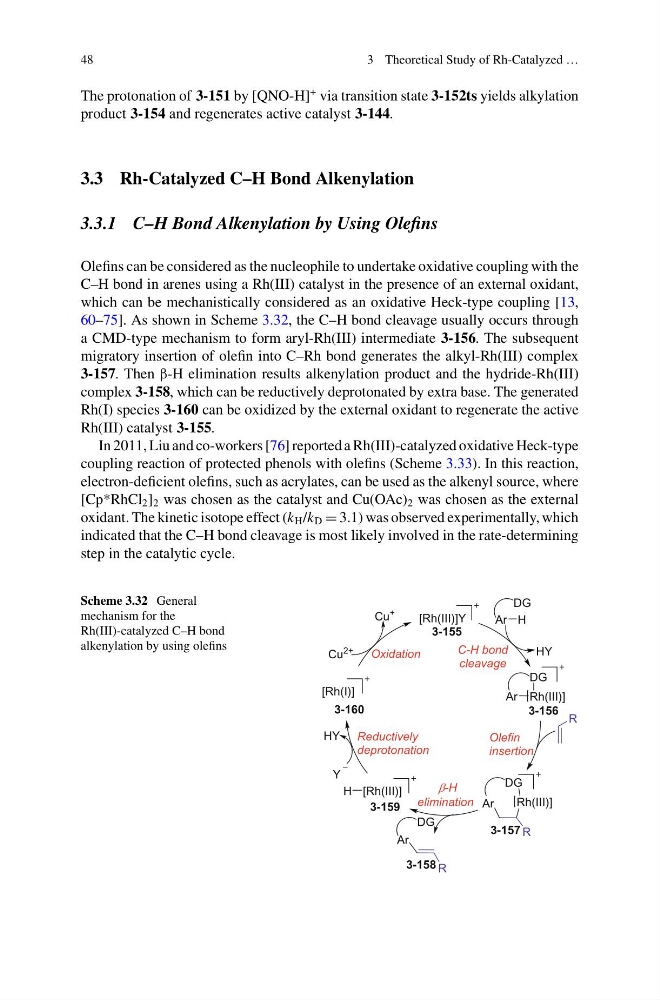
60–75]. As shown in Scheme 3.32, the C–H bond cleavage usually occurs through
a CMD-type mechanism to form aryl-Rh(III) intermediate 3-156. The subsequent
migratory insertion of olefin into C–Rh bond generates the alkyl-Rh(III) complex
3-157. Then β-H elimination results alkenylation product and the hydride-Rh(III)
complex 3-158, which can be reductively deprotonated by extra base. The generated
Rh(I) species 3-160 can be oxidized by the external oxidant to regenerate the active
Rh(III) catalyst 3-155.
In 2011, Liu and co-workers [76] reported a Rh(III)-catalyzed oxidative Heck-type
coupling reaction of protected phenols with olefins (Scheme 3.33). In this reaction,
electron-deficient olefins, such as acrylates, can be used as the alkenyl source, where
[Cp*RhCl 2 ] 2 was chosen as the catalyst and Cu(OAc) 2 was chosen as the external
oxidant. The kinetic isotope effect (k H /k D = 3.1) was observed experimentally, which
indicated that the C–H bond cleavage is most likely involved in the rate-determining
step in the catalytic cycle.
Scheme 3.32 General
mechanism for the
Rh(III)-catalyzed C–H bond
alkenylation by using olefins
[Rh(III)]Y
Ar H
DG
HY
Ar
DG
Rh(III)]
3-157
3-156
[Rh(III)]
Oxidation
Cu
2+
3-155
3-159
Olefin
insertion
-H
elimination
C-H bond
cleavage
Cu
+
DG
Rh(III)]
R
Ar
DG
Ar
3-158
H
[Rh(I)]
3-160
Y
Reductively
deprotonation
R
R
HY
3 Theoretical Study of Rh-Catalyzed …
The protonation of 3-151 by [QNO-H]
+ via transition state 3-152ts yields alkylation
product 3-154 and regenerates active catalyst 3-144.
3.3 Rh-Catalyzed C–H Bond Alkenylation
3.3.1 C–H Bond Alkenylation by Using Olefins
Olefins can be considered as the nucleophile to undertake oxidative coupling with the
C–H bond in arenes using a Rh(III) catalyst in the presence of an external oxidant,
which can be mechanistically considered as an oxidative Heck-type coupling [13,
60–75]. As shown in Scheme 3.32, the C–H bond cleavage usually occurs through
a CMD-type mechanism to form aryl-Rh(III) intermediate 3-156. The subsequent
migratory insertion of olefin into C–Rh bond generates the alkyl-Rh(III) complex
3-157. Then β-H elimination results alkenylation product and the hydride-Rh(III)
complex 3-158, which can be reductively deprotonated by extra base. The generated
Rh(I) species 3-160 can be oxidized by the external oxidant to regenerate the active
Rh(III) catalyst 3-155.
In 2011, Liu and co-workers [76] reported a Rh(III)-catalyzed oxidative Heck-type
coupling reaction of protected phenols with olefins (Scheme 3.33). In this reaction,
electron-deficient olefins, such as acrylates, can be used as the alkenyl source, where
[Cp*RhCl 2 ] 2 was chosen as the catalyst and Cu(OAc) 2 was chosen as the external
oxidant. The kinetic isotope effect (k H /k D = 3.1) was observed experimentally, which
indicated that the C–H bond cleavage is most likely involved in the rate-determining
step in the catalytic cycle.
Scheme 3.32 General
mechanism for the
Rh(III)-catalyzed C–H bond
alkenylation by using olefins
[Rh(III)]Y
Ar H
DG
HY
Ar
DG
Rh(III)]
3-157
3-156
[Rh(III)]
Oxidation
Cu
2+
3-155
3-159
Olefin
insertion
-H
elimination
C-H bond
cleavage
Cu
+
DG
Rh(III)]
R
Ar
DG
Ar
3-158
H
[Rh(I)]
3-160
Y
Reductively
deprotonation
R
R
HY