

3.3 Rh-Catalyzed C–H Bond Alkenylation
51
3-172
3-174
0.0
-14.6
G(M06, dichloromethane)
(kcal/mol)
3-176ts
8.9
3-176
-4.9
3-177
-3.9
3-178ts
8.1
C-H Bond Cleavage
3-179
-10.8
Migratory Insertion
3-181ts
5.3
3-182
-0.2
3-172
-19.7
-H Elimination
COOMe
3-173
2Cu(OAc)2 + AgNTf2
3-183 + 2CuOAc
+ HOAc + AgOAc
Oxidation
3-172
N
t Bu
O
3-174
3-175ts
HNTf2
3-176
3-177
3-178ts
3-179
3-181ts
3-182
N
t Bu
O
COOMe
3-183
3-180
-3.6
3-180
3-184ts
26.5
Rh
N
S
S
O
O
F3C
O
O
CF3
Rh
N
S
S O
O
F3C
O
O
F3C
N
t Bu
O
Rh
N
S
S
O
O
F3C
O
O
F3C
N
t Bu
O
H
Rh
N
S
S
O
O
F3C
O
O
F3C
H
O t Bu
N
3-184ts
Rh
N
t Bu
O
Rh
N
t Bu
O
COOMe
Rh
N
t Bu
O
COOMe
Rh
N
t Bu
O
COOMe
Rh
N
t Bu
O
COOMe
H
Rh
N
t Bu
O
COOMe
H
Rh
N
t Bu
O
COOMe
H
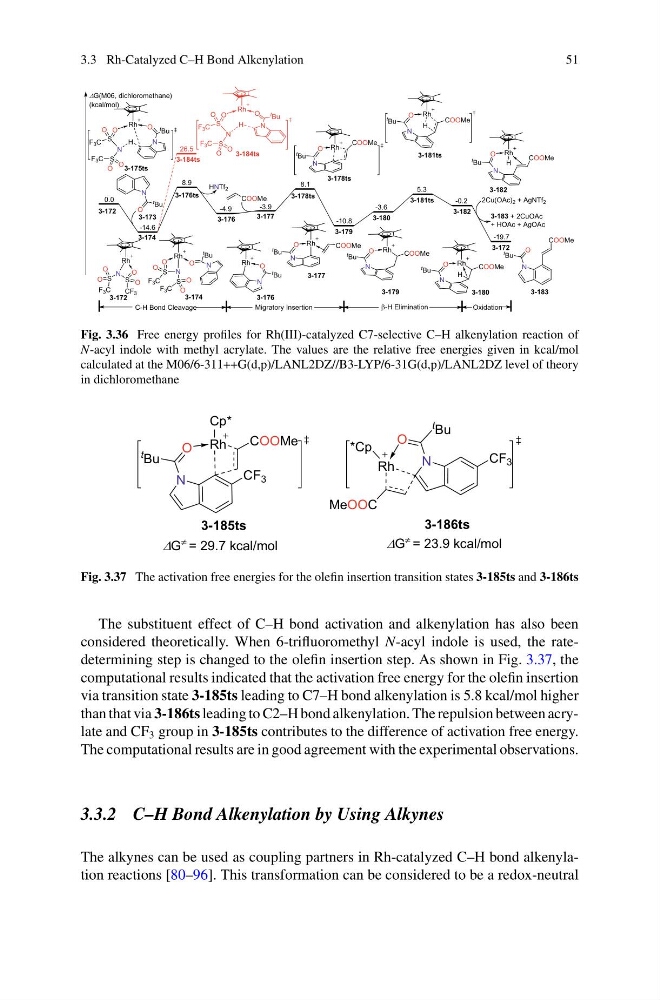
Fig. 3.36 Free energy profiles for Rh(III)-catalyzed C7-selective C–H alkenylation reaction of
N-acyl indole with methyl acrylate. The values are the relative free energies given in kcal/mol
calculated at the M06/6-311++G(d,p)/LANL2DZ//B3-LYP/6-31G(d,p)/LANL2DZ level of theory
in dichloromethane
3-185ts
G
= 29.7 kcal/mol
3-186ts
G
= 23.9 kcal/mol
Rh
Cp*
N
t Bu
O
COOMe
CF 3
CF 3
O
t Bu
MeOOC
N
*Cp
Rh
Fig. 3.37 The activation free energies for the olefin insertion transition states 3-185ts and 3-186ts
The substituent effect of C–H bond activation and alkenylation has also been
considered theoretically. When 6-trifluoromethyl N-acyl indole is used, the ratedetermining step is changed to the olefin insertion step. As shown in Fig. 3.37, the
computational results indicated that the activation free energy for the olefin insertion
via transition state 3-185ts leading to C7–H bond alkenylation is 5.8 kcal/mol higher
than that via 3-186ts leading to C2–H bond alkenylation. The repulsion between acrylate and CF 3 group in 3-185ts contributes to the difference of activation free energy.
The computational results are in good agreement with the experimental observations.
3.3.2 C–H Bond Alkenylation by Using Alkynes
The alkynes can be used as coupling partners in Rh-catalyzed C–H bond alkenylation reactions [80–96]. This transformation can be considered to be a redox-neutral
51
3-172
3-174
0.0
-14.6
G(M06, dichloromethane)
(kcal/mol)
3-176ts
8.9
3-176
-4.9
3-177
-3.9
3-178ts
8.1
C-H Bond Cleavage
3-179
-10.8
Migratory Insertion
3-181ts
5.3
3-182
-0.2
3-172
-19.7
-H Elimination
COOMe
3-173
2Cu(OAc)2 + AgNTf2
3-183 + 2CuOAc
+ HOAc + AgOAc
Oxidation
3-172
N
t Bu
O
3-174
3-175ts
HNTf2
3-176
3-177
3-178ts
3-179
3-181ts
3-182
N
t Bu
O
COOMe
3-183
3-180
-3.6
3-180
3-184ts
26.5
Rh
N
S
S
O
O
F3C
O
O
CF3
Rh
N
S
S O
O
F3C
O
O
F3C
N
t Bu
O
Rh
N
S
S
O
O
F3C
O
O
F3C
N
t Bu
O
H
Rh
N
S
S
O
O
F3C
O
O
F3C
H
O t Bu
N
3-184ts
Rh
N
t Bu
O
Rh
N
t Bu
O
COOMe
Rh
N
t Bu
O
COOMe
Rh
N
t Bu
O
COOMe
Rh
N
t Bu
O
COOMe
H
Rh
N
t Bu
O
COOMe
H
Rh
N
t Bu
O
COOMe
H
Fig. 3.36 Free energy profiles for Rh(III)-catalyzed C7-selective C–H alkenylation reaction of
N-acyl indole with methyl acrylate. The values are the relative free energies given in kcal/mol
calculated at the M06/6-311++G(d,p)/LANL2DZ//B3-LYP/6-31G(d,p)/LANL2DZ level of theory
in dichloromethane
3-185ts
G
= 29.7 kcal/mol
3-186ts
G
= 23.9 kcal/mol
Rh
Cp*
N
t Bu
O
COOMe
CF 3
CF 3
O
t Bu
MeOOC
N
*Cp
Rh
Fig. 3.37 The activation free energies for the olefin insertion transition states 3-185ts and 3-186ts
The substituent effect of C–H bond activation and alkenylation has also been
considered theoretically. When 6-trifluoromethyl N-acyl indole is used, the ratedetermining step is changed to the olefin insertion step. As shown in Fig. 3.37, the
computational results indicated that the activation free energy for the olefin insertion
via transition state 3-185ts leading to C7–H bond alkenylation is 5.8 kcal/mol higher
than that via 3-186ts leading to C2–H bond alkenylation. The repulsion between acrylate and CF 3 group in 3-185ts contributes to the difference of activation free energy.
The computational results are in good agreement with the experimental observations.
3.3.2 C–H Bond Alkenylation by Using Alkynes
The alkynes can be used as coupling partners in Rh-catalyzed C–H bond alkenylation reactions [80–96]. This transformation can be considered to be a redox-neutral