

42
3 Theoretical Study of Rh-Catalyzed …
G = 30.6 kcal/mol
G = 36.7 kcal/mol
3-93ts
3-96ts
2.07
3.28
2.37
2.32
2.37
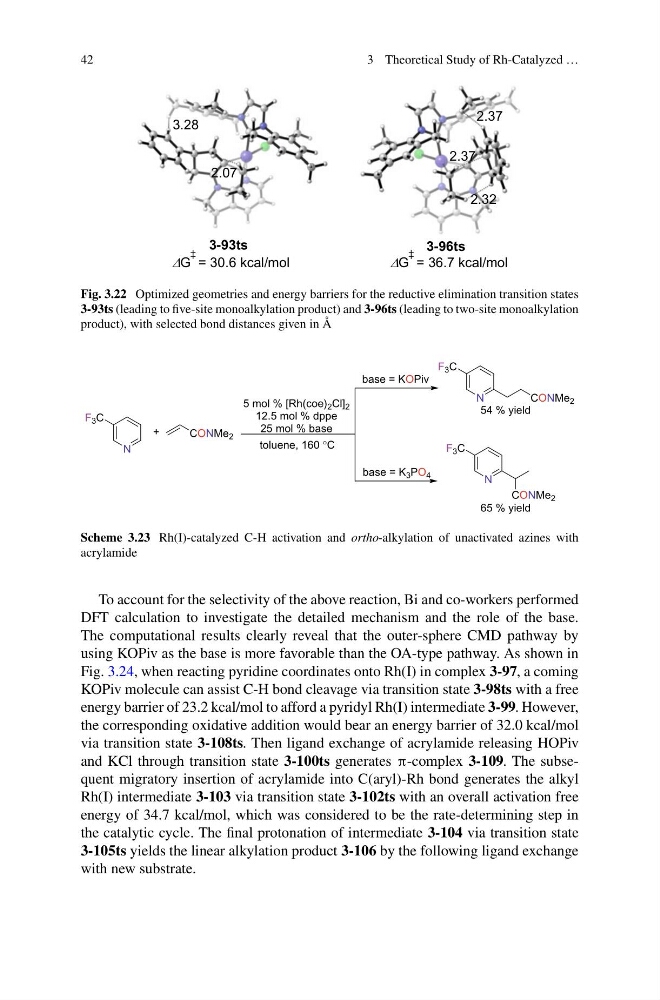
Fig. 3.22 Optimized geometries and energy barriers for the reductive elimination transition states
3-93ts (leading to five-site monoalkylation product) and 3-96ts (leading to two-site monoalkylation
product), with selected bond distances given in Å
5 mol % [Rh(coe) 2 Cl] 2
12.5 mol % dppe
25 mol % base
toluene, 160 C
+
54 % yield
N
F 3 C
CONMe 2
base = KOPiv
base = K 3 PO 4
N
F 3 C
CONMe 2
N
F 3 C
CONMe 2
65 % yield
Scheme 3.23 Rh(I)-catalyzed C-H activation and ortho-alkylation of unactivated azines with
acrylamide
To account for the selectivity of the above reaction, Bi and co-workers performed
DFT calculation to investigate the detailed mechanism and the role of the base.
The computational results clearly reveal that the outer-sphere CMD pathway by
using KOPiv as the base is more favorable than the OA-type pathway. As shown in
Fig. 3.24, when reacting pyridine coordinates onto Rh(I) in complex 3-97, a coming
KOPiv molecule can assist C-H bond cleavage via transition state 3-98ts with a free
energy barrier of 23.2 kcal/mol to afford a pyridyl Rh(I) intermediate 3-99. However,
the corresponding oxidative addition would bear an energy barrier of 32.0 kcal/mol
via transition state 3-108ts. Then ligand exchange of acrylamide releasing HOPiv
and KCl through transition state 3-100ts generates π-complex 3-109. The subsequent migratory insertion of acrylamide into C(aryl)-Rh bond generates the alkyl
Rh(I) intermediate 3-103 via transition state 3-102ts with an overall activation free
energy of 34.7 kcal/mol, which was considered to be the rate-determining step in
the catalytic cycle. The final protonation of intermediate 3-104 via transition state
3-105ts yields the linear alkylation product 3-106 by the following ligand exchange
with new substrate.
3 Theoretical Study of Rh-Catalyzed …
G = 30.6 kcal/mol
G = 36.7 kcal/mol
3-93ts
3-96ts
2.07
3.28
2.37
2.32
2.37
Fig. 3.22 Optimized geometries and energy barriers for the reductive elimination transition states
3-93ts (leading to five-site monoalkylation product) and 3-96ts (leading to two-site monoalkylation
product), with selected bond distances given in Å
5 mol % [Rh(coe) 2 Cl] 2
12.5 mol % dppe
25 mol % base
toluene, 160 C
+
54 % yield
N
F 3 C
CONMe 2
base = KOPiv
base = K 3 PO 4
N
F 3 C
CONMe 2
N
F 3 C
CONMe 2
65 % yield
Scheme 3.23 Rh(I)-catalyzed C-H activation and ortho-alkylation of unactivated azines with
acrylamide
To account for the selectivity of the above reaction, Bi and co-workers performed
DFT calculation to investigate the detailed mechanism and the role of the base.
The computational results clearly reveal that the outer-sphere CMD pathway by
using KOPiv as the base is more favorable than the OA-type pathway. As shown in
Fig. 3.24, when reacting pyridine coordinates onto Rh(I) in complex 3-97, a coming
KOPiv molecule can assist C-H bond cleavage via transition state 3-98ts with a free
energy barrier of 23.2 kcal/mol to afford a pyridyl Rh(I) intermediate 3-99. However,
the corresponding oxidative addition would bear an energy barrier of 32.0 kcal/mol
via transition state 3-108ts. Then ligand exchange of acrylamide releasing HOPiv
and KCl through transition state 3-100ts generates π-complex 3-109. The subsequent migratory insertion of acrylamide into C(aryl)-Rh bond generates the alkyl
Rh(I) intermediate 3-103 via transition state 3-102ts with an overall activation free
energy of 34.7 kcal/mol, which was considered to be the rate-determining step in
the catalytic cycle. The final protonation of intermediate 3-104 via transition state
3-105ts yields the linear alkylation product 3-106 by the following ligand exchange
with new substrate.