

3.2 Rh-Catalyzed C–H Bond Alkylation
41
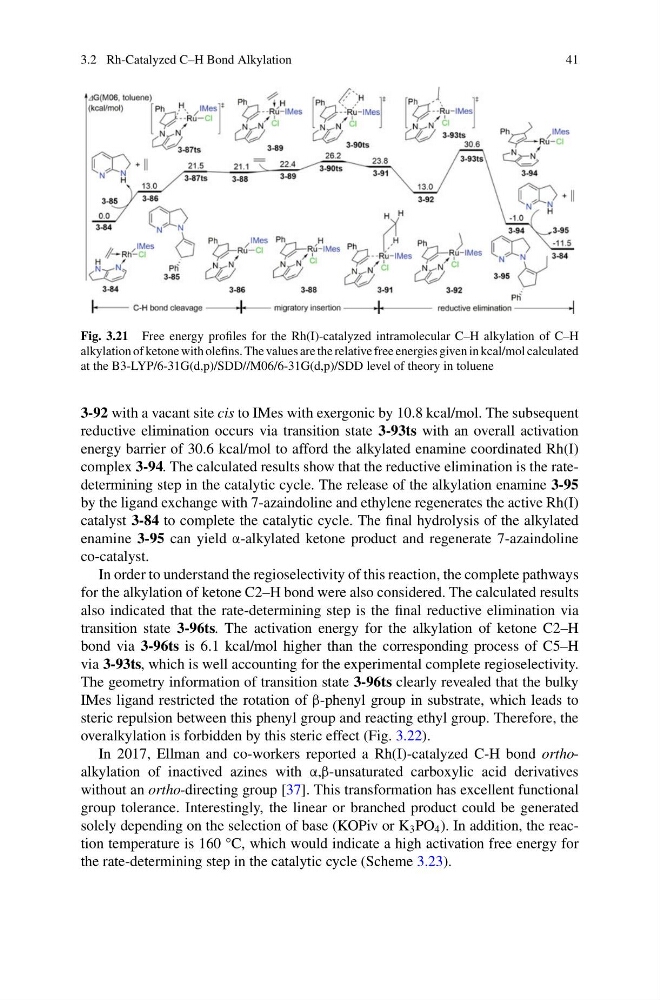
Fig. 3.21 Free energy profiles for the Rh(I)-catalyzed intramolecular C–H alkylation of C–H
alkylation of ketone with olefins. The values are the relative free energies given in kcal/mol calculated
at the B3-LYP/6-31G(d,p)/SDD//M06/6-31G(d,p)/SDD level of theory in toluene
3-92 with a vacant site cis to IMes with exergonic by 10.8 kcal/mol. The subsequent
reductive elimination occurs via transition state 3-93ts with an overall activation
energy barrier of 30.6 kcal/mol to afford the alkylated enamine coordinated Rh(I)
complex 3-94. The calculated results show that the reductive elimination is the ratedetermining step in the catalytic cycle. The release of the alkylation enamine 3-95
by the ligand exchange with 7-azaindoline and ethylene regenerates the active Rh(I)
catalyst 3-84 to complete the catalytic cycle. The final hydrolysis of the alkylated
enamine 3-95 can yield α-alkylated ketone product and regenerate 7-azaindoline
co-catalyst.
In order to understand the regioselectivity of this reaction, the complete pathways
for the alkylation of ketone C2–H bond were also considered. The calculated results
also indicated that the rate-determining step is the final reductive elimination via
transition state 3-96ts. The activation energy for the alkylation of ketone C2–H
bond via 3-96ts is 6.1 kcal/mol higher than the corresponding process of C5–H
via 3-93ts, which is well accounting for the experimental complete regioselectivity.
The geometry information of transition state 3-96ts clearly revealed that the bulky
IMes ligand restricted the rotation of β-phenyl group in substrate, which leads to
steric repulsion between this phenyl group and reacting ethyl group. Therefore, the
overalkylation is forbidden by this steric effect (Fig. 3.22).
In 2017, Ellman and co-workers reported a Rh(I)-catalyzed C-H bond orthoalkylation of inactived azines with α,β-unsaturated carboxylic acid derivatives
without an ortho-directing group [37]. This transformation has excellent functional
group tolerance. Interestingly, the linear or branched product could be generated
solely depending on the selection of base (KOPiv or K 3 PO 4 ). In addition, the reaction temperature is 160 °C, which would indicate a high activation free energy for
the rate-determining step in the catalytic cycle (Scheme 3.23).
41
Fig. 3.21 Free energy profiles for the Rh(I)-catalyzed intramolecular C–H alkylation of C–H
alkylation of ketone with olefins. The values are the relative free energies given in kcal/mol calculated
at the B3-LYP/6-31G(d,p)/SDD//M06/6-31G(d,p)/SDD level of theory in toluene
3-92 with a vacant site cis to IMes with exergonic by 10.8 kcal/mol. The subsequent
reductive elimination occurs via transition state 3-93ts with an overall activation
energy barrier of 30.6 kcal/mol to afford the alkylated enamine coordinated Rh(I)
complex 3-94. The calculated results show that the reductive elimination is the ratedetermining step in the catalytic cycle. The release of the alkylation enamine 3-95
by the ligand exchange with 7-azaindoline and ethylene regenerates the active Rh(I)
catalyst 3-84 to complete the catalytic cycle. The final hydrolysis of the alkylated
enamine 3-95 can yield α-alkylated ketone product and regenerate 7-azaindoline
co-catalyst.
In order to understand the regioselectivity of this reaction, the complete pathways
for the alkylation of ketone C2–H bond were also considered. The calculated results
also indicated that the rate-determining step is the final reductive elimination via
transition state 3-96ts. The activation energy for the alkylation of ketone C2–H
bond via 3-96ts is 6.1 kcal/mol higher than the corresponding process of C5–H
via 3-93ts, which is well accounting for the experimental complete regioselectivity.
The geometry information of transition state 3-96ts clearly revealed that the bulky
IMes ligand restricted the rotation of β-phenyl group in substrate, which leads to
steric repulsion between this phenyl group and reacting ethyl group. Therefore, the
overalkylation is forbidden by this steric effect (Fig. 3.22).
In 2017, Ellman and co-workers reported a Rh(I)-catalyzed C-H bond orthoalkylation of inactived azines with α,β-unsaturated carboxylic acid derivatives
without an ortho-directing group [37]. This transformation has excellent functional
group tolerance. Interestingly, the linear or branched product could be generated
solely depending on the selection of base (KOPiv or K 3 PO 4 ). In addition, the reaction temperature is 160 °C, which would indicate a high activation free energy for
the rate-determining step in the catalytic cycle (Scheme 3.23).