

40
3 Theoretical Study of Rh-Catalyzed …
metal-pyridyl bond positioned trans to NHC via transition state 3-73ts with an activation barrier of 16.8 kcal/mol to give σ-complex 3-74. The C–H bond activation occurs
through an oxidative addition type mechanism via transition state 3-75ts to generate
the Rh-hydride species 3-76. The σ-CAM type C–H bond activation transition state
was also considered. However, the activation free energy of σ-CAM via 3-83ts is
9.5 kcal/mol higher than that of oxidative addition via 3-75ts, which indicated that
the oxidative addition-type C–H bond activation is favorable. Subsequent coordination of olefin substrate leading to insertion into Rh–H bond occurs relatively easily
via transition state 3-78ts with an activation barrier of 12.0 kcal/mol to afford alkyl
Rh(III) intermediate 3-79. The reductive elimination of complex 3-79 takes place via
transition state to generate the alkylated bipyridine coordinated Rh(I) intermediate
3-81, which would conduct recomplexation to deliver the Rh(I) species 3-82. The
generated species 3-82 would continue decomplexation, rollover cyclometalation,
olefin insertion, and reductive elimination to complete the second alkylation.
In 2014, Dong and co-workers [50] developed a ketone α-alkylation reaction
using metal-organic cooperative catalysis (MOCC) [51, 52] strategy comprising
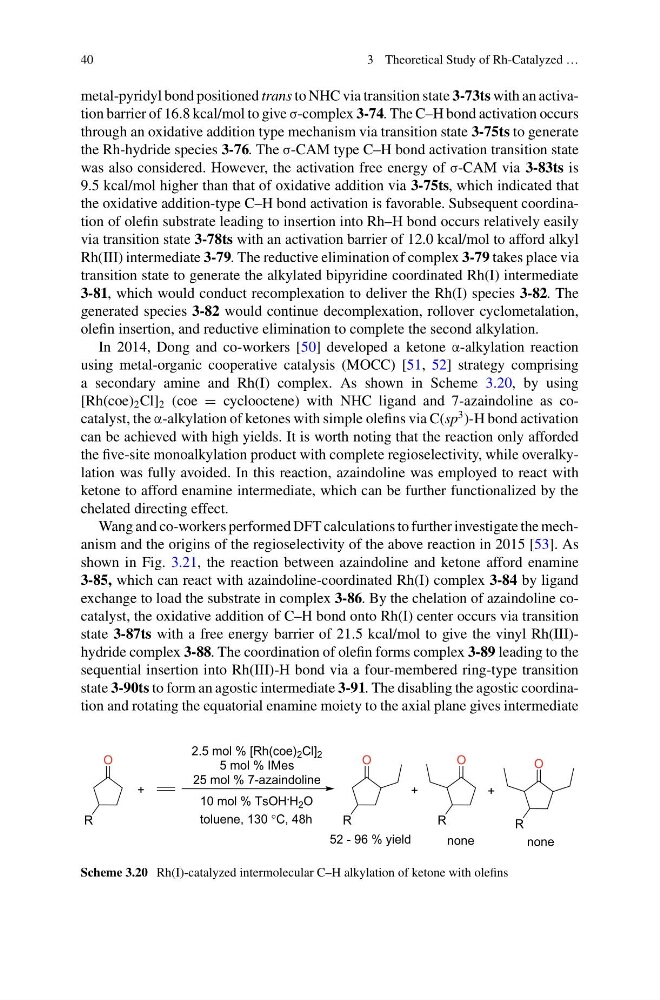
a secondary amine and Rh(I) complex. As shown in Scheme 3.20, by using
[Rh(coe) 2 Cl] 2 (coe = cyclooctene) with NHC ligand and 7-azaindoline as cocatalyst, the α-alkylation of ketones with simple olefins via C(sp
3 )-H bond activation
can be achieved with high yields. It is worth noting that the reaction only afforded
the five-site monoalkylation product with complete regioselectivity, while overalkylation was fully avoided. In this reaction, azaindoline was employed to react with
ketone to afford enamine intermediate, which can be further functionalized by the
chelated directing effect.
Wang and co-workers performed DFT calculations to further investigate the mechanism and the origins of the regioselectivity of the above reaction in 2015 [53]. As
shown in Fig. 3.21, the reaction between azaindoline and ketone afford enamine
3-85, which can react with azaindoline-coordinated Rh(I) complex 3-84 by ligand
exchange to load the substrate in complex 3-86. By the chelation of azaindoline cocatalyst, the oxidative addition of C–H bond onto Rh(I) center occurs via transition
state 3-87ts with a free energy barrier of 21.5 kcal/mol to give the vinyl Rh(III)hydride complex 3-88. The coordination of olefin forms complex 3-89 leading to the
sequential insertion into Rh(III)-H bond via a four-membered ring-type transition
state 3-90ts to form an agostic intermediate 3-91. The disabling the agostic coordination and rotating the equatorial enamine moiety to the axial plane gives intermediate
2.5 mol % [Rh(coe) 2 Cl] 2
5 mol % IMes
25 mol % 7-azaindoline
10 mol % TsOH
. H 2 O
toluene, 130 C, 48h
+
52 - 96 % yield
O
R
O
R
+
O
R
+
O
R
none
none
Scheme 3.20 Rh(I)-catalyzed intermolecular C–H alkylation of ketone with olefins
3 Theoretical Study of Rh-Catalyzed …
metal-pyridyl bond positioned trans to NHC via transition state 3-73ts with an activation barrier of 16.8 kcal/mol to give σ-complex 3-74. The C–H bond activation occurs
through an oxidative addition type mechanism via transition state 3-75ts to generate
the Rh-hydride species 3-76. The σ-CAM type C–H bond activation transition state
was also considered. However, the activation free energy of σ-CAM via 3-83ts is
9.5 kcal/mol higher than that of oxidative addition via 3-75ts, which indicated that
the oxidative addition-type C–H bond activation is favorable. Subsequent coordination of olefin substrate leading to insertion into Rh–H bond occurs relatively easily
via transition state 3-78ts with an activation barrier of 12.0 kcal/mol to afford alkyl
Rh(III) intermediate 3-79. The reductive elimination of complex 3-79 takes place via
transition state to generate the alkylated bipyridine coordinated Rh(I) intermediate
3-81, which would conduct recomplexation to deliver the Rh(I) species 3-82. The
generated species 3-82 would continue decomplexation, rollover cyclometalation,
olefin insertion, and reductive elimination to complete the second alkylation.
In 2014, Dong and co-workers [50] developed a ketone α-alkylation reaction
using metal-organic cooperative catalysis (MOCC) [51, 52] strategy comprising
a secondary amine and Rh(I) complex. As shown in Scheme 3.20, by using
[Rh(coe) 2 Cl] 2 (coe = cyclooctene) with NHC ligand and 7-azaindoline as cocatalyst, the α-alkylation of ketones with simple olefins via C(sp
3 )-H bond activation
can be achieved with high yields. It is worth noting that the reaction only afforded
the five-site monoalkylation product with complete regioselectivity, while overalkylation was fully avoided. In this reaction, azaindoline was employed to react with
ketone to afford enamine intermediate, which can be further functionalized by the
chelated directing effect.
Wang and co-workers performed DFT calculations to further investigate the mechanism and the origins of the regioselectivity of the above reaction in 2015 [53]. As
shown in Fig. 3.21, the reaction between azaindoline and ketone afford enamine
3-85, which can react with azaindoline-coordinated Rh(I) complex 3-84 by ligand
exchange to load the substrate in complex 3-86. By the chelation of azaindoline cocatalyst, the oxidative addition of C–H bond onto Rh(I) center occurs via transition
state 3-87ts with a free energy barrier of 21.5 kcal/mol to give the vinyl Rh(III)hydride complex 3-88. The coordination of olefin forms complex 3-89 leading to the
sequential insertion into Rh(III)-H bond via a four-membered ring-type transition
state 3-90ts to form an agostic intermediate 3-91. The disabling the agostic coordination and rotating the equatorial enamine moiety to the axial plane gives intermediate
2.5 mol % [Rh(coe) 2 Cl] 2
5 mol % IMes
25 mol % 7-azaindoline
10 mol % TsOH
. H 2 O
toluene, 130 C, 48h
+
52 - 96 % yield
O
R
O
R
+
O
R
+
O
R
none
none
Scheme 3.20 Rh(I)-catalyzed intermolecular C–H alkylation of ketone with olefins