

3.2 Rh-Catalyzed C–H Bond Alkylation
39
the rate-determining step of the catalytic cycle. Then the intramolecular oxidative
hydrogen transfer from imidazolium moiety to Rh in 3-67 occurs via transition state
3-68ts to give the Rh(III)-hydride intermediate 3-69 with an activation barrier of
only 9 kcal/mol. Subsequently, a rapid reductive elimination occurs via transition
state 3-70ts to get the product coordinated Rh(I) complex 3-71. The catalytic cycle
is then renewed by the displacement of the product by another molecule of alkene
with subsequent C–H activation to form the NHC complex 3-65.
In 2012, Chang, Jung, and co-workers reported a Rh-catalyzed C–H alkylation of
bipyridines with olefins (Scheme 3.18) [49]. In this transformation, the Rh(acac) 3 was
found to be the most suitable catalyst precursor. When the IMes·HCl was employed,
the reaction efficiency and selectivity were significantly increased. A wide range
of simple terminal olefins were used as alkylating reagents to give the bisalkylated
products. The kinetic isotope effect experiments (k H/D = 1.01) suggested that the
C–H bond cleavage is excluded in the rate-determining step in the catalytic cycle.
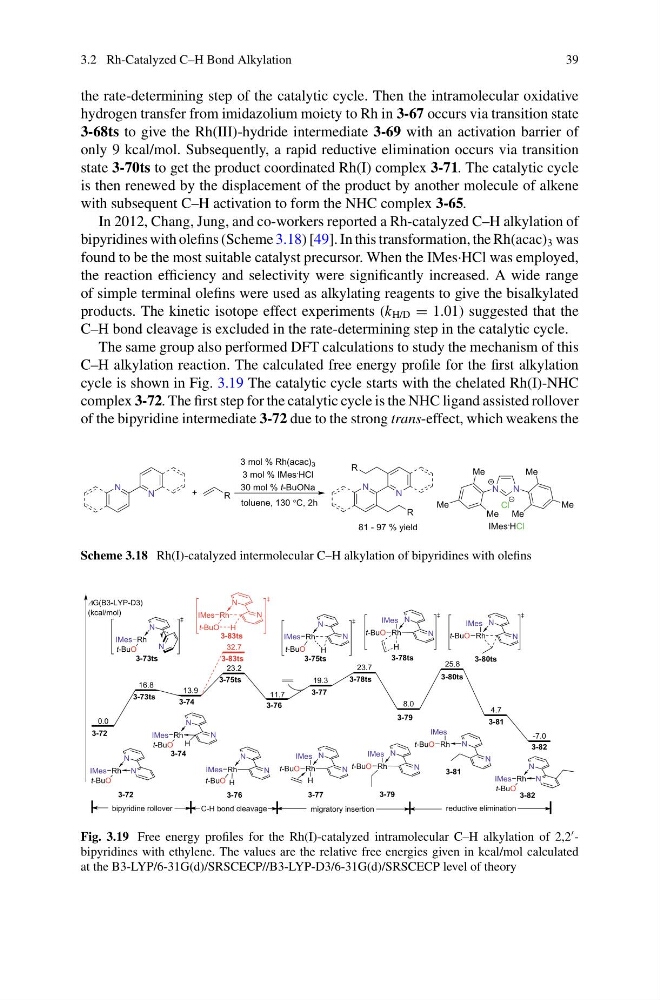
The same group also performed DFT calculations to study the mechanism of this
C–H alkylation reaction. The calculated free energy profile for the first alkylation
cycle is shown in Fig. 3.19 The catalytic cycle starts with the chelated Rh(I)-NHC
complex 3-72. The first step for the catalytic cycle is the NHC ligand assisted rollover
of the bipyridine intermediate 3-72 due to the strong trans-effect, which weakens the
3 mol % Rh(acac) 3
3 mol % IMes
. HCl
30 mol % t-BuONa
toluene, 130 C, 2h
+
R
81 - 97 % yield
N
N
N
N
R
R
N
N
Cl
Me
Me
Me
Me
Me
Me
IMes
. HCl
Scheme 3.18 Rh(I)-catalyzed intermolecular C–H alkylation of bipyridines with olefins
3-72
3-73ts
0.0
16.8
G(B3-LYP-D3)
(kcal/mol)
bipyridine rollover
3-74
13.9
3-75ts
23.2
3-76
11.7
3-77
19.3
C-H bond cleavage
3-78ts
23.7
migratory insertion
3-79
8.0
3-80ts
25.8
3-81
4.7
3-82
-7.0
3-72
3-73ts
3-74
3-75ts
3-76
3-83ts
32.7
3-83ts
3-77
3-78ts
3-79
3-80ts
3-81
3-82
reductive elimination
Rh
t-BuO
IMes
N
N
Rh
t-BuO
IMes
N
N
Rh
t-BuO
IMes
N
N
H
Rh
t-BuO
IMes
N
N
H
Rh
t-BuO
IMes
N
N
H
Rh
t-BuO
IMes
N
N
H
Rh
t-BuO
IMes N
N
H
Rh
t-BuO
IMes N
N
H
Rh
t-BuO
IMes N
N
Rh
t-BuO
IMes N
N
Rh
t-BuO
IMes
N
N
Rh
t-BuO
IMes
N
N
Fig. 3.19 Free energy profiles for the Rh(I)-catalyzed intramolecular C–H alkylation of 2,2 -
bipyridines with ethylene. The values are the relative free energies given in kcal/mol calculated
at the B3-LYP/6-31G(d)/SRSCECP//B3-LYP-D3/6-31G(d)/SRSCECP level of theory
39
the rate-determining step of the catalytic cycle. Then the intramolecular oxidative
hydrogen transfer from imidazolium moiety to Rh in 3-67 occurs via transition state
3-68ts to give the Rh(III)-hydride intermediate 3-69 with an activation barrier of
only 9 kcal/mol. Subsequently, a rapid reductive elimination occurs via transition
state 3-70ts to get the product coordinated Rh(I) complex 3-71. The catalytic cycle
is then renewed by the displacement of the product by another molecule of alkene
with subsequent C–H activation to form the NHC complex 3-65.
In 2012, Chang, Jung, and co-workers reported a Rh-catalyzed C–H alkylation of
bipyridines with olefins (Scheme 3.18) [49]. In this transformation, the Rh(acac) 3 was
found to be the most suitable catalyst precursor. When the IMes·HCl was employed,
the reaction efficiency and selectivity were significantly increased. A wide range
of simple terminal olefins were used as alkylating reagents to give the bisalkylated
products. The kinetic isotope effect experiments (k H/D = 1.01) suggested that the
C–H bond cleavage is excluded in the rate-determining step in the catalytic cycle.
The same group also performed DFT calculations to study the mechanism of this
C–H alkylation reaction. The calculated free energy profile for the first alkylation
cycle is shown in Fig. 3.19 The catalytic cycle starts with the chelated Rh(I)-NHC
complex 3-72. The first step for the catalytic cycle is the NHC ligand assisted rollover
of the bipyridine intermediate 3-72 due to the strong trans-effect, which weakens the
3 mol % Rh(acac) 3
3 mol % IMes
. HCl
30 mol % t-BuONa
toluene, 130 C, 2h
+
R
81 - 97 % yield
N
N
N
N
R
R
N
N
Cl
Me
Me
Me
Me
Me
Me
IMes
. HCl
Scheme 3.18 Rh(I)-catalyzed intermolecular C–H alkylation of bipyridines with olefins
3-72
3-73ts
0.0
16.8
G(B3-LYP-D3)
(kcal/mol)
bipyridine rollover
3-74
13.9
3-75ts
23.2
3-76
11.7
3-77
19.3
C-H bond cleavage
3-78ts
23.7
migratory insertion
3-79
8.0
3-80ts
25.8
3-81
4.7
3-82
-7.0
3-72
3-73ts
3-74
3-75ts
3-76
3-83ts
32.7
3-83ts
3-77
3-78ts
3-79
3-80ts
3-81
3-82
reductive elimination
Rh
t-BuO
IMes
N
N
Rh
t-BuO
IMes
N
N
Rh
t-BuO
IMes
N
N
H
Rh
t-BuO
IMes
N
N
H
Rh
t-BuO
IMes
N
N
H
Rh
t-BuO
IMes
N
N
H
Rh
t-BuO
IMes N
N
H
Rh
t-BuO
IMes N
N
H
Rh
t-BuO
IMes N
N
Rh
t-BuO
IMes N
N
Rh
t-BuO
IMes
N
N
Rh
t-BuO
IMes
N
N
Fig. 3.19 Free energy profiles for the Rh(I)-catalyzed intramolecular C–H alkylation of 2,2 -
bipyridines with ethylene. The values are the relative free energies given in kcal/mol calculated
at the B3-LYP/6-31G(d)/SRSCECP//B3-LYP-D3/6-31G(d)/SRSCECP level of theory