

38
3 Theoretical Study of Rh-Catalyzed …
and trisubstituted alkenyls are compatible in this reaction and allow the formation of
alkylation product with stereogenic centers (Scheme 3.16).
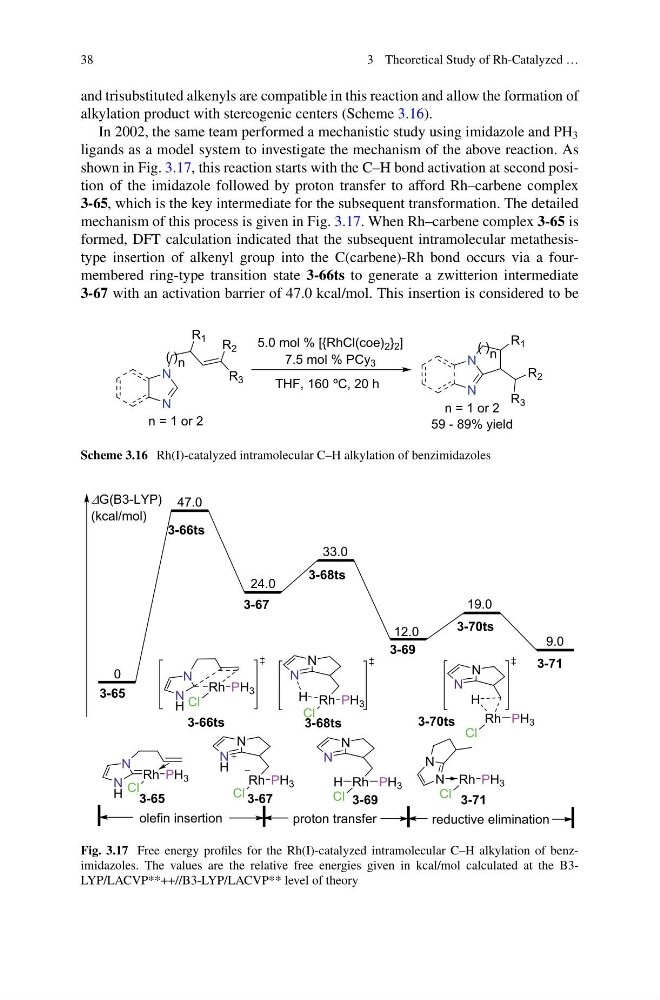
In 2002, the same team performed a mechanistic study using imidazole and PH 3
ligands as a model system to investigate the mechanism of the above reaction. As
shown in Fig. 3.17, this reaction starts with the C–H bond activation at second position of the imidazole followed by proton transfer to afford Rh–carbene complex
3-65, which is the key intermediate for the subsequent transformation. The detailed
mechanism of this process is given in Fig. 3.17. When Rh–carbene complex 3-65 is
formed, DFT calculation indicated that the subsequent intramolecular metathesistype insertion of alkenyl group into the C(carbene)-Rh bond occurs via a fourmembered ring-type transition state 3-66ts to generate a zwitterion intermediate
3-67 with an activation barrier of 47.0 kcal/mol. This insertion is considered to be
5.0 mol % [{RhCl(coe) 2 } 2 ]
7.5 mol % PCy 3
THF, 160 ºC, 20 h
59 - 89% yield
N
N
R 1
R 3
R 2
N
N
R 1
R 2
R 3
n
n = 1 or 2
n
n = 1 or 2
( )
( )
Scheme 3.16 Rh(I)-catalyzed intramolecular C–H alkylation of benzimidazoles
3-65
3-66ts
0
47.0
G(B3-LYP)
(kcal/mol)
olefin insertion
3-67
24.0
3-68ts
33.0
3-69
12.0
3-70ts
19.0
3-71
9.0
3-65
3-66ts
3-67
3-68ts
3-69
3-70ts
3-71
proton transfer
reductive elimination
N
Rh
N
H
PH 3
Cl
N
Rh
N
H
PH 3
Cl
N
H
N
Rh PH 3
Cl
N
N
Rh PH 3
Cl
H
N
N
Rh PH 3
Cl
H
N
N
Rh PH 3
Cl
H
Rh PH 3
Cl
N
N
Fig. 3.17 Free energy profiles for the Rh(I)-catalyzed intramolecular C–H alkylation of benzimidazoles. The values are the relative free energies given in kcal/mol calculated at the B3LYP/LACVP**++//B3-LYP/LACVP** level of theory
3 Theoretical Study of Rh-Catalyzed …
and trisubstituted alkenyls are compatible in this reaction and allow the formation of
alkylation product with stereogenic centers (Scheme 3.16).
In 2002, the same team performed a mechanistic study using imidazole and PH 3
ligands as a model system to investigate the mechanism of the above reaction. As
shown in Fig. 3.17, this reaction starts with the C–H bond activation at second position of the imidazole followed by proton transfer to afford Rh–carbene complex
3-65, which is the key intermediate for the subsequent transformation. The detailed
mechanism of this process is given in Fig. 3.17. When Rh–carbene complex 3-65 is
formed, DFT calculation indicated that the subsequent intramolecular metathesistype insertion of alkenyl group into the C(carbene)-Rh bond occurs via a fourmembered ring-type transition state 3-66ts to generate a zwitterion intermediate
3-67 with an activation barrier of 47.0 kcal/mol. This insertion is considered to be
5.0 mol % [{RhCl(coe) 2 } 2 ]
7.5 mol % PCy 3
THF, 160 ºC, 20 h
59 - 89% yield
N
N
R 1
R 3
R 2
N
N
R 1
R 2
R 3
n
n = 1 or 2
n
n = 1 or 2
( )
( )
Scheme 3.16 Rh(I)-catalyzed intramolecular C–H alkylation of benzimidazoles
3-65
3-66ts
0
47.0
G(B3-LYP)
(kcal/mol)
olefin insertion
3-67
24.0
3-68ts
33.0
3-69
12.0
3-70ts
19.0
3-71
9.0
3-65
3-66ts
3-67
3-68ts
3-69
3-70ts
3-71
proton transfer
reductive elimination
N
Rh
N
H
PH 3
Cl
N
Rh
N
H
PH 3
Cl
N
H
N
Rh PH 3
Cl
N
N
Rh PH 3
Cl
H
N
N
Rh PH 3
Cl
H
N
N
Rh PH 3
Cl
H
Rh PH 3
Cl
N
N
Fig. 3.17 Free energy profiles for the Rh(I)-catalyzed intramolecular C–H alkylation of benzimidazoles. The values are the relative free energies given in kcal/mol calculated at the B3LYP/LACVP**++//B3-LYP/LACVP** level of theory