

3.2 Rh-Catalyzed C–H Bond Alkylation
37
1) 2.5 mol % [{RhCl(coe) 2 } 2 ]
4.0 mol % PCy 3
. HCl
2.5 mol % PCy 3
THF, 150 °C
2) MnO 2 , benzene, 80 C
+
R
NH
N
N
N
R
46 - 90 % yield
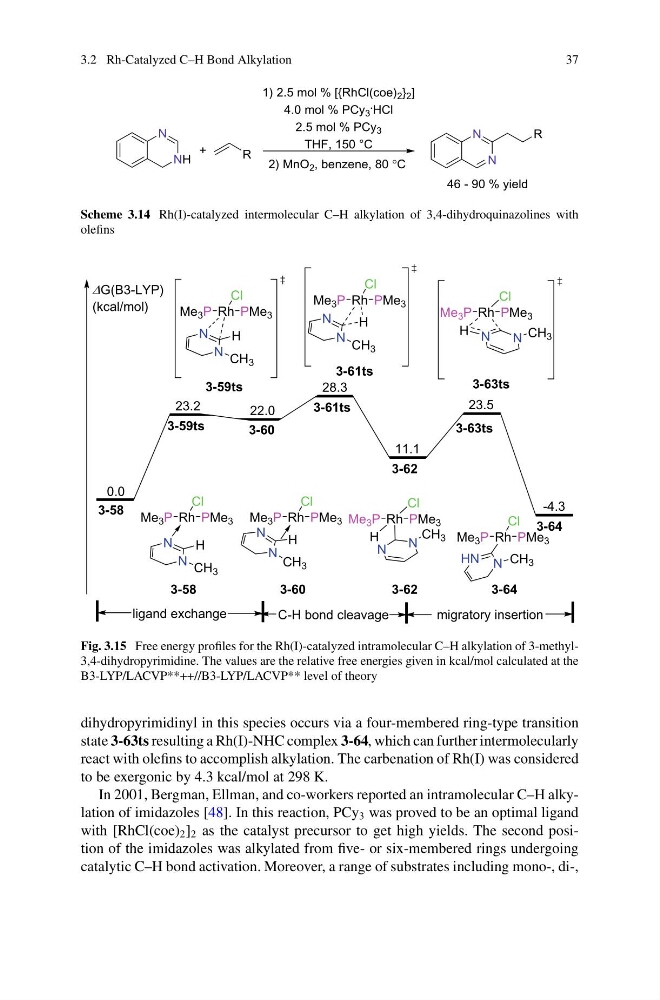
Scheme 3.14 Rh(I)-catalyzed intermolecular C–H alkylation of 3,4-dihydroquinazolines with
olefins
3-58
3-59ts
0.0
23.2
G(B3-LYP)
(kcal/mol)
ligand exchange
3-60
22.0
3-61ts
28.3
3-62
11.1
3-59ts
C-H bond cleavage
3-58
3-63ts
23.5
3-64
-4.3
3-60
3-61ts
3-62
3-63ts
3-64
migratory insertion
Rh
Cl
Me 3 P
PMe 3
N
N
CH 3
H
Rh
Cl
Me 3 P
PMe 3
N
N
CH 3
H
Rh
Cl
Me 3 P
PMe 3
N
N
CH 3
H
Rh
Cl
Me 3 P
PMe 3
N
N
CH 3
H
Rh
Cl
Me 3 P
PMe 3
N
N
CH 3
H
Rh
Cl
Me 3 P
PMe 3
N
N
CH 3
H
Rh
Cl
Me 3 P
PMe 3
N
HN
CH 3
Fig. 3.15 Free energy profiles for the Rh(I)-catalyzed intramolecular C–H alkylation of 3-methyl3,4-dihydropyrimidine. The values are the relative free energies given in kcal/mol calculated at the
B3-LYP/LACVP**++//B3-LYP/LACVP** level of theory
dihydropyrimidinyl in this species occurs via a four-membered ring-type transition
state 3-63ts resulting a Rh(I)-NHC complex 3-64, which can further intermolecularly
react with olefins to accomplish alkylation. The carbenation of Rh(I) was considered
to be exergonic by 4.3 kcal/mol at 298 K.
In 2001, Bergman, Ellman, and co-workers reported an intramolecular C–H alkylation of imidazoles [48]. In this reaction, PCy 3 was proved to be an optimal ligand
with [RhCl(coe) 2 ] 2 as the catalyst precursor to get high yields. The second position of the imidazoles was alkylated from five- or six-membered rings undergoing
catalytic C–H bond activation. Moreover, a range of substrates including mono-, di-,
37
1) 2.5 mol % [{RhCl(coe) 2 } 2 ]
4.0 mol % PCy 3
. HCl
2.5 mol % PCy 3
THF, 150 °C
2) MnO 2 , benzene, 80 C
+
R
NH
N
N
N
R
46 - 90 % yield
Scheme 3.14 Rh(I)-catalyzed intermolecular C–H alkylation of 3,4-dihydroquinazolines with
olefins
3-58
3-59ts
0.0
23.2
G(B3-LYP)
(kcal/mol)
ligand exchange
3-60
22.0
3-61ts
28.3
3-62
11.1
3-59ts
C-H bond cleavage
3-58
3-63ts
23.5
3-64
-4.3
3-60
3-61ts
3-62
3-63ts
3-64
migratory insertion
Rh
Cl
Me 3 P
PMe 3
N
N
CH 3
H
Rh
Cl
Me 3 P
PMe 3
N
N
CH 3
H
Rh
Cl
Me 3 P
PMe 3
N
N
CH 3
H
Rh
Cl
Me 3 P
PMe 3
N
N
CH 3
H
Rh
Cl
Me 3 P
PMe 3
N
N
CH 3
H
Rh
Cl
Me 3 P
PMe 3
N
N
CH 3
H
Rh
Cl
Me 3 P
PMe 3
N
HN
CH 3
Fig. 3.15 Free energy profiles for the Rh(I)-catalyzed intramolecular C–H alkylation of 3-methyl3,4-dihydropyrimidine. The values are the relative free energies given in kcal/mol calculated at the
B3-LYP/LACVP**++//B3-LYP/LACVP** level of theory
dihydropyrimidinyl in this species occurs via a four-membered ring-type transition
state 3-63ts resulting a Rh(I)-NHC complex 3-64, which can further intermolecularly
react with olefins to accomplish alkylation. The carbenation of Rh(I) was considered
to be exergonic by 4.3 kcal/mol at 298 K.
In 2001, Bergman, Ellman, and co-workers reported an intramolecular C–H alkylation of imidazoles [48]. In this reaction, PCy 3 was proved to be an optimal ligand
with [RhCl(coe) 2 ] 2 as the catalyst precursor to get high yields. The second position of the imidazoles was alkylated from five- or six-membered rings undergoing
catalytic C–H bond activation. Moreover, a range of substrates including mono-, di-,