

36
3 Theoretical Study of Rh-Catalyzed …
are usually used as the alkyl source in this reaction. Mechanistically, the key step of
C(sp
2 )–C(sp
3 ) bond formation often undergoes an insertion of unsaturated molecules
into the newly formed C(aryl)–Rh bond.
3.2.1 C–H Bond Alkylation by Using Olefins
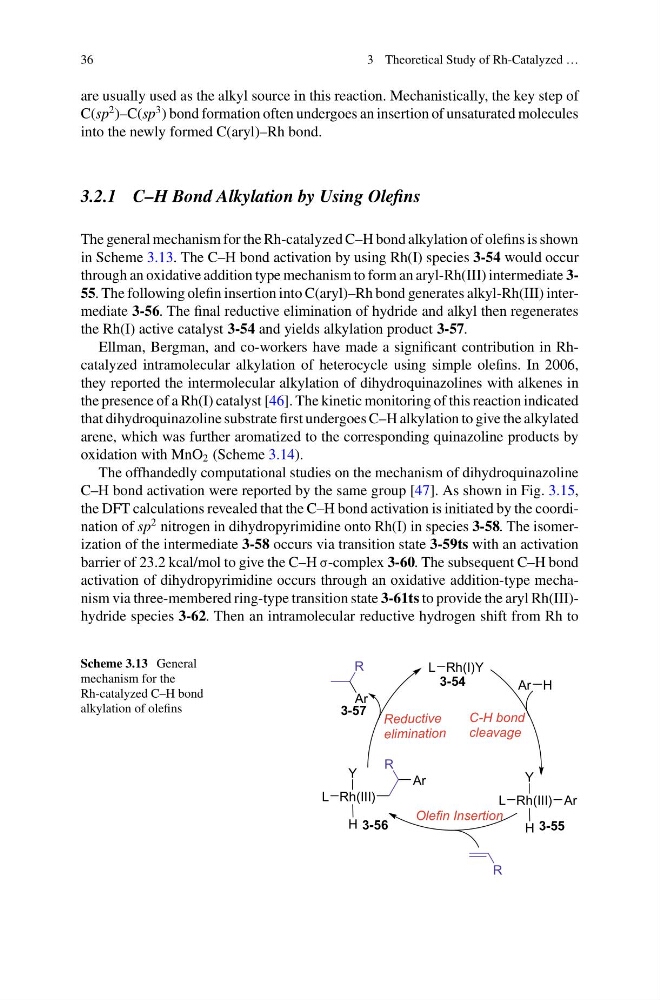
The general mechanism for the Rh-catalyzed C–H bond alkylation of olefins is shown
in Scheme 3.13. The C–H bond activation by using Rh(I) species 3-54 would occur
through an oxidative addition type mechanism to form an aryl-Rh(III) intermediate 355. The following olefin insertion into C(aryl)–Rh bond generates alkyl-Rh(III) intermediate 3-56. The final reductive elimination of hydride and alkyl then regenerates
the Rh(I) active catalyst 3-54 and yields alkylation product 3-57.
Ellman, Bergman, and co-workers have made a significant contribution in Rhcatalyzed intramolecular alkylation of heterocycle using simple olefins. In 2006,
they reported the intermolecular alkylation of dihydroquinazolines with alkenes in
the presence of a Rh(I) catalyst [46]. The kinetic monitoring of this reaction indicated
that dihydroquinazoline substrate first undergoes C–H alkylation to give the alkylated
arene, which was further aromatized to the corresponding quinazoline products by
oxidation with MnO 2 (Scheme 3.14).
The offhandedly computational studies on the mechanism of dihydroquinazoline
C–H bond activation were reported by the same group [47]. As shown in Fig. 3.15,
the DFT calculations revealed that the C–H bond activation is initiated by the coordination of sp
2 nitrogen in dihydropyrimidine onto Rh(I) in species 3-58. The isomerization of the intermediate 3-58 occurs via transition state 3-59ts with an activation
barrier of 23.2 kcal/mol to give the C–H σ-complex 3-60. The subsequent C–H bond
activation of dihydropyrimidine occurs through an oxidative addition-type mechanism via three-membered ring-type transition state 3-61ts to provide the aryl Rh(III)hydride species 3-62. Then an intramolecular reductive hydrogen shift from Rh to
Scheme 3.13 General
mechanism for the
Rh-catalyzed C–H bond
alkylation of olefins
3-55
Ar H
L Rh(I)Y
L Rh(III)
Olefin Insertion
C-H bond
cleavage
3-56
H
Ar
3-54
Reductive
elimination
3-57
Y
L Rh(III)
H
Y
R
Ar
R
R
Ar
3 Theoretical Study of Rh-Catalyzed …
are usually used as the alkyl source in this reaction. Mechanistically, the key step of
C(sp
2 )–C(sp
3 ) bond formation often undergoes an insertion of unsaturated molecules
into the newly formed C(aryl)–Rh bond.
3.2.1 C–H Bond Alkylation by Using Olefins
The general mechanism for the Rh-catalyzed C–H bond alkylation of olefins is shown
in Scheme 3.13. The C–H bond activation by using Rh(I) species 3-54 would occur
through an oxidative addition type mechanism to form an aryl-Rh(III) intermediate 355. The following olefin insertion into C(aryl)–Rh bond generates alkyl-Rh(III) intermediate 3-56. The final reductive elimination of hydride and alkyl then regenerates
the Rh(I) active catalyst 3-54 and yields alkylation product 3-57.
Ellman, Bergman, and co-workers have made a significant contribution in Rhcatalyzed intramolecular alkylation of heterocycle using simple olefins. In 2006,
they reported the intermolecular alkylation of dihydroquinazolines with alkenes in
the presence of a Rh(I) catalyst [46]. The kinetic monitoring of this reaction indicated
that dihydroquinazoline substrate first undergoes C–H alkylation to give the alkylated
arene, which was further aromatized to the corresponding quinazoline products by
oxidation with MnO 2 (Scheme 3.14).
The offhandedly computational studies on the mechanism of dihydroquinazoline
C–H bond activation were reported by the same group [47]. As shown in Fig. 3.15,
the DFT calculations revealed that the C–H bond activation is initiated by the coordination of sp
2 nitrogen in dihydropyrimidine onto Rh(I) in species 3-58. The isomerization of the intermediate 3-58 occurs via transition state 3-59ts with an activation
barrier of 23.2 kcal/mol to give the C–H σ-complex 3-60. The subsequent C–H bond
activation of dihydropyrimidine occurs through an oxidative addition-type mechanism via three-membered ring-type transition state 3-61ts to provide the aryl Rh(III)hydride species 3-62. Then an intramolecular reductive hydrogen shift from Rh to
Scheme 3.13 General
mechanism for the
Rh-catalyzed C–H bond
alkylation of olefins
3-55
Ar H
L Rh(I)Y
L Rh(III)
Olefin Insertion
C-H bond
cleavage
3-56
H
Ar
3-54
Reductive
elimination
3-57
Y
L Rh(III)
H
Y
R
Ar
R
R
Ar