

3.1 Rh-Catalyzed C–H Bond Arylation
35
3-46
3-47ts
0.0
20.0
G(PBE0, bromobenzene)
(kcal/mol)
C-H bond cleavage
reductive elimination
ligand
exchange
3-46
+
3-47ts
3-48
10.6
+
3-48
3-49
22.4
3-50ts
29.3
3-51
-1.2
3-52ts
26.8
3-53
3.5
Ph-Br + PivOPivOH
3-49
3-50ts
3-51
3-52ts
3-53
C-H bond cleavage
Rh
O
(
i Pr) 2 N
Br
Rh
O
(
i Pr) 2 N
O
O
t Bu
H
Br
Rh
O
(
i Pr) 2 N
Br
Rh
O
(
i Pr) 2 N
Br
Rh
O
(
i Pr) 2 N
O
O
t Bu
H
Br
Rh
O
(
i Pr) 2 N
O
HO
t Bu
Rh
O
(
i Pr) 2 N
O
O
t Bu
H
+
Rh
O
(
i Pr) 2 N
O
O
t Bu
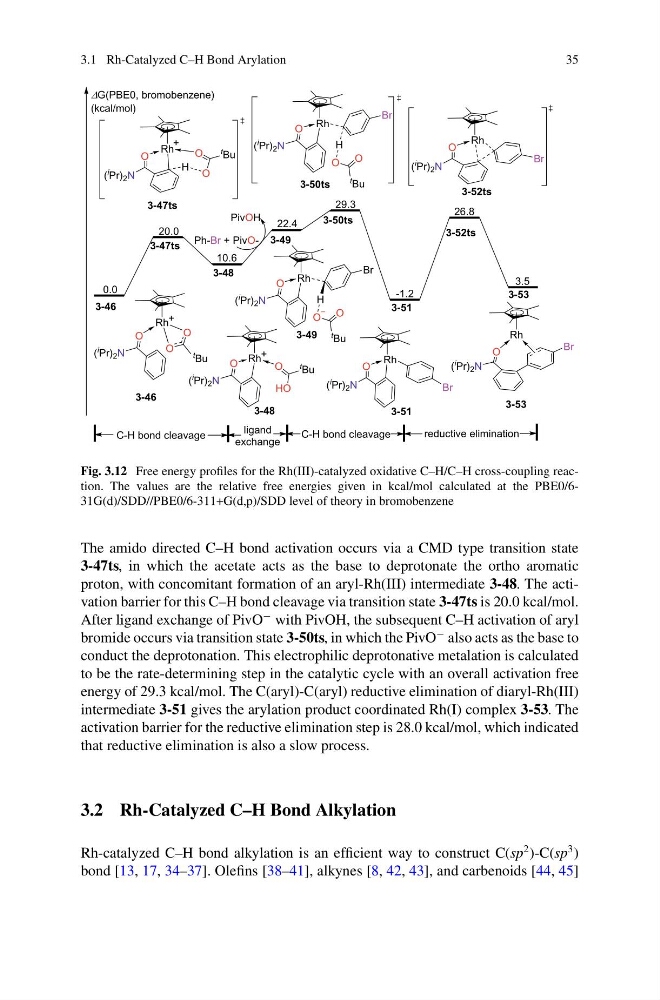
Fig. 3.12 Free energy profiles for the Rh(III)-catalyzed oxidative C–H/C–H cross-coupling reaction. The values are the relative free energies given in kcal/mol calculated at the PBE0/631G(d)/SDD//PBE0/6-311+G(d,p)/SDD level of theory in bromobenzene
The amido directed C–H bond activation occurs via a CMD type transition state
3-47ts, in which the acetate acts as the base to deprotonate the ortho aromatic
proton, with concomitant formation of an aryl-Rh(III) intermediate 3-48. The activation barrier for this C–H bond cleavage via transition state 3-47ts is 20.0 kcal/mol.
After ligand exchange of PivO
− with PivOH, the subsequent C–H activation of aryl
bromide occurs via transition state 3-50ts, in which the PivO
− also acts as the base to
conduct the deprotonation. This electrophilic deprotonative metalation is calculated
to be the rate-determining step in the catalytic cycle with an overall activation free
energy of 29.3 kcal/mol. The C(aryl)-C(aryl) reductive elimination of diaryl-Rh(III)
intermediate 3-51 gives the arylation product coordinated Rh(I) complex 3-53. The
activation barrier for the reductive elimination step is 28.0 kcal/mol, which indicated
that reductive elimination is also a slow process.
3.2 Rh-Catalyzed C–H Bond Alkylation
Rh-catalyzed C–H bond alkylation is an efficient way to construct C(sp
2 )-C(sp
3 )
bond [13, 17, 34–37]. Olefins [38–41], alkynes [8, 42, 43], and carbenoids [44, 45]
35
3-46
3-47ts
0.0
20.0
G(PBE0, bromobenzene)
(kcal/mol)
C-H bond cleavage
reductive elimination
ligand
exchange
3-46
+
3-47ts
3-48
10.6
+
3-48
3-49
22.4
3-50ts
29.3
3-51
-1.2
3-52ts
26.8
3-53
3.5
Ph-Br + PivOPivOH
3-49
3-50ts
3-51
3-52ts
3-53
C-H bond cleavage
Rh
O
(
i Pr) 2 N
Br
Rh
O
(
i Pr) 2 N
O
O
t Bu
H
Br
Rh
O
(
i Pr) 2 N
Br
Rh
O
(
i Pr) 2 N
Br
Rh
O
(
i Pr) 2 N
O
O
t Bu
H
Br
Rh
O
(
i Pr) 2 N
O
HO
t Bu
Rh
O
(
i Pr) 2 N
O
O
t Bu
H
+
Rh
O
(
i Pr) 2 N
O
O
t Bu
Fig. 3.12 Free energy profiles for the Rh(III)-catalyzed oxidative C–H/C–H cross-coupling reaction. The values are the relative free energies given in kcal/mol calculated at the PBE0/631G(d)/SDD//PBE0/6-311+G(d,p)/SDD level of theory in bromobenzene
The amido directed C–H bond activation occurs via a CMD type transition state
3-47ts, in which the acetate acts as the base to deprotonate the ortho aromatic
proton, with concomitant formation of an aryl-Rh(III) intermediate 3-48. The activation barrier for this C–H bond cleavage via transition state 3-47ts is 20.0 kcal/mol.
After ligand exchange of PivO
− with PivOH, the subsequent C–H activation of aryl
bromide occurs via transition state 3-50ts, in which the PivO
− also acts as the base to
conduct the deprotonation. This electrophilic deprotonative metalation is calculated
to be the rate-determining step in the catalytic cycle with an overall activation free
energy of 29.3 kcal/mol. The C(aryl)-C(aryl) reductive elimination of diaryl-Rh(III)
intermediate 3-51 gives the arylation product coordinated Rh(I) complex 3-53. The
activation barrier for the reductive elimination step is 28.0 kcal/mol, which indicated
that reductive elimination is also a slow process.
3.2 Rh-Catalyzed C–H Bond Alkylation
Rh-catalyzed C–H bond alkylation is an efficient way to construct C(sp
2 )-C(sp
3 )
bond [13, 17, 34–37]. Olefins [38–41], alkynes [8, 42, 43], and carbenoids [44, 45]