

34
3 Theoretical Study of Rh-Catalyzed …
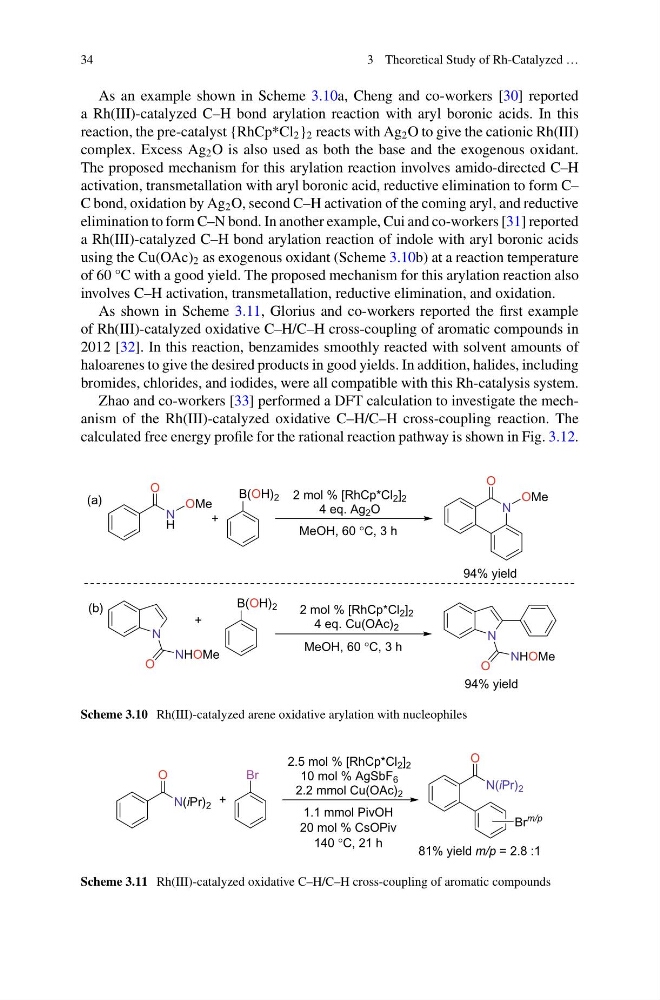
As an example shown in Scheme 3.10a, Cheng and co-workers [30] reported
a Rh(III)-catalyzed C–H bond arylation reaction with aryl boronic acids. In this
reaction, the pre-catalyst {RhCp*Cl 2 } 2 reacts with Ag 2 O to give the cationic Rh(III)
complex. Excess Ag 2 O is also used as both the base and the exogenous oxidant.
The proposed mechanism for this arylation reaction involves amido-directed C–H
activation, transmetallation with aryl boronic acid, reductive elimination to form C–
C bond, oxidation by Ag 2 O, second C–H activation of the coming aryl, and reductive
elimination to form C–N bond. In another example, Cui and co-workers [31] reported
a Rh(III)-catalyzed C–H bond arylation reaction of indole with aryl boronic acids
using the Cu(OAc) 2 as exogenous oxidant (Scheme 3.10b) at a reaction temperature
of 60 °C with a good yield. The proposed mechanism for this arylation reaction also
involves C–H activation, transmetallation, reductive elimination, and oxidation.
As shown in Scheme 3.11, Glorius and co-workers reported the first example
of Rh(III)-catalyzed oxidative C–H/C–H cross-coupling of aromatic compounds in
2012 [32]. In this reaction, benzamides smoothly reacted with solvent amounts of
haloarenes to give the desired products in good yields. In addition, halides, including
bromides, chlorides, and iodides, were all compatible with this Rh-catalysis system.
Zhao and co-workers [33] performed a DFT calculation to investigate the mechanism of the Rh(III)-catalyzed oxidative C–H/C–H cross-coupling reaction. The
calculated free energy profile for the rational reaction pathway is shown in Fig. 3.12.
2 mol % [RhCp*Cl 2 ] 2
4 eq. Ag 2 O
MeOH, 60 C, 3 h
+
(a)
(b)
O
N
H
OMe
B(OH) 2
O
N
OMe
94% yield
N
NHOMe
O
+
B(OH) 2
2 mol % [RhCp*Cl 2 ] 2
4 eq. Cu(OAc) 2
MeOH, 60 C, 3 h
N
NHOMe
O
94% yield
Scheme 3.10 Rh(III)-catalyzed arene oxidative arylation with nucleophiles
2.5 mol % [RhCp*Cl 2 ] 2
10 mol % AgSbF 6
2.2 mmol Cu(OAc) 2
1.1 mmol PivOH
20 mol % CsOPiv
140 C, 21 h
+
Br
O
N(iPr) 2
O
N(iPr) 2
Br
m/p
81% yield m/p = 2.8 :1
Scheme 3.11 Rh(III)-catalyzed oxidative C–H/C–H cross-coupling of aromatic compounds
3 Theoretical Study of Rh-Catalyzed …
As an example shown in Scheme 3.10a, Cheng and co-workers [30] reported
a Rh(III)-catalyzed C–H bond arylation reaction with aryl boronic acids. In this
reaction, the pre-catalyst {RhCp*Cl 2 } 2 reacts with Ag 2 O to give the cationic Rh(III)
complex. Excess Ag 2 O is also used as both the base and the exogenous oxidant.
The proposed mechanism for this arylation reaction involves amido-directed C–H
activation, transmetallation with aryl boronic acid, reductive elimination to form C–
C bond, oxidation by Ag 2 O, second C–H activation of the coming aryl, and reductive
elimination to form C–N bond. In another example, Cui and co-workers [31] reported
a Rh(III)-catalyzed C–H bond arylation reaction of indole with aryl boronic acids
using the Cu(OAc) 2 as exogenous oxidant (Scheme 3.10b) at a reaction temperature
of 60 °C with a good yield. The proposed mechanism for this arylation reaction also
involves C–H activation, transmetallation, reductive elimination, and oxidation.
As shown in Scheme 3.11, Glorius and co-workers reported the first example
of Rh(III)-catalyzed oxidative C–H/C–H cross-coupling of aromatic compounds in
2012 [32]. In this reaction, benzamides smoothly reacted with solvent amounts of
haloarenes to give the desired products in good yields. In addition, halides, including
bromides, chlorides, and iodides, were all compatible with this Rh-catalysis system.
Zhao and co-workers [33] performed a DFT calculation to investigate the mechanism of the Rh(III)-catalyzed oxidative C–H/C–H cross-coupling reaction. The
calculated free energy profile for the rational reaction pathway is shown in Fig. 3.12.
2 mol % [RhCp*Cl 2 ] 2
4 eq. Ag 2 O
MeOH, 60 C, 3 h
+
(a)
(b)
O
N
H
OMe
B(OH) 2
O
N
OMe
94% yield
N
NHOMe
O
+
B(OH) 2
2 mol % [RhCp*Cl 2 ] 2
4 eq. Cu(OAc) 2
MeOH, 60 C, 3 h
N
NHOMe
O
94% yield
Scheme 3.10 Rh(III)-catalyzed arene oxidative arylation with nucleophiles
2.5 mol % [RhCp*Cl 2 ] 2
10 mol % AgSbF 6
2.2 mmol Cu(OAc) 2
1.1 mmol PivOH
20 mol % CsOPiv
140 C, 21 h
+
Br
O
N(iPr) 2
O
N(iPr) 2
Br
m/p
81% yield m/p = 2.8 :1
Scheme 3.11 Rh(III)-catalyzed oxidative C–H/C–H cross-coupling of aromatic compounds