

3.2 Rh-Catalyzed C–H Bond Alkylation
43
3-97
3-98ts
0.0
23.2
G(M06, toluene)
(kcal/mol)
3-99
8.6
3-100ts
22.3
3-101
20.6
3-102ts
34.7
C-H bond cleavage
3-103
15.3
migratory insertion
3-104
12.5
3-105ts
24.6
3-97
-18.3
protonation
= dppe
3-97
KOPiv
3-98ts
3-99
CONMe 2
3-100ts
3-101
3-102ts
3-103
HOPiv
3-104
HOPiv + KCl
3-105ts
N
CF 3
+ KCl
KOPiv
N
F 3 C
CONMe 2
+
ligand exchange
3-107
3-106
3-108ts
32.0
3-108ts
Rh
Cl
P
P
N
CF 3
P
P
Rh
Cl
P
P
N
CF 3
H
Rh
Cl
P
P
N
CF 3
H
O
O
K
Rh
Cl
P
P
N
CF 3
O
OH
K
Rh
P
P
N
CF 3
CONMe 2
Rh
Cl
P
P
N
CF 3
O
OH
K
CONMe 2
Rh
P
P
N
CF 3
CONMe 2
Rh
P
P
N
CONMe 2
F 3 C
Rh
P
P
O
HO
N
Me 2 NOC
CF 3
Rh
P
P
N
Me 2 NOC
CF 3
H
O
O
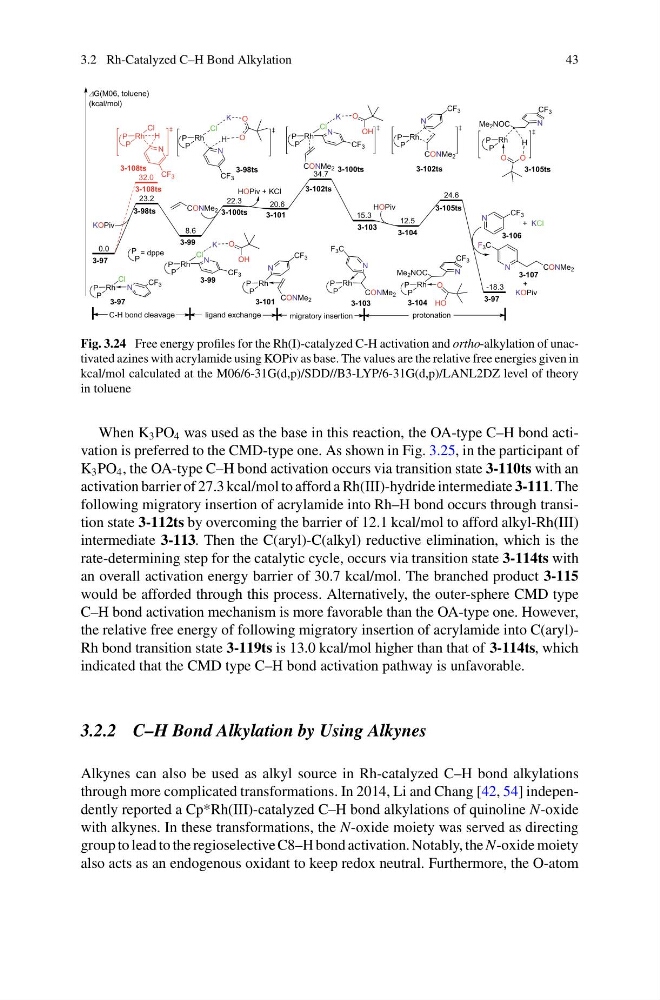
Fig. 3.24 Free energy profiles for the Rh(I)-catalyzed C-H activation and ortho-alkylation of unactivated azines with acrylamide using KOPiv as base. The values are the relative free energies given in
kcal/mol calculated at the M06/6-31G(d,p)/SDD//B3-LYP/6-31G(d,p)/LANL2DZ level of theory
in toluene
When K 3 PO 4 was used as the base in this reaction, the OA-type C–H bond activation is preferred to the CMD-type one. As shown in Fig. 3.25, in the participant of
K 3 PO 4 , the OA-type C–H bond activation occurs via transition state 3-110ts with an
activation barrier of 27.3 kcal/mol to afford a Rh(III)-hydride intermediate 3-111. The
following migratory insertion of acrylamide into Rh–H bond occurs through transition state 3-112ts by overcoming the barrier of 12.1 kcal/mol to afford alkyl-Rh(III)
intermediate 3-113. Then the C(aryl)-C(alkyl) reductive elimination, which is the
rate-determining step for the catalytic cycle, occurs via transition state 3-114ts with
an overall activation energy barrier of 30.7 kcal/mol. The branched product 3-115
would be afforded through this process. Alternatively, the outer-sphere CMD type
C–H bond activation mechanism is more favorable than the OA-type one. However,
the relative free energy of following migratory insertion of acrylamide into C(aryl)Rh bond transition state 3-119ts is 13.0 kcal/mol higher than that of 3-114ts, which
indicated that the CMD type C–H bond activation pathway is unfavorable.
3.2.2 C–H Bond Alkylation by Using Alkynes
Alkynes can also be used as alkyl source in Rh-catalyzed C–H bond alkylations
through more complicated transformations. In 2014, Li and Chang [42, 54] independently reported a Cp*Rh(III)-catalyzed C–H bond alkylations of quinoline N-oxide
with alkynes. In these transformations, the N-oxide moiety was served as directing
group to lead to the regioselective C8–H bond activation. Notably, the N-oxide moiety
also acts as an endogenous oxidant to keep redox neutral. Furthermore, the O-atom
43
3-97
3-98ts
0.0
23.2
G(M06, toluene)
(kcal/mol)
3-99
8.6
3-100ts
22.3
3-101
20.6
3-102ts
34.7
C-H bond cleavage
3-103
15.3
migratory insertion
3-104
12.5
3-105ts
24.6
3-97
-18.3
protonation
= dppe
3-97
KOPiv
3-98ts
3-99
CONMe 2
3-100ts
3-101
3-102ts
3-103
HOPiv
3-104
HOPiv + KCl
3-105ts
N
CF 3
+ KCl
KOPiv
N
F 3 C
CONMe 2
+
ligand exchange
3-107
3-106
3-108ts
32.0
3-108ts
Rh
Cl
P
P
N
CF 3
P
P
Rh
Cl
P
P
N
CF 3
H
Rh
Cl
P
P
N
CF 3
H
O
O
K
Rh
Cl
P
P
N
CF 3
O
OH
K
Rh
P
P
N
CF 3
CONMe 2
Rh
Cl
P
P
N
CF 3
O
OH
K
CONMe 2
Rh
P
P
N
CF 3
CONMe 2
Rh
P
P
N
CONMe 2
F 3 C
Rh
P
P
O
HO
N
Me 2 NOC
CF 3
Rh
P
P
N
Me 2 NOC
CF 3
H
O
O
Fig. 3.24 Free energy profiles for the Rh(I)-catalyzed C-H activation and ortho-alkylation of unactivated azines with acrylamide using KOPiv as base. The values are the relative free energies given in
kcal/mol calculated at the M06/6-31G(d,p)/SDD//B3-LYP/6-31G(d,p)/LANL2DZ level of theory
in toluene
When K 3 PO 4 was used as the base in this reaction, the OA-type C–H bond activation is preferred to the CMD-type one. As shown in Fig. 3.25, in the participant of
K 3 PO 4 , the OA-type C–H bond activation occurs via transition state 3-110ts with an
activation barrier of 27.3 kcal/mol to afford a Rh(III)-hydride intermediate 3-111. The
following migratory insertion of acrylamide into Rh–H bond occurs through transition state 3-112ts by overcoming the barrier of 12.1 kcal/mol to afford alkyl-Rh(III)
intermediate 3-113. Then the C(aryl)-C(alkyl) reductive elimination, which is the
rate-determining step for the catalytic cycle, occurs via transition state 3-114ts with
an overall activation energy barrier of 30.7 kcal/mol. The branched product 3-115
would be afforded through this process. Alternatively, the outer-sphere CMD type
C–H bond activation mechanism is more favorable than the OA-type one. However,
the relative free energy of following migratory insertion of acrylamide into C(aryl)Rh bond transition state 3-119ts is 13.0 kcal/mol higher than that of 3-114ts, which
indicated that the CMD type C–H bond activation pathway is unfavorable.
3.2.2 C–H Bond Alkylation by Using Alkynes
Alkynes can also be used as alkyl source in Rh-catalyzed C–H bond alkylations
through more complicated transformations. In 2014, Li and Chang [42, 54] independently reported a Cp*Rh(III)-catalyzed C–H bond alkylations of quinoline N-oxide
with alkynes. In these transformations, the N-oxide moiety was served as directing
group to lead to the regioselective C8–H bond activation. Notably, the N-oxide moiety
also acts as an endogenous oxidant to keep redox neutral. Furthermore, the O-atom