

32
3 Theoretical Study of Rh-Catalyzed …
coordination of the additional pivalate and indole, which is 14.0 kcal/mol endogenic.
The CMD type C–H bond cleavage at C2 position occurs via transition state 3-21ts
generating aryl rhodium intermediate 3-22 with an energy barrier of 23.0 kcal/mol. As
a contrast, the corresponding energy barrier for the C–H cleavage at C3 position via
transition state 3-30ts is 32.0 kcal/mol. The relative energy of 3-30ts is 9.0 kcal/mol
higher than that of transition state 3-21ts, which is in agreement with the experimental
results that the C–H activation at C2 is more favorable than that at C3 position. The
comparison of the geometry information of 3-21ts and 3-30ts shows that 3-21ts is
an earlier transition state, which is a consequence of the higher nucleophilicity of
C3 and donates the lower activation free energy of transition state 3-21ts. Then, the
reductive elimination of diaryl-Rh(III) complex 3-23 gives the C2-arylated indole
intermediate 3-25 via transition state 3-24ts with an overall activation free energy
of 24.7 kcal/mol. After a release of product 3-26 and coordination of phenyl iodide,
the Rh(I) complex 3-27 is regenerated. The calculated results indicate that reductive
elimination is the rate-determining step in the catalytic cycle.
3.1.1.1 C–H Bond Arylation with Another Nucleophile
In Rh-catalyzed C–H bond arylation reactions, aryl metal reagents, such as aryl
stannum [26], and aryl boranes [27–29], are usually used as the nucleophiles to
react with the C–H bond in arenes in the presence of exogenous oxidants. The
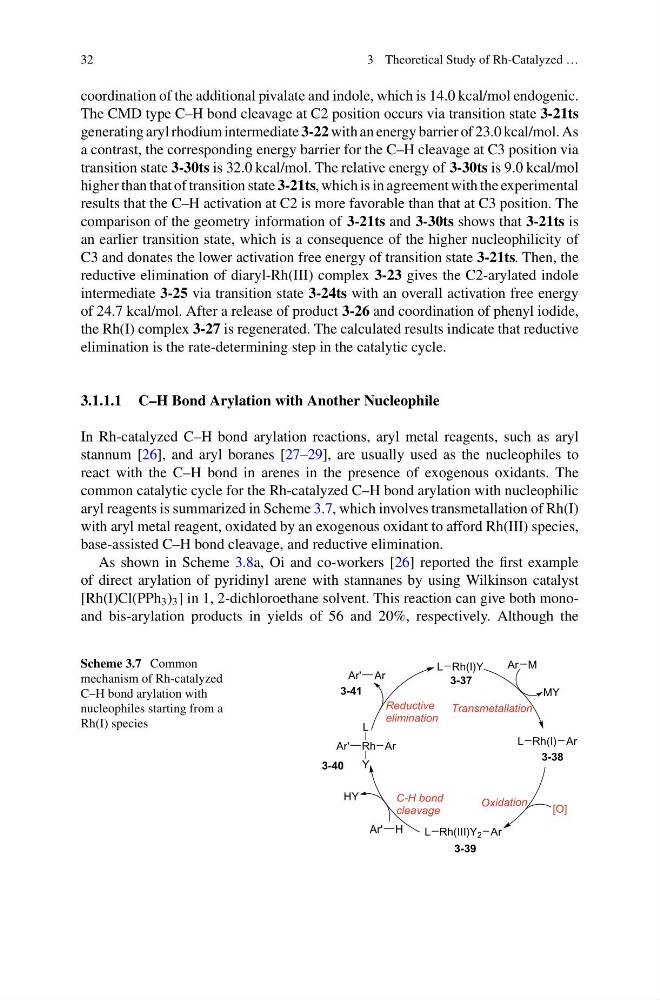
common catalytic cycle for the Rh-catalyzed C–H bond arylation with nucleophilic
aryl reagents is summarized in Scheme 3.7, which involves transmetallation of Rh(I)
with aryl metal reagent, oxidated by an exogenous oxidant to afford Rh(III) species,
base-assisted C–H bond cleavage, and reductive elimination.
As shown in Scheme 3.8a, Oi and co-workers [26] reported the first example
of direct arylation of pyridinyl arene with stannanes by using Wilkinson catalyst
[Rh(I)Cl(PPh 3 ) 3 ] in 1, 2-dichloroethane solvent. This reaction can give both monoand bis-arylation products in yields of 56 and 20%, respectively. Although the
Scheme 3.7 Common
mechanism of Rh-catalyzed
C–H bond arylation with
nucleophiles starting from a
Rh(I) species
3-38
Ar M
L Rh(I)Y
L Rh(I)
Oxidation
Ar' Ar
3-37
3-41
Transmetallation
C-H bond
cleavage
Reductive
elimination
MY
Ar
Ar' H
[O]
3-39
L Rh(III)Y 2 Ar
HY
Ar' Rh Ar
Y
3-40
L
3 Theoretical Study of Rh-Catalyzed …
coordination of the additional pivalate and indole, which is 14.0 kcal/mol endogenic.
The CMD type C–H bond cleavage at C2 position occurs via transition state 3-21ts
generating aryl rhodium intermediate 3-22 with an energy barrier of 23.0 kcal/mol. As
a contrast, the corresponding energy barrier for the C–H cleavage at C3 position via
transition state 3-30ts is 32.0 kcal/mol. The relative energy of 3-30ts is 9.0 kcal/mol
higher than that of transition state 3-21ts, which is in agreement with the experimental
results that the C–H activation at C2 is more favorable than that at C3 position. The
comparison of the geometry information of 3-21ts and 3-30ts shows that 3-21ts is
an earlier transition state, which is a consequence of the higher nucleophilicity of
C3 and donates the lower activation free energy of transition state 3-21ts. Then, the
reductive elimination of diaryl-Rh(III) complex 3-23 gives the C2-arylated indole
intermediate 3-25 via transition state 3-24ts with an overall activation free energy
of 24.7 kcal/mol. After a release of product 3-26 and coordination of phenyl iodide,
the Rh(I) complex 3-27 is regenerated. The calculated results indicate that reductive
elimination is the rate-determining step in the catalytic cycle.
3.1.1.1 C–H Bond Arylation with Another Nucleophile
In Rh-catalyzed C–H bond arylation reactions, aryl metal reagents, such as aryl
stannum [26], and aryl boranes [27–29], are usually used as the nucleophiles to
react with the C–H bond in arenes in the presence of exogenous oxidants. The
common catalytic cycle for the Rh-catalyzed C–H bond arylation with nucleophilic
aryl reagents is summarized in Scheme 3.7, which involves transmetallation of Rh(I)
with aryl metal reagent, oxidated by an exogenous oxidant to afford Rh(III) species,
base-assisted C–H bond cleavage, and reductive elimination.
As shown in Scheme 3.8a, Oi and co-workers [26] reported the first example
of direct arylation of pyridinyl arene with stannanes by using Wilkinson catalyst
[Rh(I)Cl(PPh 3 ) 3 ] in 1, 2-dichloroethane solvent. This reaction can give both monoand bis-arylation products in yields of 56 and 20%, respectively. Although the
Scheme 3.7 Common
mechanism of Rh-catalyzed
C–H bond arylation with
nucleophiles starting from a
Rh(I) species
3-38
Ar M
L Rh(I)Y
L Rh(I)
Oxidation
Ar' Ar
3-37
3-41
Transmetallation
C-H bond
cleavage
Reductive
elimination
MY
Ar
Ar' H
[O]
3-39
L Rh(III)Y 2 Ar
HY
Ar' Rh Ar
Y
3-40
L