

3.1 Rh-Catalyzed C–H Bond Arylation
31
the assistance of base, deprotonation of 3-14 gives the diaryl-Rh(III) complex 315, which undergoes reductive elimination to yield the arylation product 3-16 and
regenerate the Rh(I) species 3-12.
In 2005, Sames and co-workers [24] reported a [Rh(coe) 2 Cl] 2 catalyzed C2selective arylation of indoles in the presence of an electron-poor phosphine ligand [(pCF 3 -C 6 H 4 ) 3 P] and cesium pivalate by using aryl iodides as electrophile (Scheme 3.5).
The reaction temperature is optimized as 120 °C, which indicates a high observable
activation free energy. In an experiment, a five-coordinated Rh(III) species 3-17,
which was isolated and characterized by
31 P NMR analysis, can react with indole
to furnish 2-phenyl indole product. This observation indicated complex 3-17 was
reasonably considered to be the active species in the catalytic cycle.
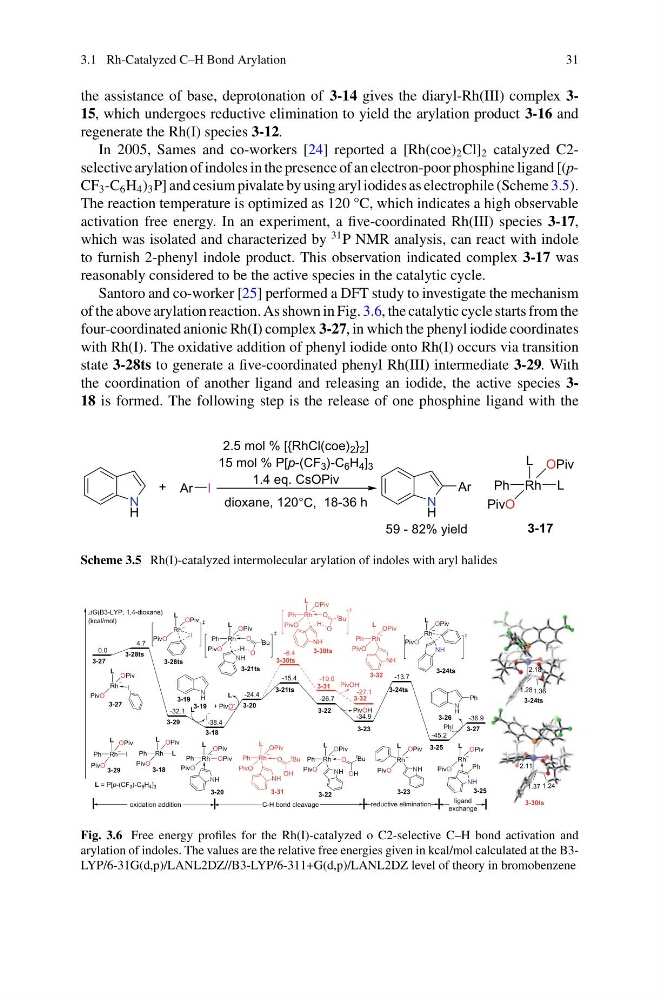
Santoro and co-worker [25] performed a DFT study to investigate the mechanism
of the above arylation reaction. As shown in Fig. 3.6, the catalytic cycle starts from the
four-coordinated anionic Rh(I) complex 3-27, in which the phenyl iodide coordinates
with Rh(I). The oxidative addition of phenyl iodide onto Rh(I) occurs via transition
state 3-28ts to generate a five-coordinated phenyl Rh(III) intermediate 3-29. With
the coordination of another ligand and releasing an iodide, the active species 318 is formed. The following step is the release of one phosphine ligand with the
2.5 mol % [{RhCl(coe) 2 } 2 ]
15 mol % P[p-(CF 3 )-C 6 H 4 ] 3
1.4 eq. CsOPiv
dioxane, 120
18-36 h
59 - 82% yield
+
N
H
N
H
Ar
Ar I
Rh
Ph
L
L
PivO
OPiv
3-17
°C,
Scheme 3.5 Rh(I)-catalyzed intermolecular arylation of indoles with aryl halides
3-24ts
1.36
1.28
2.18
3-30ts
1.24
1.37
2.11
G(B3-LYP, 1,4-dioxane)
(kcal/mol)
oxidation addition
reductive elimination
C-H bond cleavage
3-27
0.0
3-28ts
4.7
3-29
-32.1
-38.4
Rh
Ph
L
L
PivO
OPiv
3-18
L = P[p-(CF3)-C6H4]3
N
H
3-20
3-21ts
3-22
3-23
3-24ts
3-25
PhI
N
H
Ph
3-26
Rh
L
PivO
OPiv
I
3-27
3-28ts
Rh
Ph
L
PivO
OPiv
I
3-29
L
I
3-30ts
3-31
3-32
3-20
-24.4
3-21ts
-15.4
3-22
-26.7
3-23
-34.9
3-24ts
-13.7
PivOH
L
PivO -
+
3-19
3-30ts
-6.4
3-31
-19.0
-27.1
PivOH
3-25
-45.2
3-19
3-27
-36.9
ligand
exchange
Rh
L
PivO
OPiv
I
Rh
Ph
L
PivO
OPiv
OPiv
NH
Rh
L
PivO
OPiv
NH
Rh
Ph
L
PivO
OPiv
NH
O
O
t Bu
H
Rh
Ph
L
PivO
OPiv
NH
O
O
t Bu
H
Rh
Ph
L
PivO
OPiv
NH
O
OH
t Bu
Rh
Ph
L
PivO
OPiv
NH
O
OH
t Bu
Rh
Ph
L
PivO
OPiv
NH
Rh
L
PivO
OPiv
NH
Rh
L
PivO
OPiv
NH
Ph
3-18
3-32
Fig. 3.6 Free energy profiles for the Rh(I)-catalyzed o C2-selective C–H bond activation and
arylation of indoles. The values are the relative free energies given in kcal/mol calculated at the B3LYP/6-31G(d,p)/LANL2DZ//B3-LYP/6-311+G(d,p)/LANL2DZ level of theory in bromobenzene
31
the assistance of base, deprotonation of 3-14 gives the diaryl-Rh(III) complex 315, which undergoes reductive elimination to yield the arylation product 3-16 and
regenerate the Rh(I) species 3-12.
In 2005, Sames and co-workers [24] reported a [Rh(coe) 2 Cl] 2 catalyzed C2selective arylation of indoles in the presence of an electron-poor phosphine ligand [(pCF 3 -C 6 H 4 ) 3 P] and cesium pivalate by using aryl iodides as electrophile (Scheme 3.5).
The reaction temperature is optimized as 120 °C, which indicates a high observable
activation free energy. In an experiment, a five-coordinated Rh(III) species 3-17,
which was isolated and characterized by
31 P NMR analysis, can react with indole
to furnish 2-phenyl indole product. This observation indicated complex 3-17 was
reasonably considered to be the active species in the catalytic cycle.
Santoro and co-worker [25] performed a DFT study to investigate the mechanism
of the above arylation reaction. As shown in Fig. 3.6, the catalytic cycle starts from the
four-coordinated anionic Rh(I) complex 3-27, in which the phenyl iodide coordinates
with Rh(I). The oxidative addition of phenyl iodide onto Rh(I) occurs via transition
state 3-28ts to generate a five-coordinated phenyl Rh(III) intermediate 3-29. With
the coordination of another ligand and releasing an iodide, the active species 318 is formed. The following step is the release of one phosphine ligand with the
2.5 mol % [{RhCl(coe) 2 } 2 ]
15 mol % P[p-(CF 3 )-C 6 H 4 ] 3
1.4 eq. CsOPiv
dioxane, 120
18-36 h
59 - 82% yield
+
N
H
N
H
Ar
Ar I
Rh
Ph
L
L
PivO
OPiv
3-17
°C,
Scheme 3.5 Rh(I)-catalyzed intermolecular arylation of indoles with aryl halides
3-24ts
1.36
1.28
2.18
3-30ts
1.24
1.37
2.11
G(B3-LYP, 1,4-dioxane)
(kcal/mol)
oxidation addition
reductive elimination
C-H bond cleavage
3-27
0.0
3-28ts
4.7
3-29
-32.1
-38.4
Rh
Ph
L
L
PivO
OPiv
3-18
L = P[p-(CF3)-C6H4]3
N
H
3-20
3-21ts
3-22
3-23
3-24ts
3-25
PhI
N
H
Ph
3-26
Rh
L
PivO
OPiv
I
3-27
3-28ts
Rh
Ph
L
PivO
OPiv
I
3-29
L
I
3-30ts
3-31
3-32
3-20
-24.4
3-21ts
-15.4
3-22
-26.7
3-23
-34.9
3-24ts
-13.7
PivOH
L
PivO -
+
3-19
3-30ts
-6.4
3-31
-19.0
-27.1
PivOH
3-25
-45.2
3-19
3-27
-36.9
ligand
exchange
Rh
L
PivO
OPiv
I
Rh
Ph
L
PivO
OPiv
OPiv
NH
Rh
L
PivO
OPiv
NH
Rh
Ph
L
PivO
OPiv
NH
O
O
t Bu
H
Rh
Ph
L
PivO
OPiv
NH
O
O
t Bu
H
Rh
Ph
L
PivO
OPiv
NH
O
OH
t Bu
Rh
Ph
L
PivO
OPiv
NH
O
OH
t Bu
Rh
Ph
L
PivO
OPiv
NH
Rh
L
PivO
OPiv
NH
Rh
L
PivO
OPiv
NH
Ph
3-18
3-32
Fig. 3.6 Free energy profiles for the Rh(I)-catalyzed o C2-selective C–H bond activation and
arylation of indoles. The values are the relative free energies given in kcal/mol calculated at the B3LYP/6-31G(d,p)/LANL2DZ//B3-LYP/6-311+G(d,p)/LANL2DZ level of theory in bromobenzene