

30
3 Theoretical Study of Rh-Catalyzed …
5.0 mol % [{RhCl(coe) 2 } 2 ]
40 mol % PCy 3
4.0 eq. NEt 3
THF, 150°C, 6 h
56% yield
+
N
H
N
N
H
N
(a)
0.05 eq. [{RhCl(coe) 2 } 2 ]
0.15 eq. phosphepine
3.0 eq.
i Pr 2
i BuN
THF, microwave (200°C), 2 h
98% yield
X
N
H
N
(b) Proposed catalytic cycle
Rh
Cl
P
tBu
3-12
N
H
N
N
H
H
N
Rh
Cl
P
tBu
3-13
Ph X
N
H
H
N
Rh
Cl P
tBu
3-14
X
Ph
HX
N
H
N
Rh
Cl
P
tBu
3-15
Ph
N
H
N
Ph
3-16
X = I
X = Br
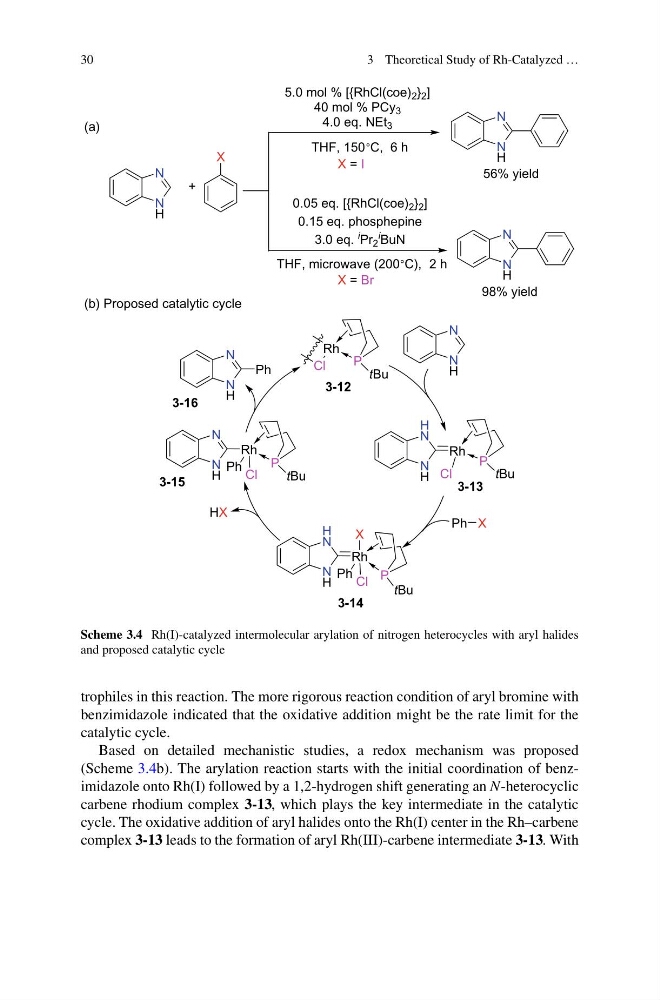
Scheme 3.4 Rh(I)-catalyzed intermolecular arylation of nitrogen heterocycles with aryl halides
and proposed catalytic cycle
trophiles in this reaction. The more rigorous reaction condition of aryl bromine with
benzimidazole indicated that the oxidative addition might be the rate limit for the
catalytic cycle.
Based on detailed mechanistic studies, a redox mechanism was proposed
(Scheme 3.4b). The arylation reaction starts with the initial coordination of benzimidazole onto Rh(I) followed by a 1,2-hydrogen shift generating an N-heterocyclic
carbene rhodium complex 3-13, which plays the key intermediate in the catalytic
cycle. The oxidative addition of aryl halides onto the Rh(I) center in the Rh–carbene
complex 3-13 leads to the formation of aryl Rh(III)-carbene intermediate 3-13. With
3 Theoretical Study of Rh-Catalyzed …
5.0 mol % [{RhCl(coe) 2 } 2 ]
40 mol % PCy 3
4.0 eq. NEt 3
THF, 150°C, 6 h
56% yield
+
N
H
N
N
H
N
(a)
0.05 eq. [{RhCl(coe) 2 } 2 ]
0.15 eq. phosphepine
3.0 eq.
i Pr 2
i BuN
THF, microwave (200°C), 2 h
98% yield
X
N
H
N
(b) Proposed catalytic cycle
Rh
Cl
P
tBu
3-12
N
H
N
N
H
H
N
Rh
Cl
P
tBu
3-13
Ph X
N
H
H
N
Rh
Cl P
tBu
3-14
X
Ph
HX
N
H
N
Rh
Cl
P
tBu
3-15
Ph
N
H
N
Ph
3-16
X = I
X = Br
Scheme 3.4 Rh(I)-catalyzed intermolecular arylation of nitrogen heterocycles with aryl halides
and proposed catalytic cycle
trophiles in this reaction. The more rigorous reaction condition of aryl bromine with
benzimidazole indicated that the oxidative addition might be the rate limit for the
catalytic cycle.
Based on detailed mechanistic studies, a redox mechanism was proposed
(Scheme 3.4b). The arylation reaction starts with the initial coordination of benzimidazole onto Rh(I) followed by a 1,2-hydrogen shift generating an N-heterocyclic
carbene rhodium complex 3-13, which plays the key intermediate in the catalytic
cycle. The oxidative addition of aryl halides onto the Rh(I) center in the Rh–carbene
complex 3-13 leads to the formation of aryl Rh(III)-carbene intermediate 3-13. With