

3.1 Rh-Catalyzed C–H Bond Arylation
29
5.0 mol % [RhCl(PPh 3 ) 3 ]
15 mol % P(
i Pr) 2 (OAr)
1.7 eq. Cs 2 CO 3
PhMe, 120
°C,
°C, 18 h
(a)
(b)
96% yield
2.5 mol % [RhCl(cod) 2 ] 2
20 mol % P(NMe 2 ) 3
2.0 eq. Cs 2 CO 3
2.0 eq. K 2 CO 3
PhMe, 100
20 h
58% yield
OH
tBu
+
Br
O
Me
OH
tBu
O
Me
OH
+
Br
OH
OMe
MeO
OMe
3-5
3-6
3-7
(c) Proposed catalytic cycle
L n Rh
Ar X
Rh X
Ar
L n
OPR 2
R
3-8
O
R
R 2 P
L n Rh
HX
Ar
3-9
O
R
R 2
P
L n Rh
Ar
3-10
OH
R
OH
R
Ar
3-11
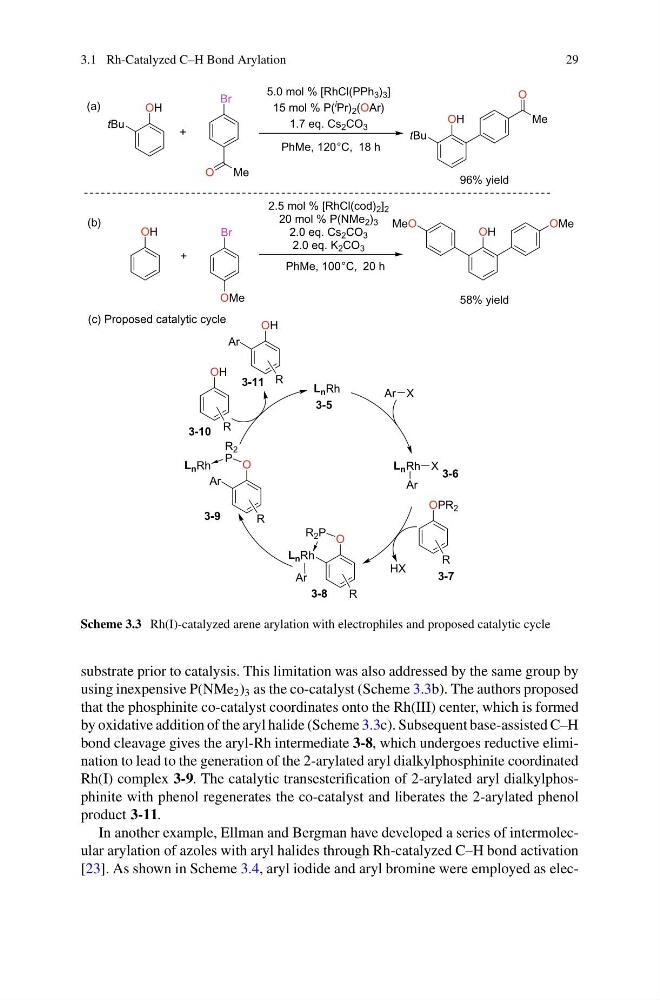
Scheme 3.3 Rh(I)-catalyzed arene arylation with electrophiles and proposed catalytic cycle
substrate prior to catalysis. This limitation was also addressed by the same group by
using inexpensive P(NMe 2 ) 3 as the co-catalyst (Scheme 3.3b). The authors proposed
that the phosphinite co-catalyst coordinates onto the Rh(III) center, which is formed
by oxidative addition of the aryl halide (Scheme 3.3c). Subsequent base-assisted C–H
bond cleavage gives the aryl-Rh intermediate 3-8, which undergoes reductive elimination to lead to the generation of the 2-arylated aryl dialkylphosphinite coordinated
Rh(I) complex 3-9. The catalytic transesterification of 2-arylated aryl dialkylphosphinite with phenol regenerates the co-catalyst and liberates the 2-arylated phenol
product 3-11.
In another example, Ellman and Bergman have developed a series of intermolecular arylation of azoles with aryl halides through Rh-catalyzed C–H bond activation
[23]. As shown in Scheme 3.4, aryl iodide and aryl bromine were employed as elec-
29
5.0 mol % [RhCl(PPh 3 ) 3 ]
15 mol % P(
i Pr) 2 (OAr)
1.7 eq. Cs 2 CO 3
PhMe, 120
°C,
°C, 18 h
(a)
(b)
96% yield
2.5 mol % [RhCl(cod) 2 ] 2
20 mol % P(NMe 2 ) 3
2.0 eq. Cs 2 CO 3
2.0 eq. K 2 CO 3
PhMe, 100
20 h
58% yield
OH
tBu
+
Br
O
Me
OH
tBu
O
Me
OH
+
Br
OH
OMe
MeO
OMe
3-5
3-6
3-7
(c) Proposed catalytic cycle
L n Rh
Ar X
Rh X
Ar
L n
OPR 2
R
3-8
O
R
R 2 P
L n Rh
HX
Ar
3-9
O
R
R 2
P
L n Rh
Ar
3-10
OH
R
OH
R
Ar
3-11
Scheme 3.3 Rh(I)-catalyzed arene arylation with electrophiles and proposed catalytic cycle
substrate prior to catalysis. This limitation was also addressed by the same group by
using inexpensive P(NMe 2 ) 3 as the co-catalyst (Scheme 3.3b). The authors proposed
that the phosphinite co-catalyst coordinates onto the Rh(III) center, which is formed
by oxidative addition of the aryl halide (Scheme 3.3c). Subsequent base-assisted C–H
bond cleavage gives the aryl-Rh intermediate 3-8, which undergoes reductive elimination to lead to the generation of the 2-arylated aryl dialkylphosphinite coordinated
Rh(I) complex 3-9. The catalytic transesterification of 2-arylated aryl dialkylphosphinite with phenol regenerates the co-catalyst and liberates the 2-arylated phenol
product 3-11.
In another example, Ellman and Bergman have developed a series of intermolecular arylation of azoles with aryl halides through Rh-catalyzed C–H bond activation
[23]. As shown in Scheme 3.4, aryl iodide and aryl bromine were employed as elec-