

28
3 Theoretical Study of Rh-Catalyzed …
Scheme 3.1 Rh-catalyzed
coupling reaction with C–H
bonds
Nu
-
E
+
Oxidative Coupling
Nu Nu
Nu E
Cross Coupling
- 2e
-
C(Nu)
[Rh]
H
3.1 Rh-Catalyzed C–H Bond Arylation
Generally, the Rh-catalyzed C–H bond arylations can be categorized as redox-neutral
cross-coupling reactions with electrophilic aryl reagents and oxidative-coupling
reactions with nucleophilic aryl reagents.
3.1.1 C–H Bond Arylation with Electrophiles
In Rh-catalyzed C–H bond arylation reactions through redox-neutral cross-coupling,
aryl bromide and aryl iodide [21] are often used as electrophiles to coupling with
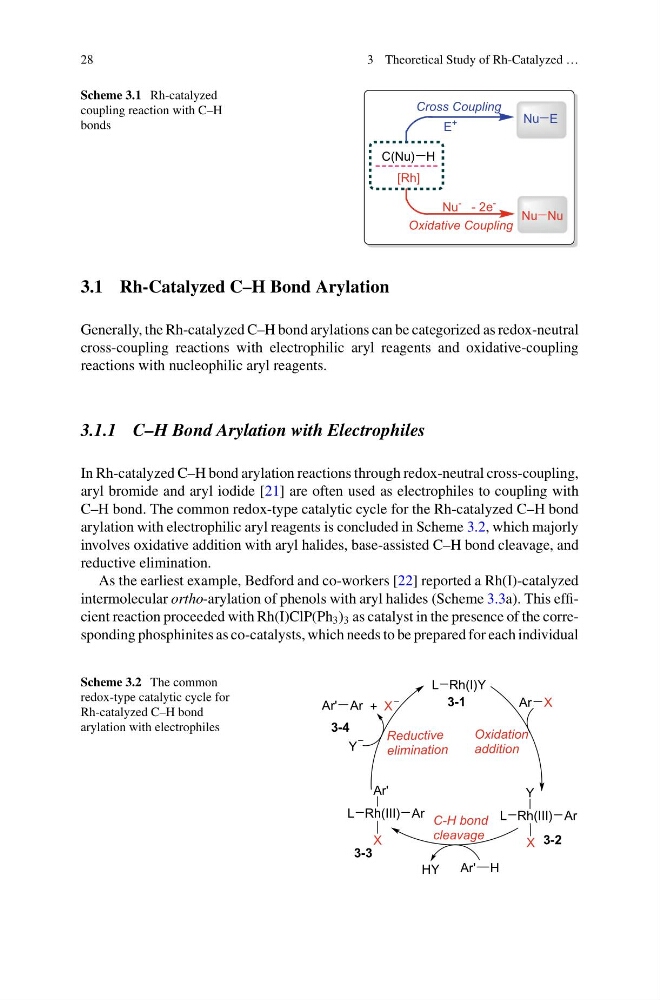
C–H bond. The common redox-type catalytic cycle for the Rh-catalyzed C–H bond
arylation with electrophilic aryl reagents is concluded in Scheme 3.2, which majorly
involves oxidative addition with aryl halides, base-assisted C–H bond cleavage, and
reductive elimination.
As the earliest example, Bedford and co-workers [22] reported a Rh(I)-catalyzed
intermolecular ortho-arylation of phenols with aryl halides (Scheme 3.3a). This efficient reaction proceeded with Rh(I)ClP(Ph 3 ) 3 as catalyst in the presence of the corresponding phosphinites as co-catalysts, which needs to be prepared for each individual
Scheme 3.2 The common
redox-type catalytic cycle for
Rh-catalyzed C–H bond
arylation with electrophiles
3-2
Ar X
L Rh(I)Y
L Rh(III)
Oxidation
addition
C-H bond
cleavage
Ar' H
HY
3-3
X
Ar
3-1
Reductive
elimination
3-4
Y
Y
Ar' Ar
X
+
L Rh(III)
X
Ar
Ar'
3 Theoretical Study of Rh-Catalyzed …
Scheme 3.1 Rh-catalyzed
coupling reaction with C–H
bonds
Nu
-
E
+
Oxidative Coupling
Nu Nu
Nu E
Cross Coupling
- 2e
-
C(Nu)
[Rh]
H
3.1 Rh-Catalyzed C–H Bond Arylation
Generally, the Rh-catalyzed C–H bond arylations can be categorized as redox-neutral
cross-coupling reactions with electrophilic aryl reagents and oxidative-coupling
reactions with nucleophilic aryl reagents.
3.1.1 C–H Bond Arylation with Electrophiles
In Rh-catalyzed C–H bond arylation reactions through redox-neutral cross-coupling,
aryl bromide and aryl iodide [21] are often used as electrophiles to coupling with
C–H bond. The common redox-type catalytic cycle for the Rh-catalyzed C–H bond
arylation with electrophilic aryl reagents is concluded in Scheme 3.2, which majorly
involves oxidative addition with aryl halides, base-assisted C–H bond cleavage, and
reductive elimination.
As the earliest example, Bedford and co-workers [22] reported a Rh(I)-catalyzed
intermolecular ortho-arylation of phenols with aryl halides (Scheme 3.3a). This efficient reaction proceeded with Rh(I)ClP(Ph 3 ) 3 as catalyst in the presence of the corresponding phosphinites as co-catalysts, which needs to be prepared for each individual
Scheme 3.2 The common
redox-type catalytic cycle for
Rh-catalyzed C–H bond
arylation with electrophiles
3-2
Ar X
L Rh(I)Y
L Rh(III)
Oxidation
addition
C-H bond
cleavage
Ar' H
HY
3-3
X
Ar
3-1
Reductive
elimination
3-4
Y
Y
Ar' Ar
X
+
L Rh(III)
X
Ar
Ar'