

6
1 Theoretical View of Rh-Catalyzed C–H Functionalization
N
+ H 3 CC CCH 3
N
Me
Me
+
N
Me
Me
Me
Me
10 mol % [RhCl(PPh 3 ) 3 ]
N
89% yield
Me
toluene, 140
o C, 20h
H 3 CC CCH 3
N
Me
Me
Me
Me
10 mol % [RhCl(PPh 3 ) 3 ]
toluene, 140
o C, 20h
+
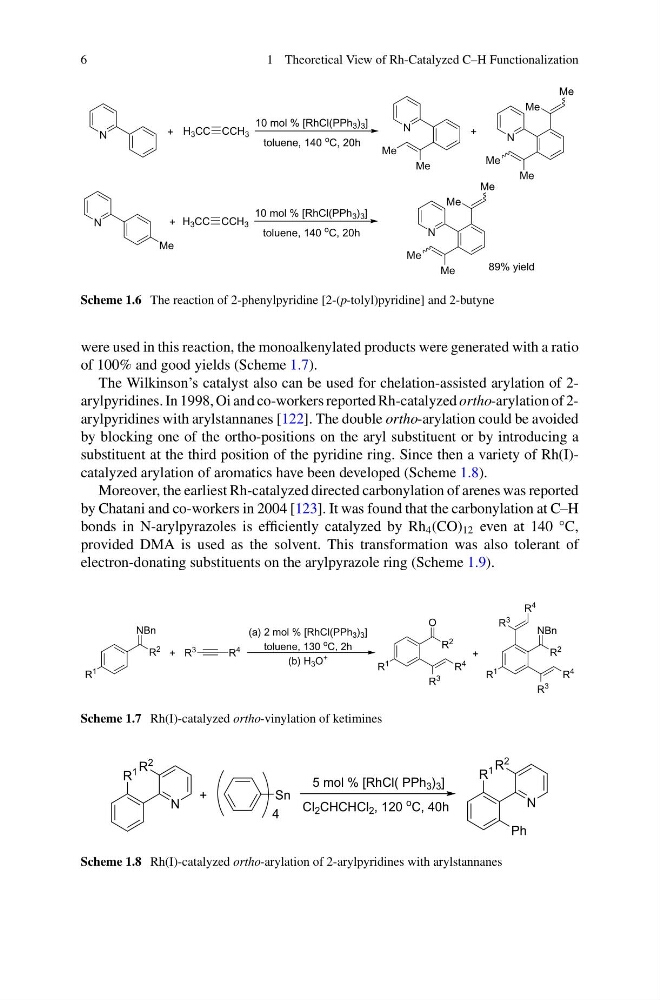
Scheme 1.6 The reaction of 2-phenylpyridine [2-(p-tolyl)pyridine] and 2-butyne
were used in this reaction, the monoalkenylated products were generated with a ratio
of 100% and good yields (Scheme 1.7).
The Wilkinson’s catalyst also can be used for chelation-assisted arylation of 2arylpyridines. In 1998, Oi and co-workers reported Rh-catalyzed ortho-arylation of 2arylpyridines with arylstannanes [122]. The double ortho-arylation could be avoided
by blocking one of the ortho-positions on the aryl substituent or by introducing a
substituent at the third position of the pyridine ring. Since then a variety of Rh(I)catalyzed arylation of aromatics have been developed (Scheme 1.8).
Moreover, the earliest Rh-catalyzed directed carbonylation of arenes was reported
by Chatani and co-workers in 2004 [123]. It was found that the carbonylation at C–H
bonds in N-arylpyrazoles is efficiently catalyzed by Rh 4 (CO) 12 even at 140 °C,
provided DMA is used as the solvent. This transformation was also tolerant of
electron-donating substituents on the arylpyrazole ring (Scheme 1.9).
R
2
NBn
R
1
+ R
3
R
4
R
2
O
R
1
R
3
R
4
+
R
2
NBn
R
1
R
3
R
4
R
3
R
4
(a) 2 mol % [RhCl(PPh 3 ) 3 ]
toluene, 130
o C, 2h
(b) H 3 O
+
Scheme 1.7 Rh(I)-catalyzed ortho-vinylation of ketimines
+
N
R
1 R
2
Sn
4
5 mol % [RhCl( PPh 3 ) 3 ]
Cl 2 CHCHCl 2 , 120
o C, 40h
N
R
1 R
2
Ph
Scheme 1.8 Rh(I)-catalyzed ortho-arylation of 2-arylpyridines with arylstannanes
1 Theoretical View of Rh-Catalyzed C–H Functionalization
N
+ H 3 CC CCH 3
N
Me
Me
+
N
Me
Me
Me
Me
10 mol % [RhCl(PPh 3 ) 3 ]
N
89% yield
Me
toluene, 140
o C, 20h
H 3 CC CCH 3
N
Me
Me
Me
Me
10 mol % [RhCl(PPh 3 ) 3 ]
toluene, 140
o C, 20h
+
Scheme 1.6 The reaction of 2-phenylpyridine [2-(p-tolyl)pyridine] and 2-butyne
were used in this reaction, the monoalkenylated products were generated with a ratio
of 100% and good yields (Scheme 1.7).
The Wilkinson’s catalyst also can be used for chelation-assisted arylation of 2arylpyridines. In 1998, Oi and co-workers reported Rh-catalyzed ortho-arylation of 2arylpyridines with arylstannanes [122]. The double ortho-arylation could be avoided
by blocking one of the ortho-positions on the aryl substituent or by introducing a
substituent at the third position of the pyridine ring. Since then a variety of Rh(I)catalyzed arylation of aromatics have been developed (Scheme 1.8).
Moreover, the earliest Rh-catalyzed directed carbonylation of arenes was reported
by Chatani and co-workers in 2004 [123]. It was found that the carbonylation at C–H
bonds in N-arylpyrazoles is efficiently catalyzed by Rh 4 (CO) 12 even at 140 °C,
provided DMA is used as the solvent. This transformation was also tolerant of
electron-donating substituents on the arylpyrazole ring (Scheme 1.9).
R
2
NBn
R
1
+ R
3
R
4
R
2
O
R
1
R
3
R
4
+
R
2
NBn
R
1
R
3
R
4
R
3
R
4
(a) 2 mol % [RhCl(PPh 3 ) 3 ]
toluene, 130
o C, 2h
(b) H 3 O
+
Scheme 1.7 Rh(I)-catalyzed ortho-vinylation of ketimines
+
N
R
1 R
2
Sn
4
5 mol % [RhCl( PPh 3 ) 3 ]
Cl 2 CHCHCl 2 , 120
o C, 40h
N
R
1 R
2
Ph
Scheme 1.8 Rh(I)-catalyzed ortho-arylation of 2-arylpyridines with arylstannanes