

1.1 A Brief History of Rh-Catalyzed C–H Functionalization
5
Under optimized conditions, this reaction was found to have substantially broader
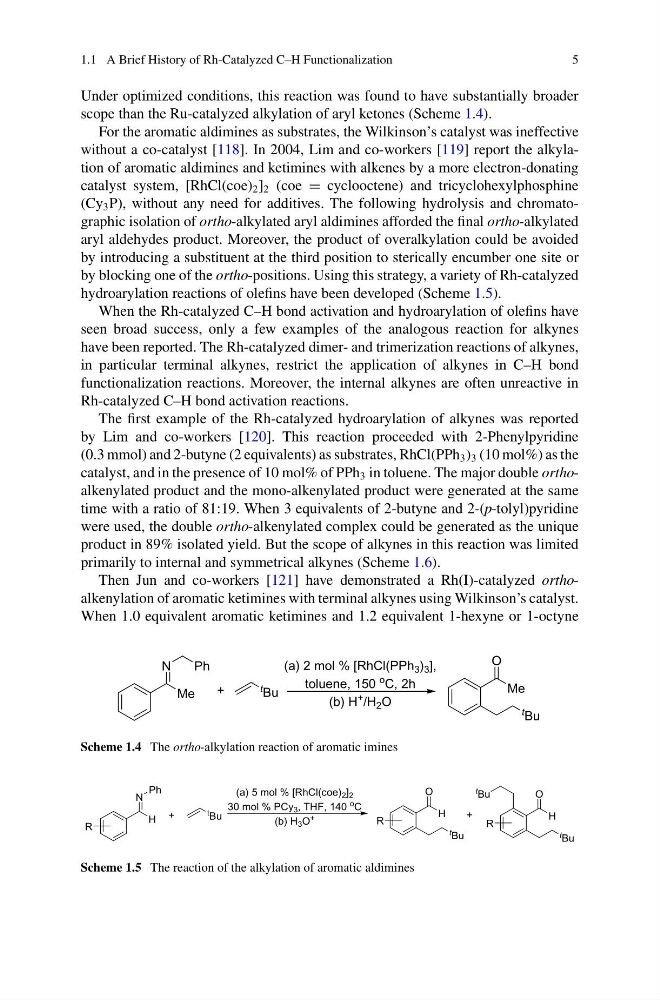
scope than the Ru-catalyzed alkylation of aryl ketones (Scheme 1.4).
For the aromatic aldimines as substrates, the Wilkinson’s catalyst was ineffective
without a co-catalyst [118]. In 2004, Lim and co-workers [119] report the alkylation of aromatic aldimines and ketimines with alkenes by a more electron-donating
catalyst system, [RhCl(coe) 2 ] 2 (coe = cyclooctene) and tricyclohexylphosphine
(Cy 3 P), without any need for additives. The following hydrolysis and chromatographic isolation of ortho-alkylated aryl aldimines afforded the final ortho-alkylated
aryl aldehydes product. Moreover, the product of overalkylation could be avoided
by introducing a substituent at the third position to sterically encumber one site or
by blocking one of the ortho-positions. Using this strategy, a variety of Rh-catalyzed
hydroarylation reactions of olefins have been developed (Scheme 1.5).
When the Rh-catalyzed C–H bond activation and hydroarylation of olefins have
seen broad success, only a few examples of the analogous reaction for alkynes
have been reported. The Rh-catalyzed dimer- and trimerization reactions of alkynes,
in particular terminal alkynes, restrict the application of alkynes in C–H bond
functionalization reactions. Moreover, the internal alkynes are often unreactive in
Rh-catalyzed C–H bond activation reactions.
The first example of the Rh-catalyzed hydroarylation of alkynes was reported
by Lim and co-workers [120]. This reaction proceeded with 2-Phenylpyridine
(0.3 mmol) and 2-butyne (2 equivalents) as substrates, RhCl(PPh 3 ) 3 (10 mol%) as the
catalyst, and in the presence of 10 mol% of PPh 3 in toluene. The major double orthoalkenylated product and the mono-alkenylated product were generated at the same
time with a ratio of 81:19. When 3 equivalents of 2-butyne and 2-(p-tolyl)pyridine
were used, the double ortho-alkenylated complex could be generated as the unique
product in 89% isolated yield. But the scope of alkynes in this reaction was limited
primarily to internal and symmetrical alkynes (Scheme 1.6).
Then Jun and co-workers [121] have demonstrated a Rh(I)-catalyzed orthoalkenylation of aromatic ketimines with terminal alkynes using Wilkinson’s catalyst.
When 1.0 equivalent aromatic ketimines and 1.2 equivalent 1-hexyne or 1-octyne
Me
+
Me
O
t Bu
(a) 2 mol % [RhCl(PPh 3 ) 3 ],
toluene, 150
o C, 2h
(b) H
+ /H 2 O
N
Ph
t Bu
Scheme 1.4 The ortho-alkylation reaction of aromatic imines
H
N
R
t Bu
+
H
t Bu
O
+
H
t Bu
O
(a) 5 mol % [RhCl(coe) 2 ] 2
30 mol % PCy 3 , THF, 140
o C
(b) H 3 O
+
Ph
R
t Bu
R
Scheme 1.5 The reaction of the alkylation of aromatic aldimines
5
Under optimized conditions, this reaction was found to have substantially broader
scope than the Ru-catalyzed alkylation of aryl ketones (Scheme 1.4).
For the aromatic aldimines as substrates, the Wilkinson’s catalyst was ineffective
without a co-catalyst [118]. In 2004, Lim and co-workers [119] report the alkylation of aromatic aldimines and ketimines with alkenes by a more electron-donating
catalyst system, [RhCl(coe) 2 ] 2 (coe = cyclooctene) and tricyclohexylphosphine
(Cy 3 P), without any need for additives. The following hydrolysis and chromatographic isolation of ortho-alkylated aryl aldimines afforded the final ortho-alkylated
aryl aldehydes product. Moreover, the product of overalkylation could be avoided
by introducing a substituent at the third position to sterically encumber one site or
by blocking one of the ortho-positions. Using this strategy, a variety of Rh-catalyzed
hydroarylation reactions of olefins have been developed (Scheme 1.5).
When the Rh-catalyzed C–H bond activation and hydroarylation of olefins have
seen broad success, only a few examples of the analogous reaction for alkynes
have been reported. The Rh-catalyzed dimer- and trimerization reactions of alkynes,
in particular terminal alkynes, restrict the application of alkynes in C–H bond
functionalization reactions. Moreover, the internal alkynes are often unreactive in
Rh-catalyzed C–H bond activation reactions.
The first example of the Rh-catalyzed hydroarylation of alkynes was reported
by Lim and co-workers [120]. This reaction proceeded with 2-Phenylpyridine
(0.3 mmol) and 2-butyne (2 equivalents) as substrates, RhCl(PPh 3 ) 3 (10 mol%) as the
catalyst, and in the presence of 10 mol% of PPh 3 in toluene. The major double orthoalkenylated product and the mono-alkenylated product were generated at the same
time with a ratio of 81:19. When 3 equivalents of 2-butyne and 2-(p-tolyl)pyridine
were used, the double ortho-alkenylated complex could be generated as the unique
product in 89% isolated yield. But the scope of alkynes in this reaction was limited
primarily to internal and symmetrical alkynes (Scheme 1.6).
Then Jun and co-workers [121] have demonstrated a Rh(I)-catalyzed orthoalkenylation of aromatic ketimines with terminal alkynes using Wilkinson’s catalyst.
When 1.0 equivalent aromatic ketimines and 1.2 equivalent 1-hexyne or 1-octyne
Me
+
Me
O
t Bu
(a) 2 mol % [RhCl(PPh 3 ) 3 ],
toluene, 150
o C, 2h
(b) H
+ /H 2 O
N
Ph
t Bu
Scheme 1.4 The ortho-alkylation reaction of aromatic imines
H
N
R
t Bu
+
H
t Bu
O
+
H
t Bu
O
(a) 5 mol % [RhCl(coe) 2 ] 2
30 mol % PCy 3 , THF, 140
o C
(b) H 3 O
+
Ph
R
t Bu
R
Scheme 1.5 The reaction of the alkylation of aromatic aldimines