

4
1 Theoretical View of Rh-Catalyzed C–H Functionalization
As an overview of Rh-catalyzed C–H functionalization, the core is the formation
of a rhodium–carbon bond and its further transformation. The rhodium-catalyzed
process usually goes through multiple steps as well as complicated catalytic cycles,
which originated from the complex bonding pattern of rhodium catalyst and the
variation of valance state for the central rhodium element. Consequently, improving
the reaction efficiency and yield for rhodium catalysis encountered difficulty. Moreover, the design of catalysis and ligand for the rhodium-catalyzed reaction is still
facing both opportunities and challenges. To solve the above-mentioned issues, the
understanding of the reaction mechanism is imperative, which could give more information for the detailed reaction process, and help to improve the reaction efficiency
and yield.
1.1.2 A Brief History of Rh-Catalyzed C–H Functionalization
Transition metal-catalyzed C–H bond functionalization has been a highly intriguing
research topic for the past two decades from the atom- and step-economical points
[112–116]. A variety of catalytic processes that use different transition metals and
modes for activating the inert C–H bond have been developed. The key issue for the
development of C–H bond activation is the selective activation of a targeted C–H
bond over the other C–H bonds in the substrate. The most promising and useful
strategy is to utilize coordination of a functional group in the substrate to the metal
center of a catalyst to conduct the selective activation of C–H bond.
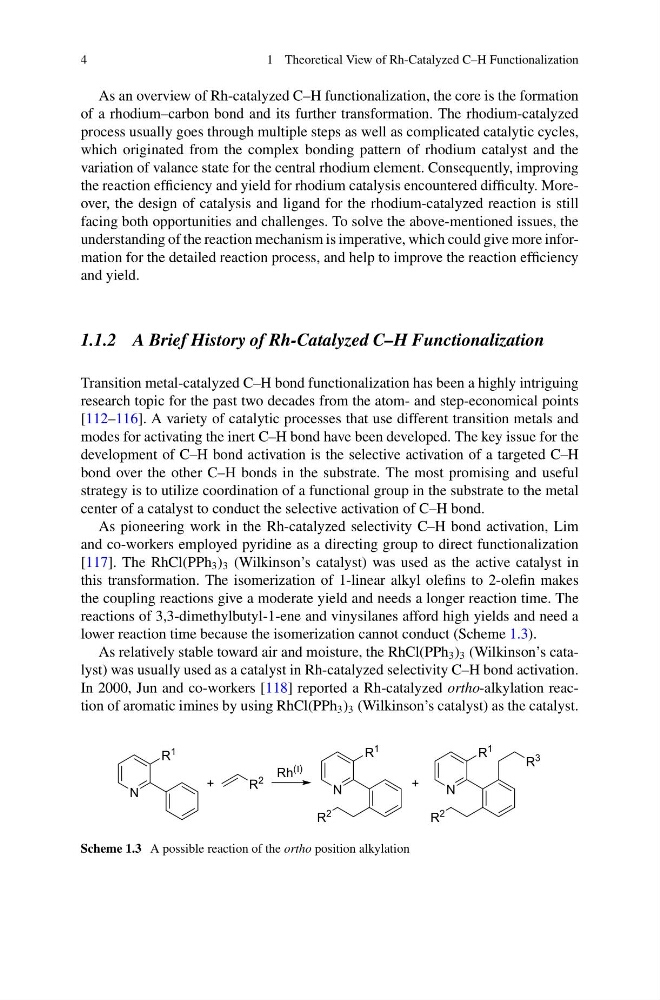
As pioneering work in the Rh-catalyzed selectivity C–H bond activation, Lim
and co-workers employed pyridine as a directing group to direct functionalization
[117]. The RhCl(PPh 3 ) 3 (Wilkinson’s catalyst) was used as the active catalyst in
this transformation. The isomerization of 1-linear alkyl olefins to 2-olefin makes
the coupling reactions give a moderate yield and needs a longer reaction time. The
reactions of 3,3-dimethylbutyl-1-ene and vinysilanes afford high yields and need a
lower reaction time because the isomerization cannot conduct (Scheme 1.3).
As relatively stable toward air and moisture, the RhCl(PPh 3 ) 3 (Wilkinson’s catalyst) was usually used as a catalyst in Rh-catalyzed selectivity C–H bond activation.
In 2000, Jun and co-workers [118] reported a Rh-catalyzed ortho-alkylation reaction of aromatic imines by using RhCl(PPh 3 ) 3 (Wilkinson’s catalyst) as the catalyst.
N
R
1
R
2
N
R
1
+
N
R
1
Rh
(I)
R
2
R
2
R
3
+
Scheme 1.3 A possible reaction of the ortho position alkylation
1 Theoretical View of Rh-Catalyzed C–H Functionalization
As an overview of Rh-catalyzed C–H functionalization, the core is the formation
of a rhodium–carbon bond and its further transformation. The rhodium-catalyzed
process usually goes through multiple steps as well as complicated catalytic cycles,
which originated from the complex bonding pattern of rhodium catalyst and the
variation of valance state for the central rhodium element. Consequently, improving
the reaction efficiency and yield for rhodium catalysis encountered difficulty. Moreover, the design of catalysis and ligand for the rhodium-catalyzed reaction is still
facing both opportunities and challenges. To solve the above-mentioned issues, the
understanding of the reaction mechanism is imperative, which could give more information for the detailed reaction process, and help to improve the reaction efficiency
and yield.
1.1.2 A Brief History of Rh-Catalyzed C–H Functionalization
Transition metal-catalyzed C–H bond functionalization has been a highly intriguing
research topic for the past two decades from the atom- and step-economical points
[112–116]. A variety of catalytic processes that use different transition metals and
modes for activating the inert C–H bond have been developed. The key issue for the
development of C–H bond activation is the selective activation of a targeted C–H
bond over the other C–H bonds in the substrate. The most promising and useful
strategy is to utilize coordination of a functional group in the substrate to the metal
center of a catalyst to conduct the selective activation of C–H bond.
As pioneering work in the Rh-catalyzed selectivity C–H bond activation, Lim
and co-workers employed pyridine as a directing group to direct functionalization
[117]. The RhCl(PPh 3 ) 3 (Wilkinson’s catalyst) was used as the active catalyst in
this transformation. The isomerization of 1-linear alkyl olefins to 2-olefin makes
the coupling reactions give a moderate yield and needs a longer reaction time. The
reactions of 3,3-dimethylbutyl-1-ene and vinysilanes afford high yields and need a
lower reaction time because the isomerization cannot conduct (Scheme 1.3).
As relatively stable toward air and moisture, the RhCl(PPh 3 ) 3 (Wilkinson’s catalyst) was usually used as a catalyst in Rh-catalyzed selectivity C–H bond activation.
In 2000, Jun and co-workers [118] reported a Rh-catalyzed ortho-alkylation reaction of aromatic imines by using RhCl(PPh 3 ) 3 (Wilkinson’s catalyst) as the catalyst.
N
R
1
R
2
N
R
1
+
N
R
1
Rh
(I)
R
2
R
2
R
3
+
Scheme 1.3 A possible reaction of the ortho position alkylation