

118
4 Theoretical View of Rh-Catalyzed C–H Functionalization …
4-149
0.0
(kcal/mol)
4-150ts
12.7
4-151
4.9
4-152
9.9
4-154
3.2
G(M06,THF)
C-H bond cleavage
reductive elimination
4-155ts
19.0
4-156
5.4
4-157ts
14.1
4-149
4-150ts
4-151
4-152ts
O
Ph
SiEt 2
4-153
4-153
Rh
P
P
H
4-154
4-156
4-157ts
4-158
O
Ph
SiEt 2
4-158
4-150ts
4-155ts
1.60
1.51
2.17
1.63
1.44
2.17
Rh
Et 2
Si
P
P
O
Ph
Ph
Rh
Et 2
Si
P
P
O
Ph
H
Rh
Et 2
Si
P
P
O
Ph
H
4-155ts
Rh
Et 2
Si
P
P
O
Ph
H
Rh
P
P H
Et 2 Si O
Ph
Rh
Et 2
Si
P
P
O
Ph
H
Rh
Et 2 Si
P
P
O
Ph
H
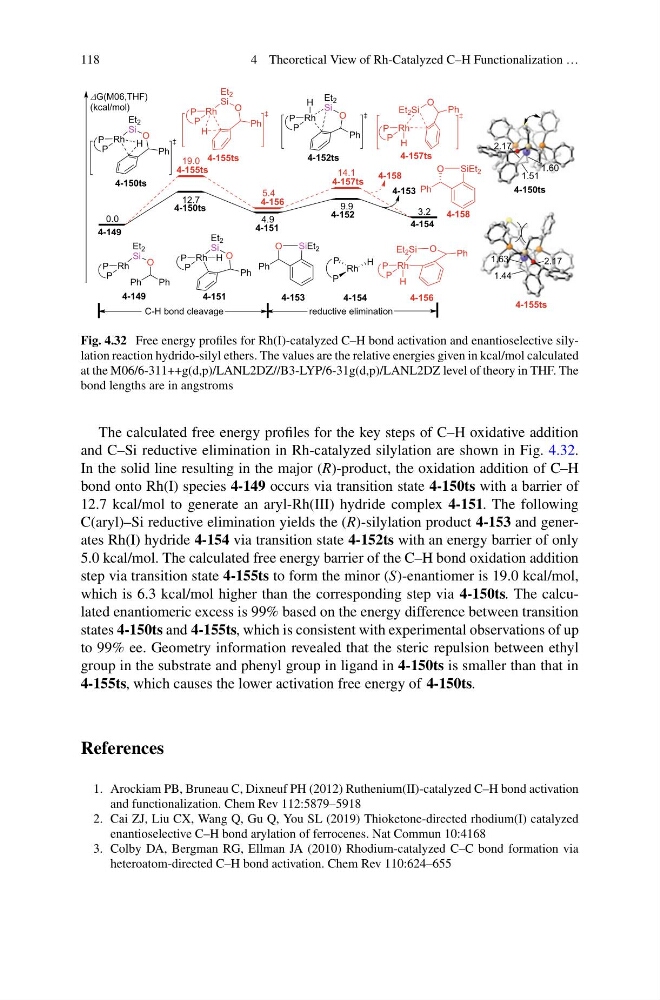
Fig. 4.32 Free energy profiles for Rh(I)-catalyzed C–H bond activation and enantioselective silylation reaction hydrido-silyl ethers. The values are the relative energies given in kcal/mol calculated
at the M06/6-311++g(d,p)/LANL2DZ//B3-LYP/6-31g(d,p)/LANL2DZ level of theory in THF. The
bond lengths are in angstroms
The calculated free energy profiles for the key steps of C–H oxidative addition
and C–Si reductive elimination in Rh-catalyzed silylation are shown in Fig. 4.32.
In the solid line resulting in the major (R)-product, the oxidation addition of C–H
bond onto Rh(I) species 4-149 occurs via transition state 4-150ts with a barrier of
12.7 kcal/mol to generate an aryl-Rh(III) hydride complex 4-151. The following
C(aryl)–Si reductive elimination yields the (R)-silylation product 4-153 and generates Rh(I) hydride 4-154 via transition state 4-152ts with an energy barrier of only
5.0 kcal/mol. The calculated free energy barrier of the C–H bond oxidation addition
step via transition state 4-155ts to form the minor (S)-enantiomer is 19.0 kcal/mol,
which is 6.3 kcal/mol higher than the corresponding step via 4-150ts. The calculated enantiomeric excess is 99% based on the energy difference between transition
states 4-150ts and 4-155ts, which is consistent with experimental observations of up
to 99% ee. Geometry information revealed that the steric repulsion between ethyl
group in the substrate and phenyl group in ligand in 4-150ts is smaller than that in
4-155ts, which causes the lower activation free energy of 4-150ts.
References
1. Arockiam PB, Bruneau C, Dixneuf PH (2012) Ruthenium(II)-catalyzed C–H bond activation
and functionalization. Chem Rev 112:5879–5918
2. Cai ZJ, Liu CX, Wang Q, Gu Q, You SL (2019) Thioketone-directed rhodium(I) catalyzed
enantioselective C–H bond arylation of ferrocenes. Nat Commun 10:4168
3. Colby DA, Bergman RG, Ellman JA (2010) Rhodium-catalyzed C–C bond formation via
heteroatom-directed C–H bond activation. Chem Rev 110:624–655
4 Theoretical View of Rh-Catalyzed C–H Functionalization …
4-149
0.0
(kcal/mol)
4-150ts
12.7
4-151
4.9
4-152
9.9
4-154
3.2
G(M06,THF)
C-H bond cleavage
reductive elimination
4-155ts
19.0
4-156
5.4
4-157ts
14.1
4-149
4-150ts
4-151
4-152ts
O
Ph
SiEt 2
4-153
4-153
Rh
P
P
H
4-154
4-156
4-157ts
4-158
O
Ph
SiEt 2
4-158
4-150ts
4-155ts
1.60
1.51
2.17
1.63
1.44
2.17
Rh
Et 2
Si
P
P
O
Ph
Ph
Rh
Et 2
Si
P
P
O
Ph
H
Rh
Et 2
Si
P
P
O
Ph
H
4-155ts
Rh
Et 2
Si
P
P
O
Ph
H
Rh
P
P H
Et 2 Si O
Ph
Rh
Et 2
Si
P
P
O
Ph
H
Rh
Et 2 Si
P
P
O
Ph
H
Fig. 4.32 Free energy profiles for Rh(I)-catalyzed C–H bond activation and enantioselective silylation reaction hydrido-silyl ethers. The values are the relative energies given in kcal/mol calculated
at the M06/6-311++g(d,p)/LANL2DZ//B3-LYP/6-31g(d,p)/LANL2DZ level of theory in THF. The
bond lengths are in angstroms
The calculated free energy profiles for the key steps of C–H oxidative addition
and C–Si reductive elimination in Rh-catalyzed silylation are shown in Fig. 4.32.
In the solid line resulting in the major (R)-product, the oxidation addition of C–H
bond onto Rh(I) species 4-149 occurs via transition state 4-150ts with a barrier of
12.7 kcal/mol to generate an aryl-Rh(III) hydride complex 4-151. The following
C(aryl)–Si reductive elimination yields the (R)-silylation product 4-153 and generates Rh(I) hydride 4-154 via transition state 4-152ts with an energy barrier of only
5.0 kcal/mol. The calculated free energy barrier of the C–H bond oxidation addition
step via transition state 4-155ts to form the minor (S)-enantiomer is 19.0 kcal/mol,
which is 6.3 kcal/mol higher than the corresponding step via 4-150ts. The calculated enantiomeric excess is 99% based on the energy difference between transition
states 4-150ts and 4-155ts, which is consistent with experimental observations of up
to 99% ee. Geometry information revealed that the steric repulsion between ethyl
group in the substrate and phenyl group in ligand in 4-150ts is smaller than that in
4-155ts, which causes the lower activation free energy of 4-150ts.
References
1. Arockiam PB, Bruneau C, Dixneuf PH (2012) Ruthenium(II)-catalyzed C–H bond activation
and functionalization. Chem Rev 112:5879–5918
2. Cai ZJ, Liu CX, Wang Q, Gu Q, You SL (2019) Thioketone-directed rhodium(I) catalyzed
enantioselective C–H bond arylation of ferrocenes. Nat Commun 10:4168
3. Colby DA, Bergman RG, Ellman JA (2010) Rhodium-catalyzed C–C bond formation via
heteroatom-directed C–H bond activation. Chem Rev 110:624–655