

4.5 C–Si Bond Formation
117
complex 4-141, which is isolated and characterized by NMR spectroscopy and Xray diffraction. In one possible pathway, intermolecular insertion of cyclohexene
into the Rh–H bond generates cyclohexyl-silyl-Rh(III) hydride 4-145. Alternatively,
the reversible reductive elimination of Si-H in 4-141 forms Rh(I) hydride 4-142.
Then a reversible insertion of cyclohexene into the Rh–H bond gives cyclohexylRh(I) intermediate 4-144. The oxidative addition of Si–H onto Rh(I) could also give
common intermediate 4-145, which would undertake C–H reductive elimination
to generate silyl-Rh(I) complex 4-146 with the release of cyclohexane. Then, the
sequential C–H bond activation of the arene and C(aryl)–Si reductive elimination
yield the silylarene product 4-148.
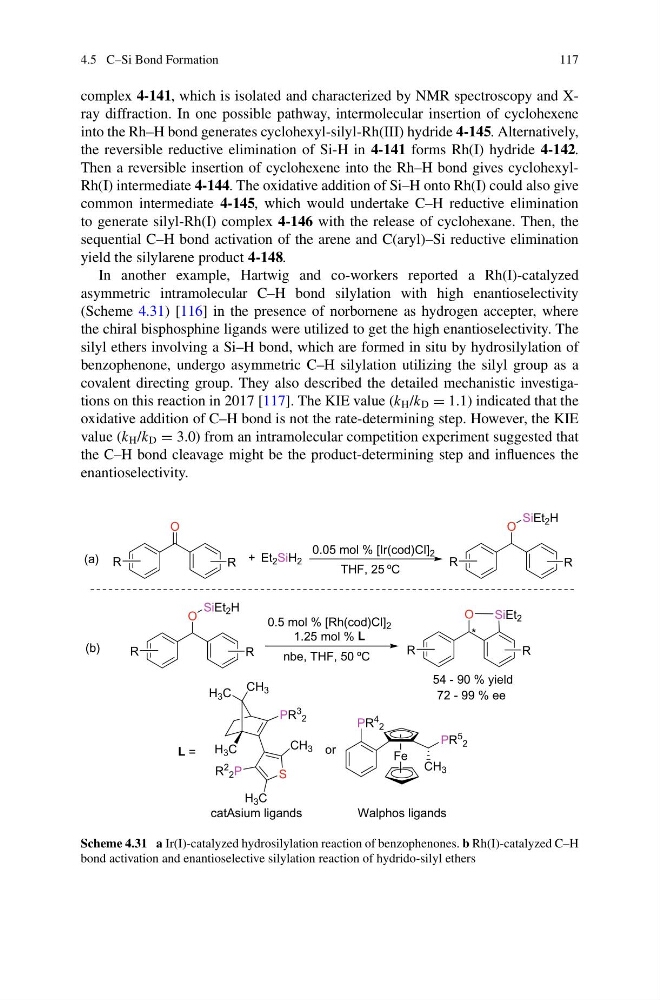
In another example, Hartwig and co-workers reported a Rh(I)-catalyzed
asymmetric intramolecular C–H bond silylation with high enantioselectivity
(Scheme 4.31) [116] in the presence of norbornene as hydrogen accepter, where
the chiral bisphosphine ligands were utilized to get the high enantioselectivity. The
silyl ethers involving a Si–H bond, which are formed in situ by hydrosilylation of
benzophenone, undergo asymmetric C–H silylation utilizing the silyl group as a
covalent directing group. They also described the detailed mechanistic investigations on this reaction in 2017 [117]. The KIE value (k H /k D = 1.1) indicated that the
oxidative addition of C–H bond is not the rate-determining step. However, the KIE
value (k H /k D = 3.0) from an intramolecular competition experiment suggested that
the C–H bond cleavage might be the product-determining step and influences the
enantioselectivity.
Fe
0.05 mol % [Ir(cod)Cl] 2
THF, 25 ºC
L =
O
R
R + Et 2 SiH 2
O
R
R
SiEt 2 H
0.5 mol % [Rh(cod)Cl] 2
1.25 mol % L
nbe, THF, 50 ºC
O
R
R
SiEt 2 H
O
R
R
SiEt 2
*
54 - 90 % yield
72 - 99 % ee
CH 3
H 3 C
H 3 C
PR
3
2
(a)
(b)
S
CH 3
R
2
2 P
H 3 C
catAsium ligands
or
PR
5
2
CH 3
PR
4
2
Walphos ligands
Scheme 4.31 a Ir(I)-catalyzed hydrosilylation reaction of benzophenones. b Rh(I)-catalyzed C–H
bond activation and enantioselective silylation reaction of hydrido-silyl ethers
117
complex 4-141, which is isolated and characterized by NMR spectroscopy and Xray diffraction. In one possible pathway, intermolecular insertion of cyclohexene
into the Rh–H bond generates cyclohexyl-silyl-Rh(III) hydride 4-145. Alternatively,
the reversible reductive elimination of Si-H in 4-141 forms Rh(I) hydride 4-142.
Then a reversible insertion of cyclohexene into the Rh–H bond gives cyclohexylRh(I) intermediate 4-144. The oxidative addition of Si–H onto Rh(I) could also give
common intermediate 4-145, which would undertake C–H reductive elimination
to generate silyl-Rh(I) complex 4-146 with the release of cyclohexane. Then, the
sequential C–H bond activation of the arene and C(aryl)–Si reductive elimination
yield the silylarene product 4-148.
In another example, Hartwig and co-workers reported a Rh(I)-catalyzed
asymmetric intramolecular C–H bond silylation with high enantioselectivity
(Scheme 4.31) [116] in the presence of norbornene as hydrogen accepter, where
the chiral bisphosphine ligands were utilized to get the high enantioselectivity. The
silyl ethers involving a Si–H bond, which are formed in situ by hydrosilylation of
benzophenone, undergo asymmetric C–H silylation utilizing the silyl group as a
covalent directing group. They also described the detailed mechanistic investigations on this reaction in 2017 [117]. The KIE value (k H /k D = 1.1) indicated that the
oxidative addition of C–H bond is not the rate-determining step. However, the KIE
value (k H /k D = 3.0) from an intramolecular competition experiment suggested that
the C–H bond cleavage might be the product-determining step and influences the
enantioselectivity.
Fe
0.05 mol % [Ir(cod)Cl] 2
THF, 25 ºC
L =
O
R
R + Et 2 SiH 2
O
R
R
SiEt 2 H
0.5 mol % [Rh(cod)Cl] 2
1.25 mol % L
nbe, THF, 50 ºC
O
R
R
SiEt 2 H
O
R
R
SiEt 2
*
54 - 90 % yield
72 - 99 % ee
CH 3
H 3 C
H 3 C
PR
3
2
(a)
(b)
S
CH 3
R
2
2 P
H 3 C
catAsium ligands
or
PR
5
2
CH 3
PR
4
2
Walphos ligands
Scheme 4.31 a Ir(I)-catalyzed hydrosilylation reaction of benzophenones. b Rh(I)-catalyzed C–H
bond activation and enantioselective silylation reaction of hydrido-silyl ethers