

116
4 Theoretical View of Rh-Catalyzed C–H Functionalization …
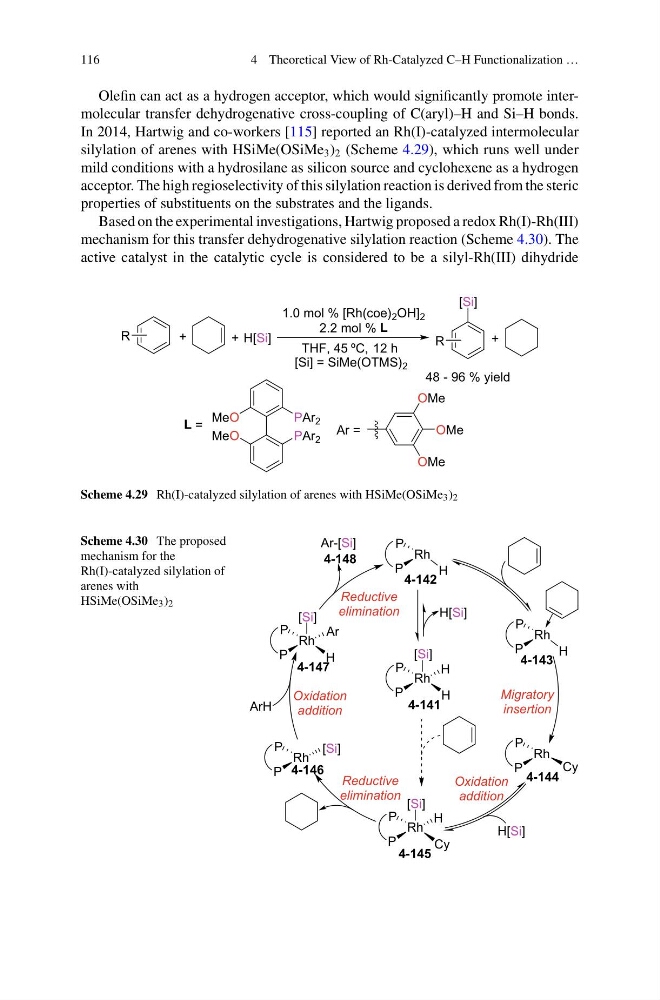
Olefin can act as a hydrogen acceptor, which would significantly promote intermolecular transfer dehydrogenative cross-coupling of C(aryl)–H and Si–H bonds.
In 2014, Hartwig and co-workers [115] reported an Rh(I)-catalyzed intermolecular
silylation of arenes with HSiMe(OSiMe 3 ) 2 (Scheme 4.29), which runs well under
mild conditions with a hydrosilane as silicon source and cyclohexene as a hydrogen
acceptor. The high regioselectivity of this silylation reaction is derived from the steric
properties of substituents on the substrates and the ligands.
Based on the experimental investigations, Hartwig proposed a redox Rh(I)-Rh(III)
mechanism for this transfer dehydrogenative silylation reaction (Scheme 4.30). The
active catalyst in the catalytic cycle is considered to be a silyl-Rh(III) dihydride
1.0 mol % [Rh(coe) 2 OH] 2
2.2 mol % L
THF, 45 ºC, 12 h
48 - 96 % yield
R
+
+ H[Si]
[Si] = SiMe(OTMS) 2
R
[Si]
+
L =
MeO
PAr 2
MeO
PAr 2
Ar =
OMe
OMe
OMe
Scheme 4.29 Rh(I)-catalyzed silylation of arenes with HSiMe(OSiMe 3 ) 2
Scheme 4.30 The proposed
mechanism for the
Rh(I)-catalyzed silylation of
arenes with
HSiMe(OSiMe 3 ) 2
Migratory
insertion
4-141
Rh
P
P
H
Rh
P
P
H
H
[Si]
4-142
H[Si]
Rh
P
P
H
4-143
Rh
P
P 4-144
Cy
4-145
Rh
P
P
Cy
H
[Si]
4-146
Rh
P
P
[Si]
ArH
4-147
Rh
P
P
H
Ar
[Si]
Ar-[Si]
4-148
H[Si]
Oxidation
addition
Reductive
elimination
Oxidation
addition
Reductive
elimination
4 Theoretical View of Rh-Catalyzed C–H Functionalization …
Olefin can act as a hydrogen acceptor, which would significantly promote intermolecular transfer dehydrogenative cross-coupling of C(aryl)–H and Si–H bonds.
In 2014, Hartwig and co-workers [115] reported an Rh(I)-catalyzed intermolecular
silylation of arenes with HSiMe(OSiMe 3 ) 2 (Scheme 4.29), which runs well under
mild conditions with a hydrosilane as silicon source and cyclohexene as a hydrogen
acceptor. The high regioselectivity of this silylation reaction is derived from the steric
properties of substituents on the substrates and the ligands.
Based on the experimental investigations, Hartwig proposed a redox Rh(I)-Rh(III)
mechanism for this transfer dehydrogenative silylation reaction (Scheme 4.30). The
active catalyst in the catalytic cycle is considered to be a silyl-Rh(III) dihydride
1.0 mol % [Rh(coe) 2 OH] 2
2.2 mol % L
THF, 45 ºC, 12 h
48 - 96 % yield
R
+
+ H[Si]
[Si] = SiMe(OTMS) 2
R
[Si]
+
L =
MeO
PAr 2
MeO
PAr 2
Ar =
OMe
OMe
OMe
Scheme 4.29 Rh(I)-catalyzed silylation of arenes with HSiMe(OSiMe 3 ) 2
Scheme 4.30 The proposed
mechanism for the
Rh(I)-catalyzed silylation of
arenes with
HSiMe(OSiMe 3 ) 2
Migratory
insertion
4-141
Rh
P
P
H
Rh
P
P
H
H
[Si]
4-142
H[Si]
Rh
P
P
H
4-143
Rh
P
P 4-144
Cy
4-145
Rh
P
P
Cy
H
[Si]
4-146
Rh
P
P
[Si]
ArH
4-147
Rh
P
P
H
Ar
[Si]
Ar-[Si]
4-148
H[Si]
Oxidation
addition
Reductive
elimination
Oxidation
addition
Reductive
elimination