

4.5 C–Si Bond Formation
115
activation of the phenyl group is the rate-determining step in the catalytic cycle
(Scheme 4.27).
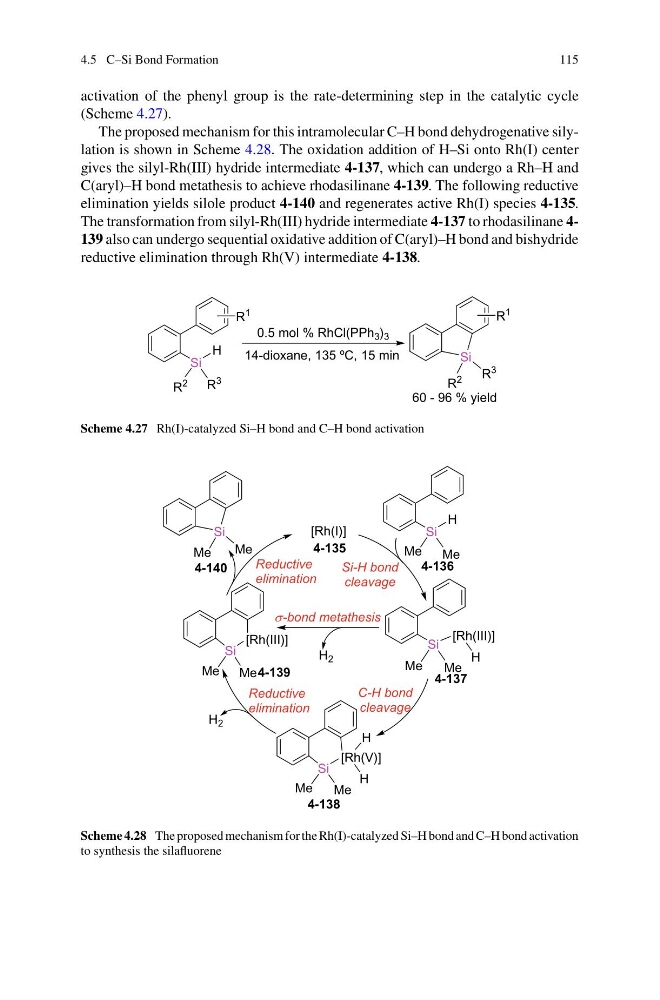
The proposed mechanism for this intramolecular C–H bond dehydrogenative silylation is shown in Scheme 4.28. The oxidation addition of H–Si onto Rh(I) center
gives the silyl-Rh(III) hydride intermediate 4-137, which can undergo a Rh–H and
C(aryl)–H bond metathesis to achieve rhodasilinane 4-139. The following reductive
elimination yields silole product 4-140 and regenerates active Rh(I) species 4-135.
The transformation from silyl-Rh(III) hydride intermediate 4-137 to rhodasilinane 4139 also can undergo sequential oxidative addition of C(aryl)–H bond and bishydride
reductive elimination through Rh(V) intermediate 4-138.
0.5 mol % RhCl(PPh 3 ) 3
14-dioxane, 135 ºC, 15 min
60 - 96 % yield
R
1
Si
H
R
2
R
3
R
1
Si
R
2
R
3
Scheme 4.27 Rh(I)-catalyzed Si–H bond and C–H bond activation
[Rh(I)]
Reductive
elimination
Si-H bond
cleavage
4-135
Si
H
Me
Me
Si
[Rh(III)]
Me
Me
4-136
H
4-137
C-H bond
cleavage
Si
[Rh(V)]
Me
Me
H
4-138
H
Reductive
elimination
H 2
Si
[Rh(III)]
Me
Me4-139
Si
Me
Me
4-140
-bond metathesis
H 2
Scheme 4.28 The proposed mechanism for the Rh(I)-catalyzed Si–H bond and C–H bond activation
to synthesis the silafluorene
115
activation of the phenyl group is the rate-determining step in the catalytic cycle
(Scheme 4.27).
The proposed mechanism for this intramolecular C–H bond dehydrogenative silylation is shown in Scheme 4.28. The oxidation addition of H–Si onto Rh(I) center
gives the silyl-Rh(III) hydride intermediate 4-137, which can undergo a Rh–H and
C(aryl)–H bond metathesis to achieve rhodasilinane 4-139. The following reductive
elimination yields silole product 4-140 and regenerates active Rh(I) species 4-135.
The transformation from silyl-Rh(III) hydride intermediate 4-137 to rhodasilinane 4139 also can undergo sequential oxidative addition of C(aryl)–H bond and bishydride
reductive elimination through Rh(V) intermediate 4-138.
0.5 mol % RhCl(PPh 3 ) 3
14-dioxane, 135 ºC, 15 min
60 - 96 % yield
R
1
Si
H
R
2
R
3
R
1
Si
R
2
R
3
Scheme 4.27 Rh(I)-catalyzed Si–H bond and C–H bond activation
[Rh(I)]
Reductive
elimination
Si-H bond
cleavage
4-135
Si
H
Me
Me
Si
[Rh(III)]
Me
Me
4-136
H
4-137
C-H bond
cleavage
Si
[Rh(V)]
Me
Me
H
4-138
H
Reductive
elimination
H 2
Si
[Rh(III)]
Me
Me4-139
Si
Me
Me
4-140
-bond metathesis
H 2
Scheme 4.28 The proposed mechanism for the Rh(I)-catalyzed Si–H bond and C–H bond activation
to synthesis the silafluorene