

114
4 Theoretical View of Rh-Catalyzed C–H Functionalization …
4-127
0.0
(kcal/mol)
4-129
4.7
4-130ts
17.8
4-131
12.4
4-132ts
21.1
G(B3-LYP)
C-H bond cleavage
4-134
1.4
reductive elimination
4-128
4-133
Rh
R 2 B
BR 2
4-127
H 3 C H
4-129
4-130ts
4-131
4-132ts
R 2 B CH 3
Rh
R 2 B
H
4-134
BR 2 = B
O
O
Rh
R 2 B
R 2 B H 3 C
H
Rh
R 2 B
R 2 B CH 3
H
Rh
R 2 B
R 2 B
CH 2
H
Rh
R 2 B
R 2 B
CH 2
H
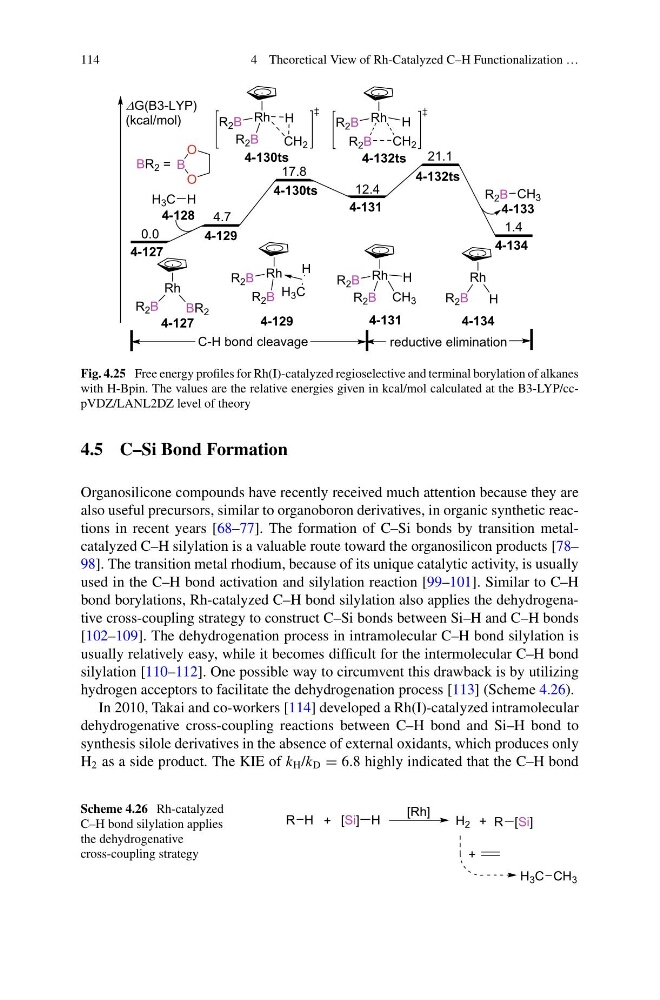
Fig. 4.25 Free energy profiles for Rh(I)-catalyzed regioselective and terminal borylation of alkanes
with H-Bpin. The values are the relative energies given in kcal/mol calculated at the B3-LYP/ccpVDZ/LANL2DZ level of theory
4.5 C–Si Bond Formation
Organosilicone compounds have recently received much attention because they are
also useful precursors, similar to organoboron derivatives, in organic synthetic reactions in recent years [68–77]. The formation of C–Si bonds by transition metalcatalyzed C–H silylation is a valuable route toward the organosilicon products [78–
98]. The transition metal rhodium, because of its unique catalytic activity, is usually
used in the C–H bond activation and silylation reaction [99–101]. Similar to C–H
bond borylations, Rh-catalyzed C–H bond silylation also applies the dehydrogenative cross-coupling strategy to construct C–Si bonds between Si–H and C–H bonds
[102–109]. The dehydrogenation process in intramolecular C–H bond silylation is
usually relatively easy, while it becomes difficult for the intermolecular C–H bond
silylation [110–112]. One possible way to circumvent this drawback is by utilizing
hydrogen acceptors to facilitate the dehydrogenation process [113] (Scheme 4.26).
In 2010, Takai and co-workers [114] developed a Rh(I)-catalyzed intramolecular
dehydrogenative cross-coupling reactions between C–H bond and Si–H bond to
synthesis silole derivatives in the absence of external oxidants, which produces only
H 2 as a side product. The KIE of k H /k D = 6.8 highly indicated that the C–H bond
Scheme 4.26 Rh-catalyzed
C–H bond silylation applies
the dehydrogenative
cross-coupling strategy
R H + [Si] H
[Rh]
H 2 + R [Si]
H 3 C CH 3
+
4 Theoretical View of Rh-Catalyzed C–H Functionalization …
4-127
0.0
(kcal/mol)
4-129
4.7
4-130ts
17.8
4-131
12.4
4-132ts
21.1
G(B3-LYP)
C-H bond cleavage
4-134
1.4
reductive elimination
4-128
4-133
Rh
R 2 B
BR 2
4-127
H 3 C H
4-129
4-130ts
4-131
4-132ts
R 2 B CH 3
Rh
R 2 B
H
4-134
BR 2 = B
O
O
Rh
R 2 B
R 2 B H 3 C
H
Rh
R 2 B
R 2 B CH 3
H
Rh
R 2 B
R 2 B
CH 2
H
Rh
R 2 B
R 2 B
CH 2
H
Fig. 4.25 Free energy profiles for Rh(I)-catalyzed regioselective and terminal borylation of alkanes
with H-Bpin. The values are the relative energies given in kcal/mol calculated at the B3-LYP/ccpVDZ/LANL2DZ level of theory
4.5 C–Si Bond Formation
Organosilicone compounds have recently received much attention because they are
also useful precursors, similar to organoboron derivatives, in organic synthetic reactions in recent years [68–77]. The formation of C–Si bonds by transition metalcatalyzed C–H silylation is a valuable route toward the organosilicon products [78–
98]. The transition metal rhodium, because of its unique catalytic activity, is usually
used in the C–H bond activation and silylation reaction [99–101]. Similar to C–H
bond borylations, Rh-catalyzed C–H bond silylation also applies the dehydrogenative cross-coupling strategy to construct C–Si bonds between Si–H and C–H bonds
[102–109]. The dehydrogenation process in intramolecular C–H bond silylation is
usually relatively easy, while it becomes difficult for the intermolecular C–H bond
silylation [110–112]. One possible way to circumvent this drawback is by utilizing
hydrogen acceptors to facilitate the dehydrogenation process [113] (Scheme 4.26).
In 2010, Takai and co-workers [114] developed a Rh(I)-catalyzed intramolecular
dehydrogenative cross-coupling reactions between C–H bond and Si–H bond to
synthesis silole derivatives in the absence of external oxidants, which produces only
H 2 as a side product. The KIE of k H /k D = 6.8 highly indicated that the C–H bond
Scheme 4.26 Rh-catalyzed
C–H bond silylation applies
the dehydrogenative
cross-coupling strategy
R H + [Si] H
[Rh]
H 2 + R [Si]
H 3 C CH 3
+