

4.4 C–B Bond Formation
113
4-116ts to give a η
3 -benzylic Rh(III)-hydride intermediate 4-117 with a barrier of
23.5 kcal/mol. This C–H bond cleavage is considered to be the rate-determining step
in the catalytic cycle. The reductive elimination of two hydrides in 4-117 and sequential substitution of dihydrogen by H-Bpin give intermediate 4-120. The following
oxidation addition of the B–H bond onto Rh(I) center takes place via transition
state 4-121ts with an energy barrier of 6.8 kcal/mol resulting in the boryl–Rh(III)
complex 4-122. Then, the reductive elimination of B-C(benzyl) bond would yield
the borylated product 4-124 and regenerate the active Rh(I)-hydride active catalyst
4-113.
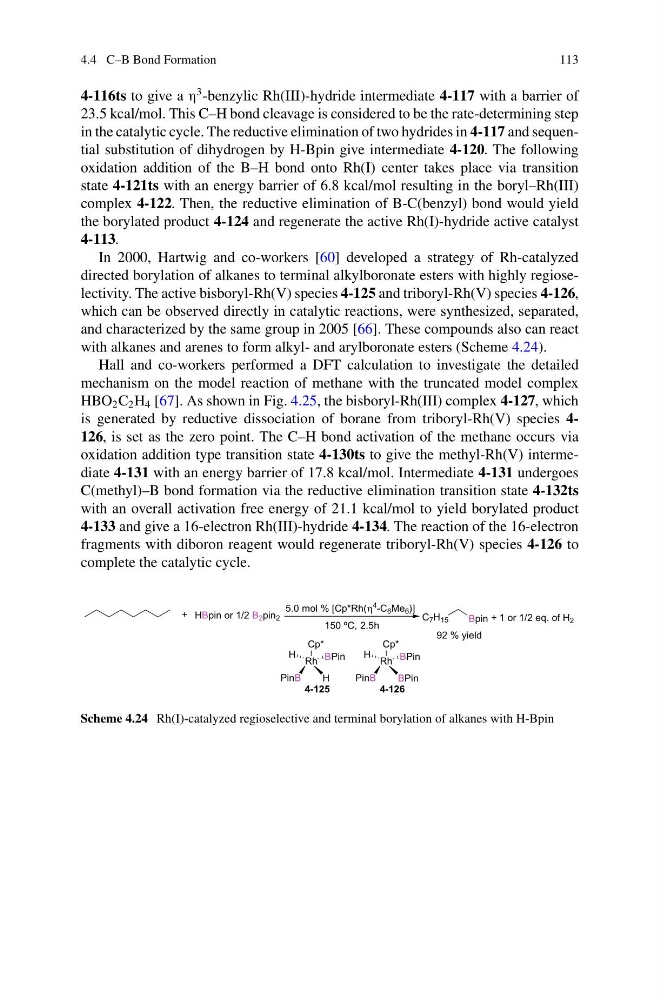
In 2000, Hartwig and co-workers [60] developed a strategy of Rh-catalyzed
directed borylation of alkanes to terminal alkylboronate esters with highly regioselectivity. The active bisboryl-Rh(V) species 4-125 and triboryl-Rh(V) species 4-126,
which can be observed directly in catalytic reactions, were synthesized, separated,
and characterized by the same group in 2005 [66]. These compounds also can react
with alkanes and arenes to form alkyl- and arylboronate esters (Scheme 4.24).
Hall and co-workers performed a DFT calculation to investigate the detailed
mechanism on the model reaction of methane with the truncated model complex
HBO 2 C 2 H 4 [67]. As shown in Fig. 4.25, the bisboryl-Rh(III) complex 4-127, which
is generated by reductive dissociation of borane from triboryl-Rh(V) species 4126, is set as the zero point. The C–H bond activation of the methane occurs via
oxidation addition type transition state 4-130ts to give the methyl-Rh(V) intermediate 4-131 with an energy barrier of 17.8 kcal/mol. Intermediate 4-131 undergoes
C(methyl)–B bond formation via the reductive elimination transition state 4-132ts
with an overall activation free energy of 21.1 kcal/mol to yield borylated product
4-133 and give a 16-electron Rh(III)-hydride 4-134. The reaction of the 16-electron
fragments with diboron reagent would regenerate triboryl-Rh(V) species 4-126 to
complete the catalytic cycle.
5.0 mol % [Cp*Rh(
4 -C 6 Me 6 )]
+
150 ºC, 2.5h
HBpin or 1/2 B 2 pin 2
C 7 H 15
Bpin + 1 or 1/2 eq. of H 2
92 % yield
Rh
Cp*
H
PinB
H
BPin
4-125
Rh
Cp*
H
PinB
BPin
BPin
4-126
Scheme 4.24 Rh(I)-catalyzed regioselective and terminal borylation of alkanes with H-Bpin
113
4-116ts to give a η
3 -benzylic Rh(III)-hydride intermediate 4-117 with a barrier of
23.5 kcal/mol. This C–H bond cleavage is considered to be the rate-determining step
in the catalytic cycle. The reductive elimination of two hydrides in 4-117 and sequential substitution of dihydrogen by H-Bpin give intermediate 4-120. The following
oxidation addition of the B–H bond onto Rh(I) center takes place via transition
state 4-121ts with an energy barrier of 6.8 kcal/mol resulting in the boryl–Rh(III)
complex 4-122. Then, the reductive elimination of B-C(benzyl) bond would yield
the borylated product 4-124 and regenerate the active Rh(I)-hydride active catalyst
4-113.
In 2000, Hartwig and co-workers [60] developed a strategy of Rh-catalyzed
directed borylation of alkanes to terminal alkylboronate esters with highly regioselectivity. The active bisboryl-Rh(V) species 4-125 and triboryl-Rh(V) species 4-126,
which can be observed directly in catalytic reactions, were synthesized, separated,
and characterized by the same group in 2005 [66]. These compounds also can react
with alkanes and arenes to form alkyl- and arylboronate esters (Scheme 4.24).
Hall and co-workers performed a DFT calculation to investigate the detailed
mechanism on the model reaction of methane with the truncated model complex
HBO 2 C 2 H 4 [67]. As shown in Fig. 4.25, the bisboryl-Rh(III) complex 4-127, which
is generated by reductive dissociation of borane from triboryl-Rh(V) species 4126, is set as the zero point. The C–H bond activation of the methane occurs via
oxidation addition type transition state 4-130ts to give the methyl-Rh(V) intermediate 4-131 with an energy barrier of 17.8 kcal/mol. Intermediate 4-131 undergoes
C(methyl)–B bond formation via the reductive elimination transition state 4-132ts
with an overall activation free energy of 21.1 kcal/mol to yield borylated product
4-133 and give a 16-electron Rh(III)-hydride 4-134. The reaction of the 16-electron
fragments with diboron reagent would regenerate triboryl-Rh(V) species 4-126 to
complete the catalytic cycle.
5.0 mol % [Cp*Rh(
4 -C 6 Me 6 )]
+
150 ºC, 2.5h
HBpin or 1/2 B 2 pin 2
C 7 H 15
Bpin + 1 or 1/2 eq. of H 2
92 % yield
Rh
Cp*
H
PinB
H
BPin
4-125
Rh
Cp*
H
PinB
BPin
BPin
4-126
Scheme 4.24 Rh(I)-catalyzed regioselective and terminal borylation of alkanes with H-Bpin