

112
4 Theoretical View of Rh-Catalyzed C–H Functionalization …
to afford alkyl-Rh(V) intermediate 4-108, which can undergo a B(boryl)–C(alkyl)
reductive elimination to yield borylation product 4-109. The generated boryl Rh(III)–
hydride 4-110 can react with diboryl through sequential B(boryl)–B(boryl) oxidative
addition and B(boryl)–H reductive elimination to regenerate active species 4-107.
When H-Bpin is used as boryl source, Rh-catalyzed C–H bond borylation reaction
can undertake a dehydrogenative coupling with C–H bond. These transformations do
not require external oxidants and keep redox neutral through the release of gaseous
dihydrogenation. In 2001, Marder and co-workers [64] developed a highly selective
Rh(I)-catalyzed borylation of C(benzyl)–H bonds with H-Bpin. The high selectivity
for the benzylic C–H functionalization was observed with toluene, p-xylene, and
mesitylene. The Rh(III) complex 4-112, which is generated by oxidative addition of
H-Bpin onto Rh(I) catalyst, was separated and determined by X-ray diffraction. In
addition, Rh(III) complex 4-112 can also catalyze this borylation reaction, so it was
considered as the active precursor in the catalytic cycle (Scheme 4.22).
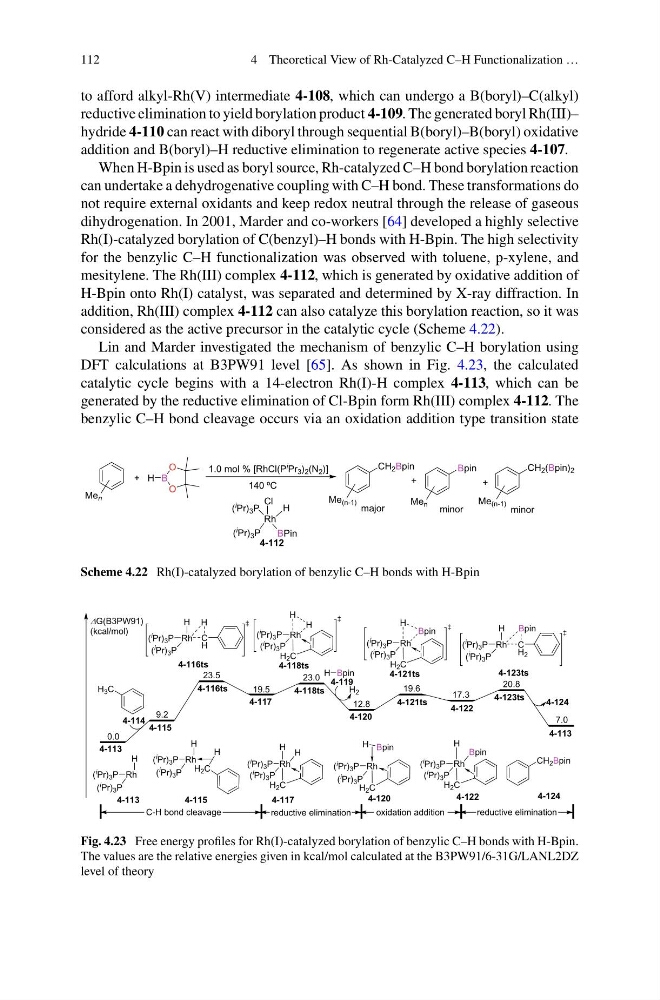
Lin and Marder investigated the mechanism of benzylic C–H borylation using
DFT calculations at B3PW91 level [65]. As shown in Fig. 4.23, the calculated
catalytic cycle begins with a 14-electron Rh(I)-H complex 4-113, which can be
generated by the reductive elimination of Cl-Bpin form Rh(III) complex 4-112. The
benzylic C–H bond cleavage occurs via an oxidation addition type transition state
1.0 mol % [RhCl(P
i Pr 3 ) 2 (N 2 )]
+
140 ºC
Me n
B
O
O
H
Me (n-1)
CH 2 Bpin
major
+
Me n
Bpin
minor
+
Me (n-1)
CH 2 (Bpin) 2
minor
Rh
(
i Pr) 3 P
(
i Pr) 3 P
BPin
H
Cl
4-112
Scheme 4.22 Rh(I)-catalyzed borylation of benzylic C–H bonds with H-Bpin
4-113
0.0
(kcal/mol)
4-115
9.2
4-116ts
23.5
4-117
19.5
4-118ts
23.0
G(B3PW91)
C-H bond cleavage
reductive elimination
4-120
12.8
4-121ts
19.6
4-122
17.3
4-123ts
20.8
4-113
7.0
4-124
reductive elimination
oxidation addition
4-114
4-119
H 2
Rh
(
i Pr) 3 P
(
i Pr) 3 P
H
4-113
H 3 C
Rh
(
i Pr) 3 P
(
i Pr) 3 P
H
4-115
H 2 C
H
4-116ts
Rh
(
i Pr) 3 P
(
i Pr) 3 P
H 2 C
H
H
4-117
4-118ts
Bpin
H
Rh
(
i Pr) 3 P
(
i Pr) 3 P
H 2 C
4-120
Bpin
H
4-121ts
4-122
Rh
(
i Pr) 3 P
(
i Pr) 3 P
C
H 2
Bpin
H
4-123ts
CH 2 Bpin
4-124
Rh
(
i Pr) 3 P
(
i Pr) 3 P
H 2 C
Bpin
H
Rh
(
i Pr) 3 P
(
i Pr) 3 P
H 2 C
H
H
Rh
(
i Pr) 3 P
(
i Pr) 3 P
H 2 C
Bpin
H
Rh
(
i Pr) 3 P
(
i Pr) 3 P
C
H
H
H
Fig. 4.23 Free energy profiles for Rh(I)-catalyzed borylation of benzylic C–H bonds with H-Bpin.
The values are the relative energies given in kcal/mol calculated at the B3PW91/6-31G/LANL2DZ
level of theory
4 Theoretical View of Rh-Catalyzed C–H Functionalization …
to afford alkyl-Rh(V) intermediate 4-108, which can undergo a B(boryl)–C(alkyl)
reductive elimination to yield borylation product 4-109. The generated boryl Rh(III)–
hydride 4-110 can react with diboryl through sequential B(boryl)–B(boryl) oxidative
addition and B(boryl)–H reductive elimination to regenerate active species 4-107.
When H-Bpin is used as boryl source, Rh-catalyzed C–H bond borylation reaction
can undertake a dehydrogenative coupling with C–H bond. These transformations do
not require external oxidants and keep redox neutral through the release of gaseous
dihydrogenation. In 2001, Marder and co-workers [64] developed a highly selective
Rh(I)-catalyzed borylation of C(benzyl)–H bonds with H-Bpin. The high selectivity
for the benzylic C–H functionalization was observed with toluene, p-xylene, and
mesitylene. The Rh(III) complex 4-112, which is generated by oxidative addition of
H-Bpin onto Rh(I) catalyst, was separated and determined by X-ray diffraction. In
addition, Rh(III) complex 4-112 can also catalyze this borylation reaction, so it was
considered as the active precursor in the catalytic cycle (Scheme 4.22).
Lin and Marder investigated the mechanism of benzylic C–H borylation using
DFT calculations at B3PW91 level [65]. As shown in Fig. 4.23, the calculated
catalytic cycle begins with a 14-electron Rh(I)-H complex 4-113, which can be
generated by the reductive elimination of Cl-Bpin form Rh(III) complex 4-112. The
benzylic C–H bond cleavage occurs via an oxidation addition type transition state
1.0 mol % [RhCl(P
i Pr 3 ) 2 (N 2 )]
+
140 ºC
Me n
B
O
O
H
Me (n-1)
CH 2 Bpin
major
+
Me n
Bpin
minor
+
Me (n-1)
CH 2 (Bpin) 2
minor
Rh
(
i Pr) 3 P
(
i Pr) 3 P
BPin
H
Cl
4-112
Scheme 4.22 Rh(I)-catalyzed borylation of benzylic C–H bonds with H-Bpin
4-113
0.0
(kcal/mol)
4-115
9.2
4-116ts
23.5
4-117
19.5
4-118ts
23.0
G(B3PW91)
C-H bond cleavage
reductive elimination
4-120
12.8
4-121ts
19.6
4-122
17.3
4-123ts
20.8
4-113
7.0
4-124
reductive elimination
oxidation addition
4-114
4-119
H 2
Rh
(
i Pr) 3 P
(
i Pr) 3 P
H
4-113
H 3 C
Rh
(
i Pr) 3 P
(
i Pr) 3 P
H
4-115
H 2 C
H
4-116ts
Rh
(
i Pr) 3 P
(
i Pr) 3 P
H 2 C
H
H
4-117
4-118ts
Bpin
H
Rh
(
i Pr) 3 P
(
i Pr) 3 P
H 2 C
4-120
Bpin
H
4-121ts
4-122
Rh
(
i Pr) 3 P
(
i Pr) 3 P
C
H 2
Bpin
H
4-123ts
CH 2 Bpin
4-124
Rh
(
i Pr) 3 P
(
i Pr) 3 P
H 2 C
Bpin
H
Rh
(
i Pr) 3 P
(
i Pr) 3 P
H 2 C
H
H
Rh
(
i Pr) 3 P
(
i Pr) 3 P
H 2 C
Bpin
H
Rh
(
i Pr) 3 P
(
i Pr) 3 P
C
H
H
H
Fig. 4.23 Free energy profiles for Rh(I)-catalyzed borylation of benzylic C–H bonds with H-Bpin.
The values are the relative energies given in kcal/mol calculated at the B3PW91/6-31G/LANL2DZ
level of theory