

4.4 C–B Bond Formation
111
recent years [54–60]. The Rh-catalyzed C–H bond borylation reactions have attracted
much attention due to high activity and high selectivity [61–63].
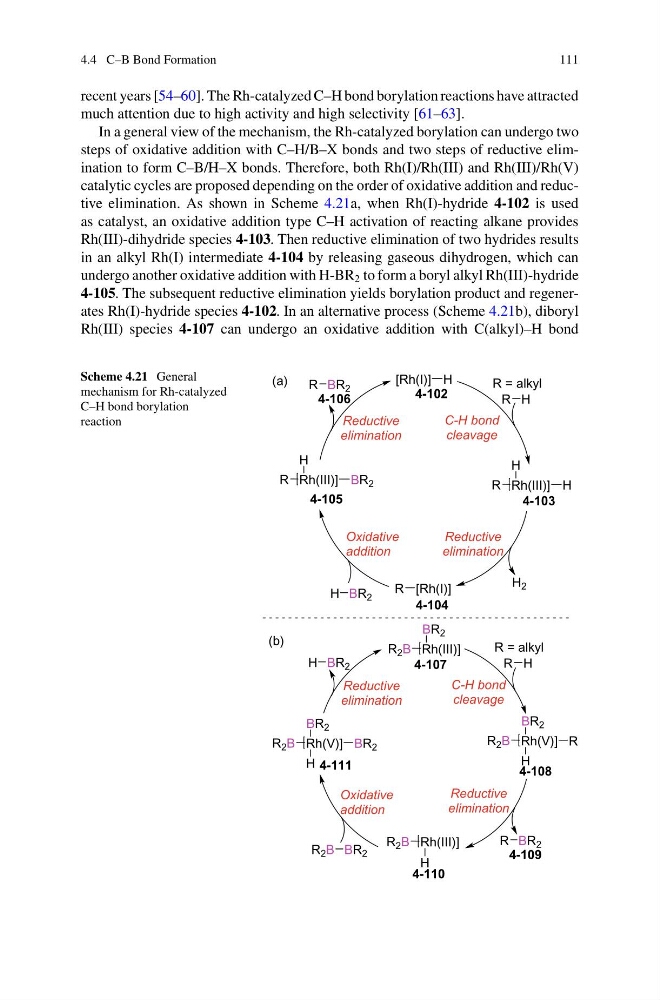
In a general view of the mechanism, the Rh-catalyzed borylation can undergo two
steps of oxidative addition with C–H/B–X bonds and two steps of reductive elimination to form C–B/H–X bonds. Therefore, both Rh(I)/Rh(III) and Rh(III)/Rh(V)
catalytic cycles are proposed depending on the order of oxidative addition and reductive elimination. As shown in Scheme 4.21a, when Rh(I)-hydride 4-102 is used
as catalyst, an oxidative addition type C–H activation of reacting alkane provides
Rh(III)-dihydride species 4-103. Then reductive elimination of two hydrides results
in an alkyl Rh(I) intermediate 4-104 by releasing gaseous dihydrogen, which can
undergo another oxidative addition with H-BR 2 to form a boryl alkyl Rh(III)-hydride
4-105. The subsequent reductive elimination yields borylation product and regenerates Rh(I)-hydride species 4-102. In an alternative process (Scheme 4.21b), diboryl
Rh(III) species 4-107 can undergo an oxidative addition with C(alkyl)–H bond
Scheme 4.21 General
mechanism for Rh-catalyzed
C–H bond borylation
reaction
(a)
(b)
R Rh(III)]
4-103
Reductive
elimination
4-104
[Rh(I)]
R H
4-102
Oxidative
addition
C-H bond
cleavage
4-105
4-106
H
R = alkyl
H
H
H 2
[Rh(I)]
R
H BR 2
R Rh(III)]
H
BR 2
Reductive
elimination
R BR 2
R 2 B Rh(III)]
4-108
Reductive
elimination
4-110
4-107
Oxidative
addition
C-H bond
cleavage
4-109
BR 2
Reductive
elimination
R BR 2
R 2 B BR 2
R H
R = alkyl
R 2 B Rh(V)]
BR 2
H
R
R 2 B Rh(III)]
4-111
H
H BR 2
R 2 B Rh(V)]
BR 2
H
BR 2
111
recent years [54–60]. The Rh-catalyzed C–H bond borylation reactions have attracted
much attention due to high activity and high selectivity [61–63].
In a general view of the mechanism, the Rh-catalyzed borylation can undergo two
steps of oxidative addition with C–H/B–X bonds and two steps of reductive elimination to form C–B/H–X bonds. Therefore, both Rh(I)/Rh(III) and Rh(III)/Rh(V)
catalytic cycles are proposed depending on the order of oxidative addition and reductive elimination. As shown in Scheme 4.21a, when Rh(I)-hydride 4-102 is used
as catalyst, an oxidative addition type C–H activation of reacting alkane provides
Rh(III)-dihydride species 4-103. Then reductive elimination of two hydrides results
in an alkyl Rh(I) intermediate 4-104 by releasing gaseous dihydrogen, which can
undergo another oxidative addition with H-BR 2 to form a boryl alkyl Rh(III)-hydride
4-105. The subsequent reductive elimination yields borylation product and regenerates Rh(I)-hydride species 4-102. In an alternative process (Scheme 4.21b), diboryl
Rh(III) species 4-107 can undergo an oxidative addition with C(alkyl)–H bond
Scheme 4.21 General
mechanism for Rh-catalyzed
C–H bond borylation
reaction
(a)
(b)
R Rh(III)]
4-103
Reductive
elimination
4-104
[Rh(I)]
R H
4-102
Oxidative
addition
C-H bond
cleavage
4-105
4-106
H
R = alkyl
H
H
H 2
[Rh(I)]
R
H BR 2
R Rh(III)]
H
BR 2
Reductive
elimination
R BR 2
R 2 B Rh(III)]
4-108
Reductive
elimination
4-110
4-107
Oxidative
addition
C-H bond
cleavage
4-109
BR 2
Reductive
elimination
R BR 2
R 2 B BR 2
R H
R = alkyl
R 2 B Rh(V)]
BR 2
H
R
R 2 B Rh(III)]
4-111
H
H BR 2
R 2 B Rh(V)]
BR 2
H
BR 2