

110
4 Theoretical View of Rh-Catalyzed C–H Functionalization …
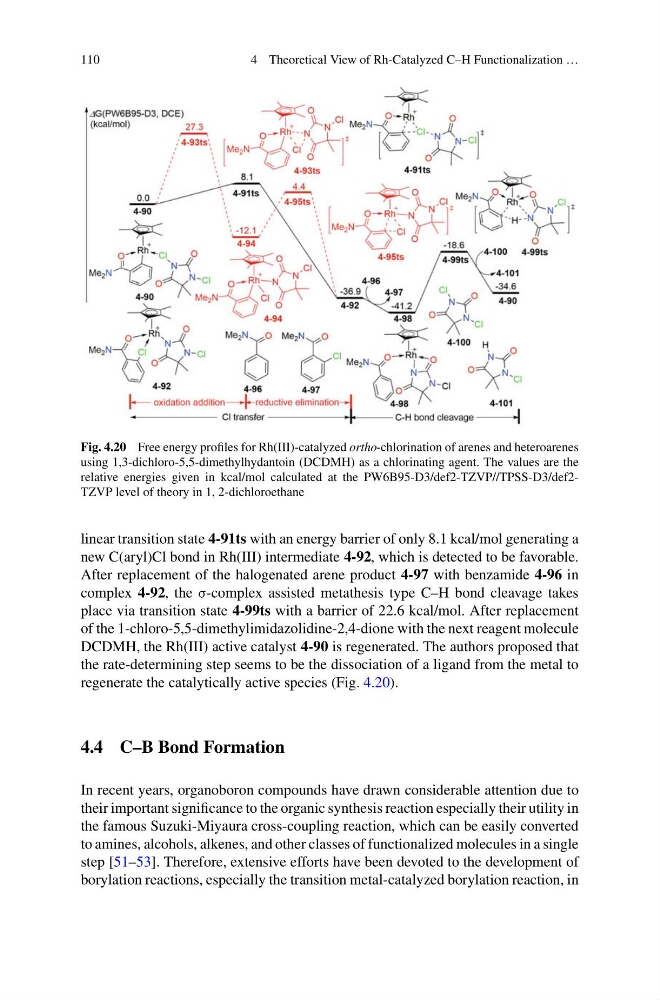
Fig. 4.20 Free energy profiles for Rh(III)-catalyzed ortho-chlorination of arenes and heteroarenes
using 1,3-dichloro-5,5-dimethylhydantoin (DCDMH) as a chlorinating agent. The values are the
relative energies given in kcal/mol calculated at the PW6B95-D3/def2-TZVP//TPSS-D3/def2TZVP level of theory in 1, 2-dichloroethane
linear transition state 4-91ts with an energy barrier of only 8.1 kcal/mol generating a
new C(aryl)Cl bond in Rh(III) intermediate 4-92, which is detected to be favorable.
After replacement of the halogenated arene product 4-97 with benzamide 4-96 in
complex 4-92, the σ-complex assisted metathesis type C–H bond cleavage takes
place via transition state 4-99ts with a barrier of 22.6 kcal/mol. After replacement
of the 1-chloro-5,5-dimethylimidazolidine-2,4-dione with the next reagent molecule
DCDMH, the Rh(III) active catalyst 4-90 is regenerated. The authors proposed that
the rate-determining step seems to be the dissociation of a ligand from the metal to
regenerate the catalytically active species (Fig. 4.20).
4.4 C–B Bond Formation
In recent years, organoboron compounds have drawn considerable attention due to
their important significance to the organic synthesis reaction especially their utility in
the famous Suzuki-Miyaura cross-coupling reaction, which can be easily converted
to amines, alcohols, alkenes, and other classes of functionalized molecules in a single
step [51–53]. Therefore, extensive efforts have been devoted to the development of
borylation reactions, especially the transition metal-catalyzed borylation reaction, in
4 Theoretical View of Rh-Catalyzed C–H Functionalization …
Fig. 4.20 Free energy profiles for Rh(III)-catalyzed ortho-chlorination of arenes and heteroarenes
using 1,3-dichloro-5,5-dimethylhydantoin (DCDMH) as a chlorinating agent. The values are the
relative energies given in kcal/mol calculated at the PW6B95-D3/def2-TZVP//TPSS-D3/def2TZVP level of theory in 1, 2-dichloroethane
linear transition state 4-91ts with an energy barrier of only 8.1 kcal/mol generating a
new C(aryl)Cl bond in Rh(III) intermediate 4-92, which is detected to be favorable.
After replacement of the halogenated arene product 4-97 with benzamide 4-96 in
complex 4-92, the σ-complex assisted metathesis type C–H bond cleavage takes
place via transition state 4-99ts with a barrier of 22.6 kcal/mol. After replacement
of the 1-chloro-5,5-dimethylimidazolidine-2,4-dione with the next reagent molecule
DCDMH, the Rh(III) active catalyst 4-90 is regenerated. The authors proposed that
the rate-determining step seems to be the dissociation of a ligand from the metal to
regenerate the catalytically active species (Fig. 4.20).
4.4 C–B Bond Formation
In recent years, organoboron compounds have drawn considerable attention due to
their important significance to the organic synthesis reaction especially their utility in
the famous Suzuki-Miyaura cross-coupling reaction, which can be easily converted
to amines, alcohols, alkenes, and other classes of functionalized molecules in a single
step [51–53]. Therefore, extensive efforts have been devoted to the development of
borylation reactions, especially the transition metal-catalyzed borylation reaction, in