

4.3 C–Halide Bond Formation
109
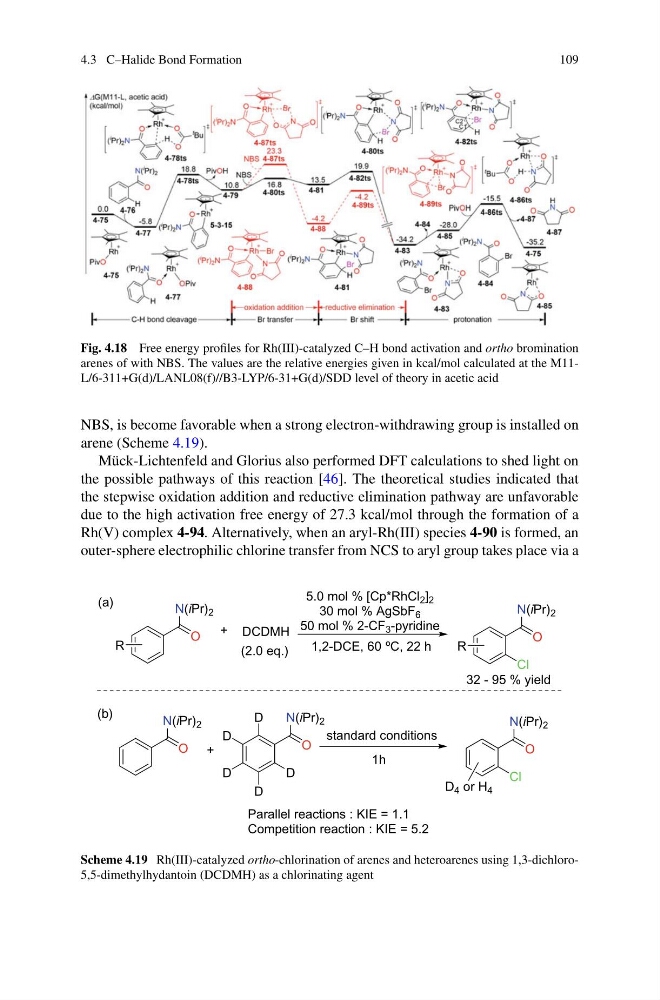
Fig. 4.18 Free energy profiles for Rh(III)-catalyzed C–H bond activation and ortho bromination
arenes of with NBS. The values are the relative energies given in kcal/mol calculated at the M11L/6-311+G(d)/LANL08(f)//B3-LYP/6-31+G(d)/SDD level of theory in acetic acid
NBS, is become favorable when a strong electron-withdrawing group is installed on
arene (Scheme 4.19).
Mück-Lichtenfeld and Glorius also performed DFT calculations to shed light on
the possible pathways of this reaction [46]. The theoretical studies indicated that
the stepwise oxidation addition and reductive elimination pathway are unfavorable
due to the high activation free energy of 27.3 kcal/mol through the formation of a
Rh(V) complex 4-94. Alternatively, when an aryl-Rh(III) species 4-90 is formed, an
outer-sphere electrophilic chlorine transfer from NCS to aryl group takes place via a
5.0 mol % [Cp*RhCl 2 ] 2
30 mol % AgSbF 6
50 mol % 2-CF 3 -pyridine
+
1,2-DCE, 60 ºC, 22 h
32 - 95 % yield
DCDMH
(2.0 eq.)
O
N(iPr) 2
(a)
R
O
N(iPr) 2
R
Cl
(b)
+
O
N(iPr) 2
O
N(iPr) 2
Cl
D
D
D
D
D
O
N(iPr) 2
standard conditions
1h
D 4 or H 4
Parallel reactions : KIE = 1.1
Competition reaction : KIE = 5.2
Scheme 4.19 Rh(III)-catalyzed ortho-chlorination of arenes and heteroarenes using 1,3-dichloro5,5-dimethylhydantoin (DCDMH) as a chlorinating agent
109
Fig. 4.18 Free energy profiles for Rh(III)-catalyzed C–H bond activation and ortho bromination
arenes of with NBS. The values are the relative energies given in kcal/mol calculated at the M11L/6-311+G(d)/LANL08(f)//B3-LYP/6-31+G(d)/SDD level of theory in acetic acid
NBS, is become favorable when a strong electron-withdrawing group is installed on
arene (Scheme 4.19).
Mück-Lichtenfeld and Glorius also performed DFT calculations to shed light on
the possible pathways of this reaction [46]. The theoretical studies indicated that
the stepwise oxidation addition and reductive elimination pathway are unfavorable
due to the high activation free energy of 27.3 kcal/mol through the formation of a
Rh(V) complex 4-94. Alternatively, when an aryl-Rh(III) species 4-90 is formed, an
outer-sphere electrophilic chlorine transfer from NCS to aryl group takes place via a
5.0 mol % [Cp*RhCl 2 ] 2
30 mol % AgSbF 6
50 mol % 2-CF 3 -pyridine
+
1,2-DCE, 60 ºC, 22 h
32 - 95 % yield
DCDMH
(2.0 eq.)
O
N(iPr) 2
(a)
R
O
N(iPr) 2
R
Cl
(b)
+
O
N(iPr) 2
O
N(iPr) 2
Cl
D
D
D
D
D
O
N(iPr) 2
standard conditions
1h
D 4 or H 4
Parallel reactions : KIE = 1.1
Competition reaction : KIE = 5.2
Scheme 4.19 Rh(III)-catalyzed ortho-chlorination of arenes and heteroarenes using 1,3-dichloro5,5-dimethylhydantoin (DCDMH) as a chlorinating agent