

108
4 Theoretical View of Rh-Catalyzed C–H Functionalization …
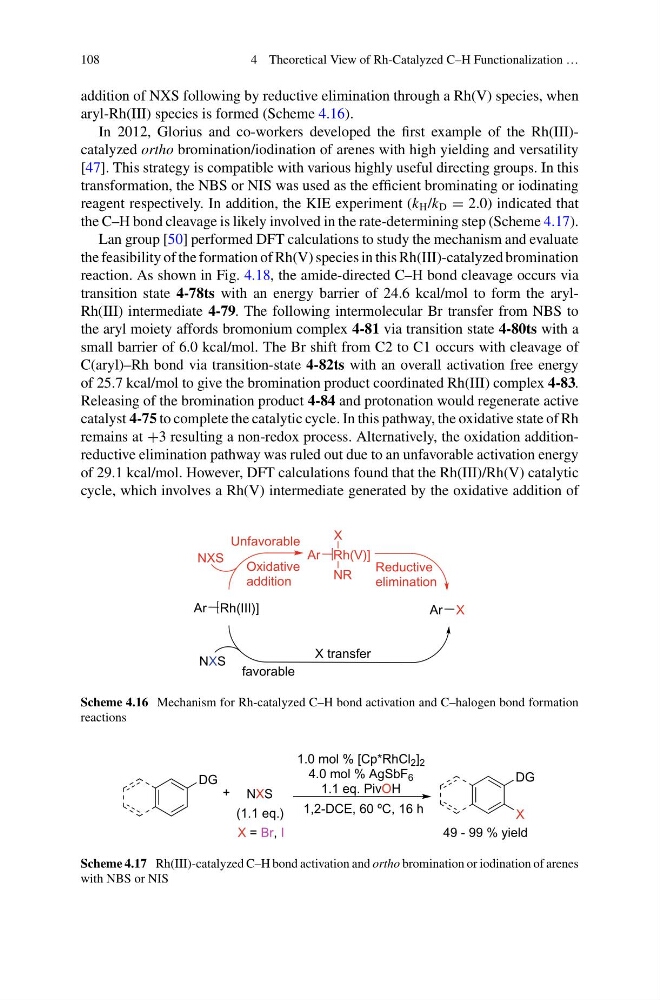
addition of NXS following by reductive elimination through a Rh(V) species, when
aryl-Rh(III) species is formed (Scheme 4.16).
In 2012, Glorius and co-workers developed the first example of the Rh(III)catalyzed ortho bromination/iodination of arenes with high yielding and versatility
[47]. This strategy is compatible with various highly useful directing groups. In this
transformation, the NBS or NIS was used as the efficient brominating or iodinating
reagent respectively. In addition, the KIE experiment (k H /k D = 2.0) indicated that
the C–H bond cleavage is likely involved in the rate-determining step (Scheme 4.17).
Lan group [50] performed DFT calculations to study the mechanism and evaluate
the feasibility of the formation of Rh(V) species in this Rh(III)-catalyzed bromination
reaction. As shown in Fig. 4.18, the amide-directed C–H bond cleavage occurs via
transition state 4-78ts with an energy barrier of 24.6 kcal/mol to form the arylRh(III) intermediate 4-79. The following intermolecular Br transfer from NBS to
the aryl moiety affords bromonium complex 4-81 via transition state 4-80ts with a
small barrier of 6.0 kcal/mol. The Br shift from C2 to C1 occurs with cleavage of
C(aryl)–Rh bond via transition-state 4-82ts with an overall activation free energy
of 25.7 kcal/mol to give the bromination product coordinated Rh(III) complex 4-83.
Releasing of the bromination product 4-84 and protonation would regenerate active
catalyst 4-75 to complete the catalytic cycle. In this pathway, the oxidative state of Rh
remains at +3 resulting a non-redox process. Alternatively, the oxidation additionreductive elimination pathway was ruled out due to an unfavorable activation energy
of 29.1 kcal/mol. However, DFT calculations found that the Rh(III)/Rh(V) catalytic
cycle, which involves a Rh(V) intermediate generated by the oxidative addition of
Ar Rh(III)]
Ar X
Ar Rh(V)]
X
NR
Oxidative
addition
X transfer
Reductive
elimination
Unfavorable
favorable
NXS
NXS
Scheme 4.16 Mechanism for Rh-catalyzed C–H bond activation and C–halogen bond formation
reactions
1.0 mol % [Cp*RhCl 2 ] 2
4.0 mol % AgSbF 6
1.1 eq. PivOH
+
1,2-DCE, 60 ºC, 16 h
49 - 99 % yield
DG
NXS
(1.1 eq.)
X = Br, I
DG
X
Scheme 4.17 Rh(III)-catalyzed C–H bond activation and ortho bromination or iodination of arenes
with NBS or NIS
4 Theoretical View of Rh-Catalyzed C–H Functionalization …
addition of NXS following by reductive elimination through a Rh(V) species, when
aryl-Rh(III) species is formed (Scheme 4.16).
In 2012, Glorius and co-workers developed the first example of the Rh(III)catalyzed ortho bromination/iodination of arenes with high yielding and versatility
[47]. This strategy is compatible with various highly useful directing groups. In this
transformation, the NBS or NIS was used as the efficient brominating or iodinating
reagent respectively. In addition, the KIE experiment (k H /k D = 2.0) indicated that
the C–H bond cleavage is likely involved in the rate-determining step (Scheme 4.17).
Lan group [50] performed DFT calculations to study the mechanism and evaluate
the feasibility of the formation of Rh(V) species in this Rh(III)-catalyzed bromination
reaction. As shown in Fig. 4.18, the amide-directed C–H bond cleavage occurs via
transition state 4-78ts with an energy barrier of 24.6 kcal/mol to form the arylRh(III) intermediate 4-79. The following intermolecular Br transfer from NBS to
the aryl moiety affords bromonium complex 4-81 via transition state 4-80ts with a
small barrier of 6.0 kcal/mol. The Br shift from C2 to C1 occurs with cleavage of
C(aryl)–Rh bond via transition-state 4-82ts with an overall activation free energy
of 25.7 kcal/mol to give the bromination product coordinated Rh(III) complex 4-83.
Releasing of the bromination product 4-84 and protonation would regenerate active
catalyst 4-75 to complete the catalytic cycle. In this pathway, the oxidative state of Rh
remains at +3 resulting a non-redox process. Alternatively, the oxidation additionreductive elimination pathway was ruled out due to an unfavorable activation energy
of 29.1 kcal/mol. However, DFT calculations found that the Rh(III)/Rh(V) catalytic
cycle, which involves a Rh(V) intermediate generated by the oxidative addition of
Ar Rh(III)]
Ar X
Ar Rh(V)]
X
NR
Oxidative
addition
X transfer
Reductive
elimination
Unfavorable
favorable
NXS
NXS
Scheme 4.16 Mechanism for Rh-catalyzed C–H bond activation and C–halogen bond formation
reactions
1.0 mol % [Cp*RhCl 2 ] 2
4.0 mol % AgSbF 6
1.1 eq. PivOH
+
1,2-DCE, 60 ºC, 16 h
49 - 99 % yield
DG
NXS
(1.1 eq.)
X = Br, I
DG
X
Scheme 4.17 Rh(III)-catalyzed C–H bond activation and ortho bromination or iodination of arenes
with NBS or NIS