

4.2 C–N Bond Formation
107
4-63
0.0
(kcal/mol)
4-67
-2.1
4-66ts
17.3
4-67
-16.3
4-68
0.4
G(M11-L, acetone)
oxidation
reductive elimination
4-69ts
4.3
4-70
-18.1
4
-
7
1
-
4
7
.
2
4-72ts
-37.3
4-64
4-73
-83.6
4-63
-89.6
4-74
IPh
C-H bond cleavage
OTS
Cl
PhI(OAc)OTs
4-63
4-64
4-65
4-66ts
4-67
Cl
2-PhPy
4-68
4-69ts
4-70
N 3
4-71
4-72ts
4-73
N
N 3
4-74
Rh
Cl
O
O
Me
Rh
Cl
O
O
Me
I Ph
OAc
Rh
Cl
O
O
H 3 C
I Ph
AcO
Rh
Cl
AcO
OAc
N
Rh
AcO
OAc
2+
N
Rh
AcO
O
O
H
Me
2+
N
Rh
AcO
2+
N
Rh
AcO
+
N 3
N
Rh
AcO
+
N 3
N
Rh
AcO
+
N 3
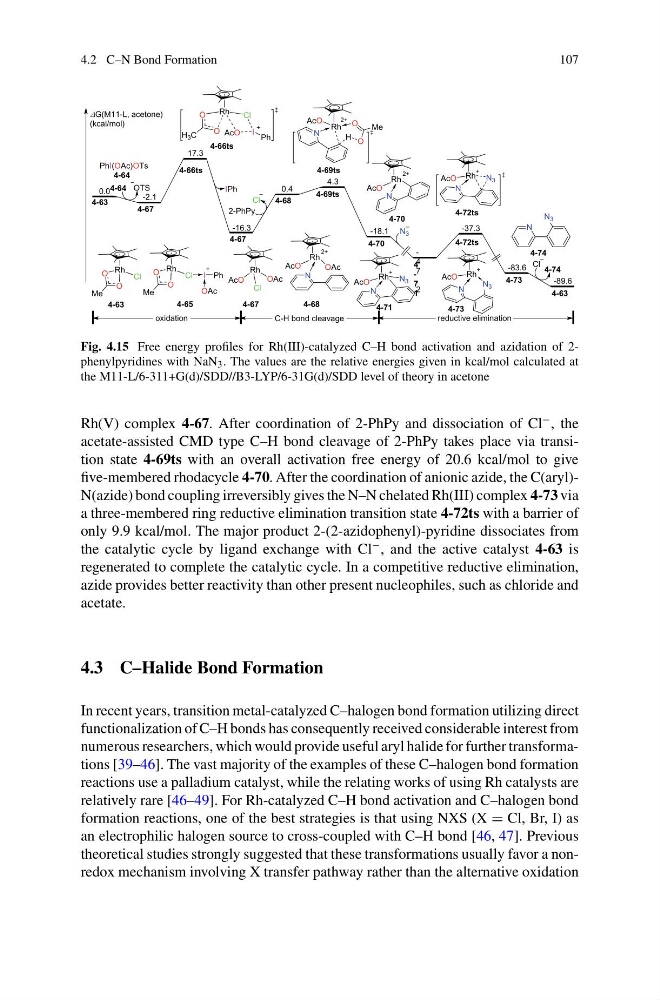
Fig. 4.15 Free energy profiles for Rh(III)-catalyzed C–H bond activation and azidation of 2phenylpyridines with NaN 3 . The values are the relative energies given in kcal/mol calculated at
the M11-L/6-311+G(d)/SDD//B3-LYP/6-31G(d)/SDD level of theory in acetone
Rh(V) complex 4-67. After coordination of 2-PhPy and dissociation of Cl
− , the
acetate-assisted CMD type C–H bond cleavage of 2-PhPy takes place via transition state 4-69ts with an overall activation free energy of 20.6 kcal/mol to give
five-membered rhodacycle 4-70. After the coordination of anionic azide, the C(aryl)N(azide) bond coupling irreversibly gives the N–N chelated Rh(III) complex 4-73 via
a three-membered ring reductive elimination transition state 4-72ts with a barrier of
only 9.9 kcal/mol. The major product 2-(2-azidophenyl)-pyridine dissociates from
the catalytic cycle by ligand exchange with Cl
− , and the active catalyst 4-63 is
regenerated to complete the catalytic cycle. In a competitive reductive elimination,
azide provides better reactivity than other present nucleophiles, such as chloride and
acetate.
4.3 C–Halide Bond Formation
In recent years, transition metal-catalyzed C–halogen bond formation utilizing direct
functionalization of C–H bonds has consequently received considerable interest from
numerous researchers, which would provide useful aryl halide for further transformations [39–46]. The vast majority of the examples of these C–halogen bond formation
reactions use a palladium catalyst, while the relating works of using Rh catalysts are
relatively rare [46–49]. For Rh-catalyzed C–H bond activation and C–halogen bond
formation reactions, one of the best strategies is that using NXS (X = Cl, Br, I) as
an electrophilic halogen source to cross-coupled with C–H bond [46, 47]. Previous
theoretical studies strongly suggested that these transformations usually favor a nonredox mechanism involving X transfer pathway rather than the alternative oxidation
107
4-63
0.0
(kcal/mol)
4-67
-2.1
4-66ts
17.3
4-67
-16.3
4-68
0.4
G(M11-L, acetone)
oxidation
reductive elimination
4-69ts
4.3
4-70
-18.1
4
-
7
1
-
4
7
.
2
4-72ts
-37.3
4-64
4-73
-83.6
4-63
-89.6
4-74
IPh
C-H bond cleavage
OTS
Cl
PhI(OAc)OTs
4-63
4-64
4-65
4-66ts
4-67
Cl
2-PhPy
4-68
4-69ts
4-70
N 3
4-71
4-72ts
4-73
N
N 3
4-74
Rh
Cl
O
O
Me
Rh
Cl
O
O
Me
I Ph
OAc
Rh
Cl
O
O
H 3 C
I Ph
AcO
Rh
Cl
AcO
OAc
N
Rh
AcO
OAc
2+
N
Rh
AcO
O
O
H
Me
2+
N
Rh
AcO
2+
N
Rh
AcO
+
N 3
N
Rh
AcO
+
N 3
N
Rh
AcO
+
N 3
Fig. 4.15 Free energy profiles for Rh(III)-catalyzed C–H bond activation and azidation of 2phenylpyridines with NaN 3 . The values are the relative energies given in kcal/mol calculated at
the M11-L/6-311+G(d)/SDD//B3-LYP/6-31G(d)/SDD level of theory in acetone
Rh(V) complex 4-67. After coordination of 2-PhPy and dissociation of Cl
− , the
acetate-assisted CMD type C–H bond cleavage of 2-PhPy takes place via transition state 4-69ts with an overall activation free energy of 20.6 kcal/mol to give
five-membered rhodacycle 4-70. After the coordination of anionic azide, the C(aryl)N(azide) bond coupling irreversibly gives the N–N chelated Rh(III) complex 4-73 via
a three-membered ring reductive elimination transition state 4-72ts with a barrier of
only 9.9 kcal/mol. The major product 2-(2-azidophenyl)-pyridine dissociates from
the catalytic cycle by ligand exchange with Cl
− , and the active catalyst 4-63 is
regenerated to complete the catalytic cycle. In a competitive reductive elimination,
azide provides better reactivity than other present nucleophiles, such as chloride and
acetate.
4.3 C–Halide Bond Formation
In recent years, transition metal-catalyzed C–halogen bond formation utilizing direct
functionalization of C–H bonds has consequently received considerable interest from
numerous researchers, which would provide useful aryl halide for further transformations [39–46]. The vast majority of the examples of these C–halogen bond formation
reactions use a palladium catalyst, while the relating works of using Rh catalysts are
relatively rare [46–49]. For Rh-catalyzed C–H bond activation and C–halogen bond
formation reactions, one of the best strategies is that using NXS (X = Cl, Br, I) as
an electrophilic halogen source to cross-coupled with C–H bond [46, 47]. Previous
theoretical studies strongly suggested that these transformations usually favor a nonredox mechanism involving X transfer pathway rather than the alternative oxidation