

106
4 Theoretical View of Rh-Catalyzed C–H Functionalization …
4-56
0.0
(kcal/mol)
4-58ts
10.8
4-60
-20.1
4-61ts
-19.0
4-62
-30.8
G(B3-LYP)
C-H bond cleavage
4-57
radical rebound
4-59
4-59
Rh
III L
N
Ts
4-56
O
t Bu
t Bu
N
O
N
NO 2
Rh
III
O
t Bu
t Bu
A
x
A
x
4-55
Rh
III L =
Rh
III L
N
Ts
4-58ts
O
H
H
Rh
III L
NH
Ts
4-60
O
H
4-59
Rh
III L
NH
Ts
O
H
4-61ts
Rh
III L
NH
Ts
O
H
4-62
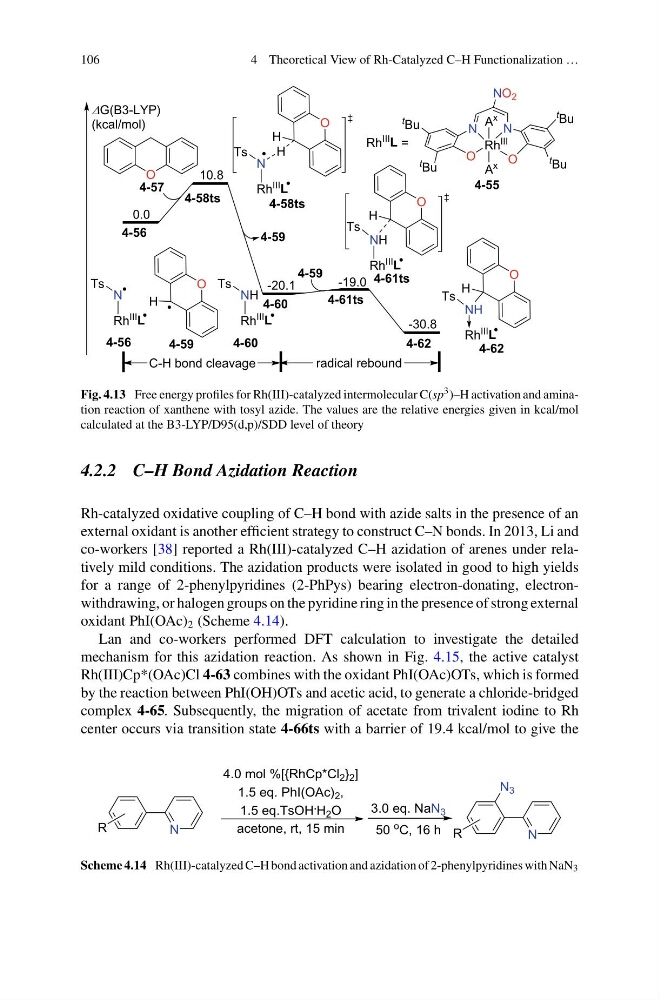
Fig. 4.13 Free energy profiles for Rh(III)-catalyzed intermolecular C(sp 3 )–H activation and amination reaction of xanthene with tosyl azide. The values are the relative energies given in kcal/mol
calculated at the B3-LYP/D95(d,p)/SDD level of theory
4.2.2 C–H Bond Azidation Reaction
Rh-catalyzed oxidative coupling of C–H bond with azide salts in the presence of an
external oxidant is another efficient strategy to construct C–N bonds. In 2013, Li and
co-workers [38] reported a Rh(III)-catalyzed C–H azidation of arenes under relatively mild conditions. The azidation products were isolated in good to high yields
for a range of 2-phenylpyridines (2-PhPys) bearing electron-donating, electronwithdrawing, or halogen groups on the pyridine ring in the presence of strong external
oxidant PhI(OAc) 2 (Scheme 4.14).
Lan and co-workers performed DFT calculation to investigate the detailed
mechanism for this azidation reaction. As shown in Fig. 4.15, the active catalyst
Rh(III)Cp*(OAc)Cl 4-63 combines with the oxidant PhI(OAc)OTs, which is formed
by the reaction between PhI(OH)OTs and acetic acid, to generate a chloride-bridged
complex 4-65. Subsequently, the migration of acetate from trivalent iodine to Rh
center occurs via transition state 4-66ts with a barrier of 19.4 kcal/mol to give the
N
4.0 mol %[{RhCp*Cl 2 } 2 ]
1.5 eq. PhI(OAc) 2 ,
1.5 eq.TsOH
. H 2 O
N
N 3
R
R
acetone, rt, 15 min
3.0 eq. NaN 3
50
o C, 16 h
Scheme 4.14 Rh(III)-catalyzed C–H bond activation and azidation of 2-phenylpyridines with NaN 3
4 Theoretical View of Rh-Catalyzed C–H Functionalization …
4-56
0.0
(kcal/mol)
4-58ts
10.8
4-60
-20.1
4-61ts
-19.0
4-62
-30.8
G(B3-LYP)
C-H bond cleavage
4-57
radical rebound
4-59
4-59
Rh
III L
N
Ts
4-56
O
t Bu
t Bu
N
O
N
NO 2
Rh
III
O
t Bu
t Bu
A
x
A
x
4-55
Rh
III L =
Rh
III L
N
Ts
4-58ts
O
H
H
Rh
III L
NH
Ts
4-60
O
H
4-59
Rh
III L
NH
Ts
O
H
4-61ts
Rh
III L
NH
Ts
O
H
4-62
Fig. 4.13 Free energy profiles for Rh(III)-catalyzed intermolecular C(sp 3 )–H activation and amination reaction of xanthene with tosyl azide. The values are the relative energies given in kcal/mol
calculated at the B3-LYP/D95(d,p)/SDD level of theory
4.2.2 C–H Bond Azidation Reaction
Rh-catalyzed oxidative coupling of C–H bond with azide salts in the presence of an
external oxidant is another efficient strategy to construct C–N bonds. In 2013, Li and
co-workers [38] reported a Rh(III)-catalyzed C–H azidation of arenes under relatively mild conditions. The azidation products were isolated in good to high yields
for a range of 2-phenylpyridines (2-PhPys) bearing electron-donating, electronwithdrawing, or halogen groups on the pyridine ring in the presence of strong external
oxidant PhI(OAc) 2 (Scheme 4.14).
Lan and co-workers performed DFT calculation to investigate the detailed
mechanism for this azidation reaction. As shown in Fig. 4.15, the active catalyst
Rh(III)Cp*(OAc)Cl 4-63 combines with the oxidant PhI(OAc)OTs, which is formed
by the reaction between PhI(OH)OTs and acetic acid, to generate a chloride-bridged
complex 4-65. Subsequently, the migration of acetate from trivalent iodine to Rh
center occurs via transition state 4-66ts with a barrier of 19.4 kcal/mol to give the
N
4.0 mol %[{RhCp*Cl 2 } 2 ]
1.5 eq. PhI(OAc) 2 ,
1.5 eq.TsOH
. H 2 O
N
N 3
R
R
acetone, rt, 15 min
3.0 eq. NaN 3
50
o C, 16 h
Scheme 4.14 Rh(III)-catalyzed C–H bond activation and azidation of 2-phenylpyridines with NaN 3