

4.2 C–N Bond Formation
103
8.0 mol % [Cp*Rh(MeCN) 3 ](SbF 6 ) 2
1.0 eq. PivOH
+
DCM, 100 ºC
37 - 96 % yield
N
O
N
R
1
R
2
N
R
1
HN
O
R
2
N
N
O
Rh
Cp*
4-32
H
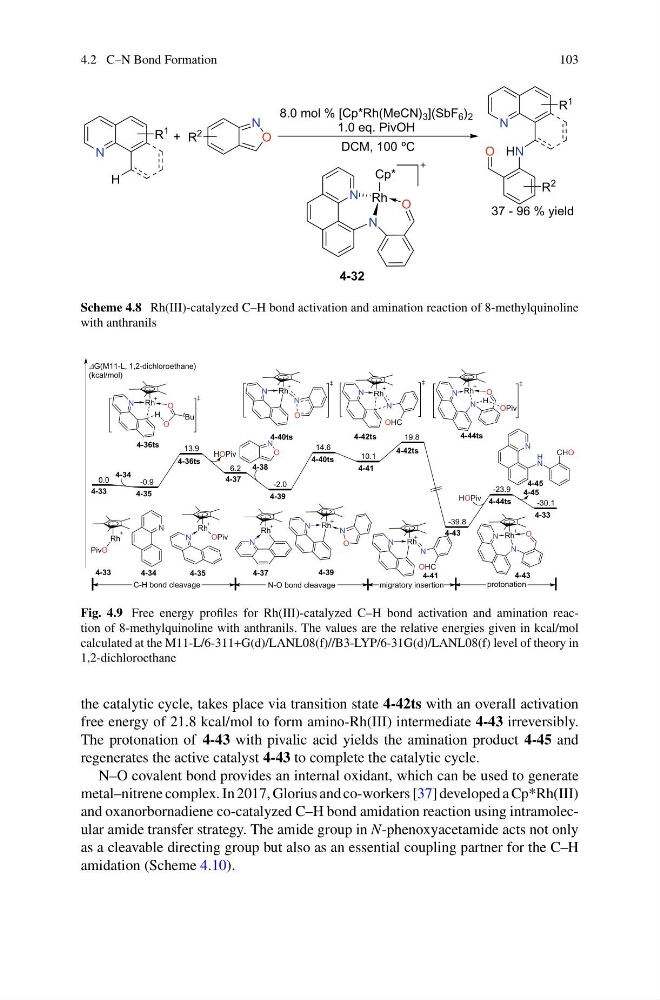
Scheme 4.8 Rh(III)-catalyzed C–H bond activation and amination reaction of 8-methylquinoline
with anthranils
4-33
0.0
(kcal/mol)
4-35
-0.9
4-36ts
13.9
4-37
6.2
4-39
-2.0
G(M11-L, 1,2-dichloroethane)
C-H bond cleavage
migratory insertion
4-40ts
14.6
4-41
10.1
4-42ts
19.8
4-43
-39.8
4-34
4-38
4-44ts
-23.9
4-33
-30.1
HOPiv
4-45
Rh
PivO
4-33
N
4-34
4-35
4-36ts
HOPiv
4-37
O
N
4-39
4-40ts
4-41
4-42ts
4-43
4-44ts
N
H
N
4-45
CHO
N-O bond cleavage
protonation
N
Rh
OPiv
N
Rh
N Rh
O
t Bu
O
H
N Rh
N
O
N Rh N
O
N
Rh
N
OHC
N Rh
N
OHC
N Rh
N
O
N Rh
N
O
H
OPiv
Fig. 4.9 Free energy profiles for Rh(III)-catalyzed C–H bond activation and amination reaction of 8-methylquinoline with anthranils. The values are the relative energies given in kcal/mol
calculated at the M11-L/6-311+G(d)/LANL08(f)//B3-LYP/6-31G(d)/LANL08(f) level of theory in
1,2-dichloroethane
the catalytic cycle, takes place via transition state 4-42ts with an overall activation
free energy of 21.8 kcal/mol to form amino-Rh(III) intermediate 4-43 irreversibly.
The protonation of 4-43 with pivalic acid yields the amination product 4-45 and
regenerates the active catalyst 4-43 to complete the catalytic cycle.
N–O covalent bond provides an internal oxidant, which can be used to generate
metal–nitrene complex. In 2017, Glorius and co-workers [37] developed a Cp*Rh(III)
and oxanorbornadiene co-catalyzed C–H bond amidation reaction using intramolecular amide transfer strategy. The amide group in N-phenoxyacetamide acts not only
as a cleavable directing group but also as an essential coupling partner for the C–H
amidation (Scheme 4.10).
103
8.0 mol % [Cp*Rh(MeCN) 3 ](SbF 6 ) 2
1.0 eq. PivOH
+
DCM, 100 ºC
37 - 96 % yield
N
O
N
R
1
R
2
N
R
1
HN
O
R
2
N
N
O
Rh
Cp*
4-32
H
Scheme 4.8 Rh(III)-catalyzed C–H bond activation and amination reaction of 8-methylquinoline
with anthranils
4-33
0.0
(kcal/mol)
4-35
-0.9
4-36ts
13.9
4-37
6.2
4-39
-2.0
G(M11-L, 1,2-dichloroethane)
C-H bond cleavage
migratory insertion
4-40ts
14.6
4-41
10.1
4-42ts
19.8
4-43
-39.8
4-34
4-38
4-44ts
-23.9
4-33
-30.1
HOPiv
4-45
Rh
PivO
4-33
N
4-34
4-35
4-36ts
HOPiv
4-37
O
N
4-39
4-40ts
4-41
4-42ts
4-43
4-44ts
N
H
N
4-45
CHO
N-O bond cleavage
protonation
N
Rh
OPiv
N
Rh
N Rh
O
t Bu
O
H
N Rh
N
O
N Rh N
O
N
Rh
N
OHC
N Rh
N
OHC
N Rh
N
O
N Rh
N
O
H
OPiv
Fig. 4.9 Free energy profiles for Rh(III)-catalyzed C–H bond activation and amination reaction of 8-methylquinoline with anthranils. The values are the relative energies given in kcal/mol
calculated at the M11-L/6-311+G(d)/LANL08(f)//B3-LYP/6-31G(d)/LANL08(f) level of theory in
1,2-dichloroethane
the catalytic cycle, takes place via transition state 4-42ts with an overall activation
free energy of 21.8 kcal/mol to form amino-Rh(III) intermediate 4-43 irreversibly.
The protonation of 4-43 with pivalic acid yields the amination product 4-45 and
regenerates the active catalyst 4-43 to complete the catalytic cycle.
N–O covalent bond provides an internal oxidant, which can be used to generate
metal–nitrene complex. In 2017, Glorius and co-workers [37] developed a Cp*Rh(III)
and oxanorbornadiene co-catalyzed C–H bond amidation reaction using intramolecular amide transfer strategy. The amide group in N-phenoxyacetamide acts not only
as a cleavable directing group but also as an essential coupling partner for the C–H
amidation (Scheme 4.10).