

102
4 Theoretical View of Rh-Catalyzed C–H Functionalization …
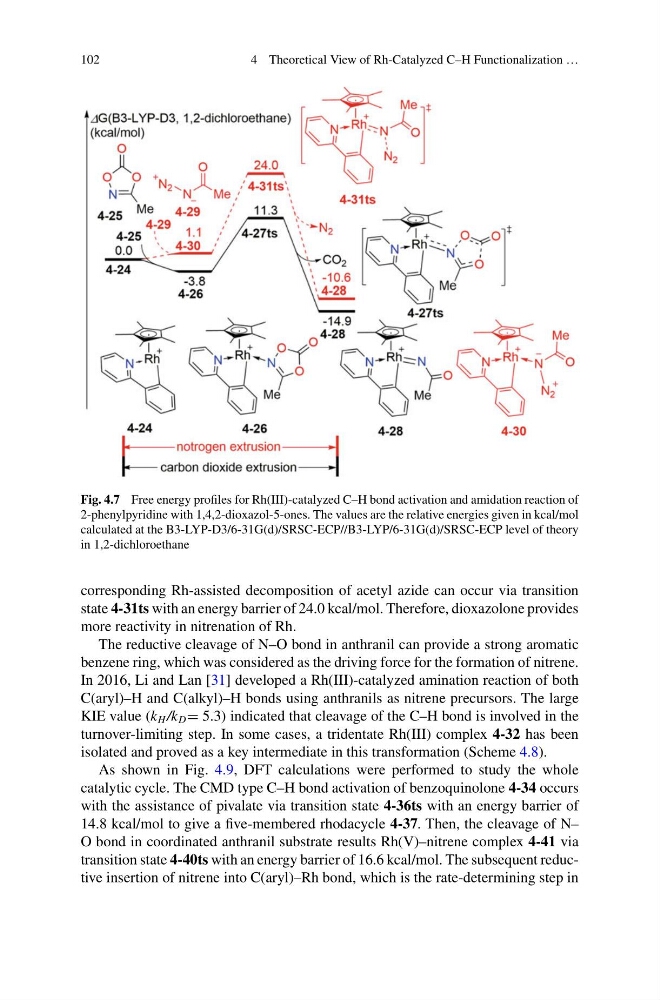
Fig. 4.7 Free energy profiles for Rh(III)-catalyzed C–H bond activation and amidation reaction of
2-phenylpyridine with 1,4,2-dioxazol-5-ones. The values are the relative energies given in kcal/mol
calculated at the B3-LYP-D3/6-31G(d)/SRSC-ECP//B3-LYP/6-31G(d)/SRSC-ECP level of theory
in 1,2-dichloroethane
corresponding Rh-assisted decomposition of acetyl azide can occur via transition
state 4-31ts with an energy barrier of 24.0 kcal/mol. Therefore, dioxazolone provides
more reactivity in nitrenation of Rh.
The reductive cleavage of N–O bond in anthranil can provide a strong aromatic
benzene ring, which was considered as the driving force for the formation of nitrene.
In 2016, Li and Lan [31] developed a Rh(III)-catalyzed amination reaction of both
C(aryl)–H and C(alkyl)–H bonds using anthranils as nitrene precursors. The large
KIE value (k H /k D = 5.3) indicated that cleavage of the C–H bond is involved in the
turnover-limiting step. In some cases, a tridentate Rh(III) complex 4-32 has been
isolated and proved as a key intermediate in this transformation (Scheme 4.8).
As shown in Fig. 4.9, DFT calculations were performed to study the whole
catalytic cycle. The CMD type C–H bond activation of benzoquinolone 4-34 occurs
with the assistance of pivalate via transition state 4-36ts with an energy barrier of
14.8 kcal/mol to give a five-membered rhodacycle 4-37. Then, the cleavage of N–
O bond in coordinated anthranil substrate results Rh(V)–nitrene complex 4-41 via
transition state 4-40ts with an energy barrier of 16.6 kcal/mol. The subsequent reductive insertion of nitrene into C(aryl)–Rh bond, which is the rate-determining step in
4 Theoretical View of Rh-Catalyzed C–H Functionalization …
Fig. 4.7 Free energy profiles for Rh(III)-catalyzed C–H bond activation and amidation reaction of
2-phenylpyridine with 1,4,2-dioxazol-5-ones. The values are the relative energies given in kcal/mol
calculated at the B3-LYP-D3/6-31G(d)/SRSC-ECP//B3-LYP/6-31G(d)/SRSC-ECP level of theory
in 1,2-dichloroethane
corresponding Rh-assisted decomposition of acetyl azide can occur via transition
state 4-31ts with an energy barrier of 24.0 kcal/mol. Therefore, dioxazolone provides
more reactivity in nitrenation of Rh.
The reductive cleavage of N–O bond in anthranil can provide a strong aromatic
benzene ring, which was considered as the driving force for the formation of nitrene.
In 2016, Li and Lan [31] developed a Rh(III)-catalyzed amination reaction of both
C(aryl)–H and C(alkyl)–H bonds using anthranils as nitrene precursors. The large
KIE value (k H /k D = 5.3) indicated that cleavage of the C–H bond is involved in the
turnover-limiting step. In some cases, a tridentate Rh(III) complex 4-32 has been
isolated and proved as a key intermediate in this transformation (Scheme 4.8).
As shown in Fig. 4.9, DFT calculations were performed to study the whole
catalytic cycle. The CMD type C–H bond activation of benzoquinolone 4-34 occurs
with the assistance of pivalate via transition state 4-36ts with an energy barrier of
14.8 kcal/mol to give a five-membered rhodacycle 4-37. Then, the cleavage of N–
O bond in coordinated anthranil substrate results Rh(V)–nitrene complex 4-41 via
transition state 4-40ts with an energy barrier of 16.6 kcal/mol. The subsequent reductive insertion of nitrene into C(aryl)–Rh bond, which is the rate-determining step in