

104
4 Theoretical View of Rh-Catalyzed C–H Functionalization …
5.0 mol % [Cp*Rh(CH 3 CN) 3 ](SbF 6 ) 2
50 mol % NaOAc
CH 2 Cl 2 , rt, 12h
63 - 90 % yield
R
1
O N
R
2
O
O
F
F
F
F (20 mol %)
R
1
OH
N
H
R
2
O
Scheme 4.10 Rh(III) and bicyclic olefin co-catalyzed C–H bond activation and amidation reaction
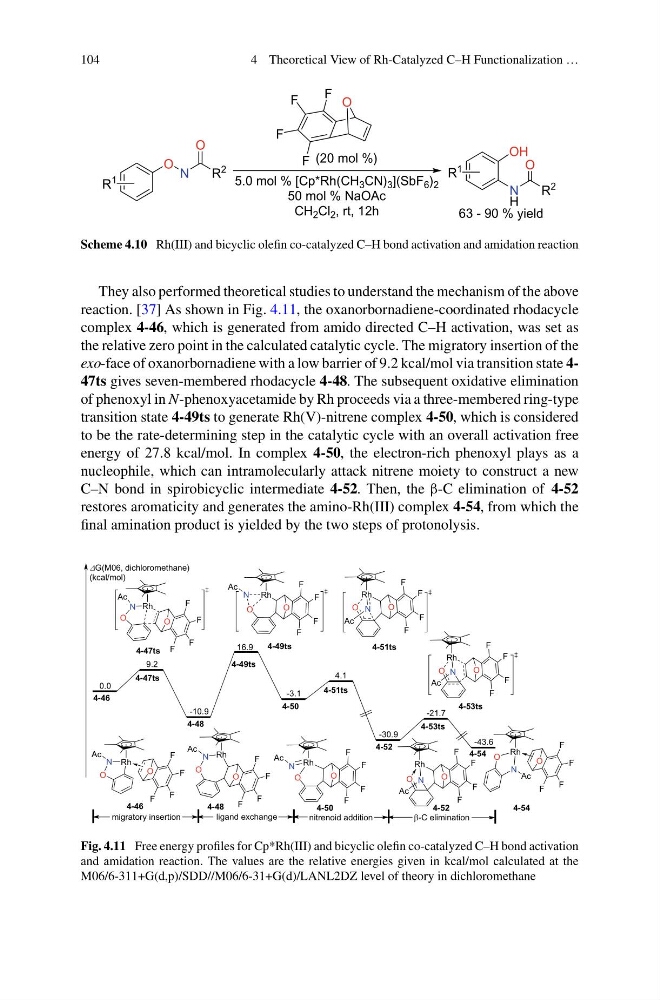
They also performed theoretical studies to understand the mechanism of the above
reaction. [37] As shown in Fig. 4.11, the oxanorbornadiene-coordinated rhodacycle
complex 4-46, which is generated from amido directed C–H activation, was set as
the relative zero point in the calculated catalytic cycle. The migratory insertion of the
exo-face of oxanorbornadiene with a low barrier of 9.2 kcal/mol via transition state 447ts gives seven-membered rhodacycle 4-48. The subsequent oxidative elimination
of phenoxyl in N-phenoxyacetamide by Rh proceeds via a three-membered ring-type
transition state 4-49ts to generate Rh(V)-nitrene complex 4-50, which is considered
to be the rate-determining step in the catalytic cycle with an overall activation free
energy of 27.8 kcal/mol. In complex 4-50, the electron-rich phenoxyl plays as a
nucleophile, which can intramolecularly attack nitrene moiety to construct a new
C–N bond in spirobicyclic intermediate 4-52. Then, the β-C elimination of 4-52
restores aromaticity and generates the amino-Rh(III) complex 4-54, from which the
final amination product is yielded by the two steps of protonolysis.
4-46
0.0
(kcal/mol)
4-47ts
9.2
4-48
-10.9
4-49ts
16.9
4-50
-3.1
G(M06, dichloromethane)
migratory insertion
ligand exchange
4-51ts
4.1
4-52
-30.9
4-53ts
-21.7
4-54
-43.6
4-46
4-47ts
4-48
4-49ts
4-50
4-51ts
4-52
4-53ts
4-54
nitrenoid addition
-C elimination
O
N
Ac
Rh
O
F
F
F
F
O
N
Ac
Rh
O
F
F
F
F
O
N
Ac
Rh
O
F
F
F
F
O
N
Ac
Rh
O
F
F
F
F
O
N
Ac
Rh
O
F
F
F
F
O N
Ac
Rh
O
F
F
F
F
O N
Ac
Rh
O
F
F
F
F
O N
Ac
Rh
O
F
F
F
F
O
Rh
O
F
F
F
F
N
Ac
Fig. 4.11 Free energy profiles for Cp*Rh(III) and bicyclic olefin co-catalyzed C–H bond activation
and amidation reaction. The values are the relative energies given in kcal/mol calculated at the
M06/6-311+G(d,p)/SDD//M06/6-31+G(d)/LANL2DZ level of theory in dichloromethane
4 Theoretical View of Rh-Catalyzed C–H Functionalization …
5.0 mol % [Cp*Rh(CH 3 CN) 3 ](SbF 6 ) 2
50 mol % NaOAc
CH 2 Cl 2 , rt, 12h
63 - 90 % yield
R
1
O N
R
2
O
O
F
F
F
F (20 mol %)
R
1
OH
N
H
R
2
O
Scheme 4.10 Rh(III) and bicyclic olefin co-catalyzed C–H bond activation and amidation reaction
They also performed theoretical studies to understand the mechanism of the above
reaction. [37] As shown in Fig. 4.11, the oxanorbornadiene-coordinated rhodacycle
complex 4-46, which is generated from amido directed C–H activation, was set as
the relative zero point in the calculated catalytic cycle. The migratory insertion of the
exo-face of oxanorbornadiene with a low barrier of 9.2 kcal/mol via transition state 447ts gives seven-membered rhodacycle 4-48. The subsequent oxidative elimination
of phenoxyl in N-phenoxyacetamide by Rh proceeds via a three-membered ring-type
transition state 4-49ts to generate Rh(V)-nitrene complex 4-50, which is considered
to be the rate-determining step in the catalytic cycle with an overall activation free
energy of 27.8 kcal/mol. In complex 4-50, the electron-rich phenoxyl plays as a
nucleophile, which can intramolecularly attack nitrene moiety to construct a new
C–N bond in spirobicyclic intermediate 4-52. Then, the β-C elimination of 4-52
restores aromaticity and generates the amino-Rh(III) complex 4-54, from which the
final amination product is yielded by the two steps of protonolysis.
4-46
0.0
(kcal/mol)
4-47ts
9.2
4-48
-10.9
4-49ts
16.9
4-50
-3.1
G(M06, dichloromethane)
migratory insertion
ligand exchange
4-51ts
4.1
4-52
-30.9
4-53ts
-21.7
4-54
-43.6
4-46
4-47ts
4-48
4-49ts
4-50
4-51ts
4-52
4-53ts
4-54
nitrenoid addition
-C elimination
O
N
Ac
Rh
O
F
F
F
F
O
N
Ac
Rh
O
F
F
F
F
O
N
Ac
Rh
O
F
F
F
F
O
N
Ac
Rh
O
F
F
F
F
O
N
Ac
Rh
O
F
F
F
F
O N
Ac
Rh
O
F
F
F
F
O N
Ac
Rh
O
F
F
F
F
O N
Ac
Rh
O
F
F
F
F
O
Rh
O
F
F
F
F
N
Ac
Fig. 4.11 Free energy profiles for Cp*Rh(III) and bicyclic olefin co-catalyzed C–H bond activation
and amidation reaction. The values are the relative energies given in kcal/mol calculated at the
M06/6-311+G(d,p)/SDD//M06/6-31+G(d)/LANL2DZ level of theory in dichloromethane